August 12, 2024

Identification of ENTPD1 as a novel biomarker linking allergic rhinitis and systemic lupus erythematosus

Chen, M., Meng, Y., Shi, X. et al.  Sci Rep 14, 18266 (2024). https://doi.org/10.1038/s41598-024-69228-3

Abstract

Several studies reveal that allergic rhinitis (AR) is a significant risk factor of systemic lupus erythematosus (SLE). However, studies investigating the common pathogenesis linking AR and SLE are lacking. Our study aims to search for the shared biomarkers and mechanisms that may provide new therapeutic targets for preventing AR from developing SLE. GSE50223 for AR and GSE103760 for SLE were downloaded from the Gene Expression Omnibus (GEO) database to screen differentially expressed genes (DEGs). The Gene Ontology (GO) analysis and Kyoto Encyclopedia of Genes and Genomes (KEGG) pathway enrichment analysis were performed to explore the functions of shared DEGs. 

August 11, 2024

Oral Antibiotics and Risk of Serious Cutaneous Adverse Drug Reactions

Lee EY, Gomes T, Drucker AM, Daneman N, Asaf A, Wu F, Piguet V, Juurlink DN. JAMA. 2024 Aug 8:e2411437. doi: 10.1001/jama.2024.11437. 

Key Points

Question  Do commonly prescribed oral antibiotics carry differential risks of cutaneous adverse drug reactions (cADRs) leading to an emergency department visit or hospitalization?

Findings  In this population-based, nested case-control study spanning 2 decades, sulfonamide antibiotics and cephalosporins carried the highest risk of serious cADRs relative to macrolides, followed by nitrofurantoin, penicillins, and fluoroquinolones.

Meaning  All commonly prescribed oral antibiotics are associated with an increased risk of serious cADRs compared with macrolides, with sulfonamide antibiotics and cephalosporins carrying the highest risk.

Abstract

Importance  Serious cutaneous adverse drug reactions (cADRs) are potentially life-threatening drug hypersensitivity reactions involving the skin and internal organs. Antibiotics are a recognized cause of these reactions, but no studies have compared relative risks across antibiotic classes.

The Circadian Rhythm of Itching among 241 Adults with Atopic Dermatitis: A Cross-sectional Study

 Sang X, Lu J, Tan L, Zeng J, Wang D, Guo A, et al. Acta Derm Venereol [Internet]. 2024 Aug. 5 [cited 2024 Aug. 11];104:adv35427.

Abstract

A) Time period during which the patient experiences itching;
(B) time period during which the patient experiences maximum itching.
****p < 0.0001 vs 04:00–08:00, #p < 0.05,  ###p <  0.001,  ####p <   0.0001 vs 20:00–00:00
The pattern of itching in patients with atopic dermatitis has not been systematically studied. Therefore, this study aimed to assess the pattern of itching in adults with atopic dermatitis using questionnaires to assess for a circadian rhythm of itching in participating patients at a single institution (n = 241). A self-report questionnaire was used to assess circadian rhythm and intensity of itching in patients. In addition, the patients’ disease severity (Eczema Area and Severity Index [EASI]) and quality of life (Dermatology Life Quality Index [DLQI]) were assessed.

Nasal sprays and behavioural interventions compared with usual care for acute respiratory illness in primary care: a randomised, controlled, open-label, parallel-group trial

Little, Paul et al.

Summary

Background

A small amount of evidence suggests that nasal sprays, or physical activity and stress management, could shorten the duration of respiratory infections. This study aimed to assess the effect of nasal sprays or a behavioural intervention promoting physical activity and stress management on respiratory illnesses, compared with usual care.

Methods

This randomised, controlled, open-label, parallel-group trial was done at 332 general practitioner practices in the UK. Eligible adults (aged ≥18 years) had at least one comorbidity or risk factor increasing their risk of adverse outcomes due to respiratory illness (eg, immune compromise due to serious illness or medication; heart disease; asthma or lung disease; diabetes; mild hepatic impairment; stroke or severe neurological problem; obesity [BMI ≥30 kg/m2]; or age ≥65 years) or at least three self-reported respiratory tract infections in a normal year (ie, any year before the COVID-19 pandemic). Participants were randomly assigned (1:1:1:1) using a computerised system to: usual care (brief advice about managing illness); gel-based spray (two sprays per nostril at the first sign of an infection or after potential exposure to infection, up to 6 times per day); saline spray (two sprays per nostril at the first sign of an infection or after potential exposure to infection, up to 6 times per day); or a brief behavioural intervention in which participants were given access to a website promoting physical activity and stress management.

August 8, 2024

Multidisciplinary management of type 2 inflammation diseases using a screening tool

Palomares O, Cisneros C, Ortiz de Frutos FJ et al. Front Allergy. 2024 Jul 18;5:1427279. doi: 10.3389/falgy.2024.1427279. 

Abstract

Dysregulation of type 2 (T2) immune response leads to an aberrant inflammatory reaction that constitutes the pathophysiological basis of diseases involving various organs. For this reason, several disorders can coexist in a single patient; however, as different specialists often treat these pathologies, T2 dysregulation, particularly when mild, is not always the first diagnostic suspicion. A breakdown in interdisciplinary communication or the lack of adequate tools to detect these entities can delay diagnosis, and this, together with a lack of coordination, can lead to suboptimal care. In this context, a multidisciplinary group of specialists in pneumology, immunology, allergology, dermatology and otorhinolaryngology compiled a list of the cardinal symptoms reported by patients presenting with T2 inflammation-related diseases: asthma, chronic rhinosinusitis, allergic rhinitis, allergic conjunctivitis, IgE-mediated food allergy, atopic dermatitis, eosinophilic oesophagitis, and NSAID-exacerbated respiratory disease (NERD).

Paris air quality monitoring for the 2024 Olympics and Paralympics: focus on air pollutants and pollen.

Bougault V, Valorso R, Sarda-Esteve R et al. Br J Sports Med. 2024 Jul 25:bjsports-2024-108129. doi: 10.1136/bjsports-2024-108129.

Abstract

Background Exposure to air pollution can affect the health of individuals with respiratory disease, but may also impede the health and performance of athletes. This is potentially relevant for people travelling to and competing in the Olympic and Paralympic Games (OPG) in Paris. We describe anticipated air quality in Paris based on historical monitoring data and describe the impact of the process on the development of monitoring strategies for future international sporting events.

Methods Air pollutant data for July to September 2020–2023 and pollen data for 2015–2022 were provided by Airparif (particulate matter (PM2.5), nitrogen dioxide (NO2) and ozone (O3)) and RNSA stations in the Paris region.

August 6, 2024

Mucocutaneous Manifestations in Patients with Dengue Fever: From the EPIDENGUE Cohort on Reunion Island

Maillard O, Fera C, Joly E et al. Acta Derm Venereol. 2024 Jul 18;104:adv40334. doi: 10.2340/actadv.v104.40334.

Abstract

Nearly 4 billion people live in a dengue risk area worldwide. The prevalence of dengue-related mucocutaneous manifestations and their association with severe dengue differ across studies. The aim of the study was to describe the characteristics of patients with dengue-related mucocutaneous manifestations and to investigate those were associated with severe dengue. A retrospective study was conducted in 2019 among patients with a positive RT-PCR for dengue at the University Hospital of Reunion, which has been experiencing a re-emergence of dengue since 2018. Of 847 patients with confirmed dengue, 283 (33.4%) developed mucocutaneous manifestations.

August 5, 2024

Improving allergy management and treatment: a proposed algorithm and curriculum for prescribing allergen immunotherapy in the primary care setting.

Bustos, G., Sanchez-Gonzalez, M.A., Grogan, T. et al.  npj Prim. Care Respir. Med. 34, 22 (2024). https://doi.org/10.1038/s41533-024-00380-z

Abstract

Allergic rhinitis (AR), a condition characterized by sensitivity to allergens leading to poor quality of life, including disrupted sleep, reduced vitality, lowered mood, changes in blood pressure limited frustration tolerance, impaired focus, decreased performance in academic and professional settings, and millions of missed work and school days every year. Approximately 20–40% of individuals in the United States are affected by AR, which carries notable clinical and financial burdens. Interestingly, there is a strong link between AR and asthma to the extent that countries with a high prevalence of rhinitis have asthma rates ranging from 10% to 25%. Research has indicated that Allergen Immunotherapy (AIT) is associated with improved AR symptoms, a potential to resolve the AR over time, a decreased likelihood of asthma exacerbations and incidence of pneumonia in individuals with concurrent asthma, which are advantages that persist for years even after the cessation of treatment. 
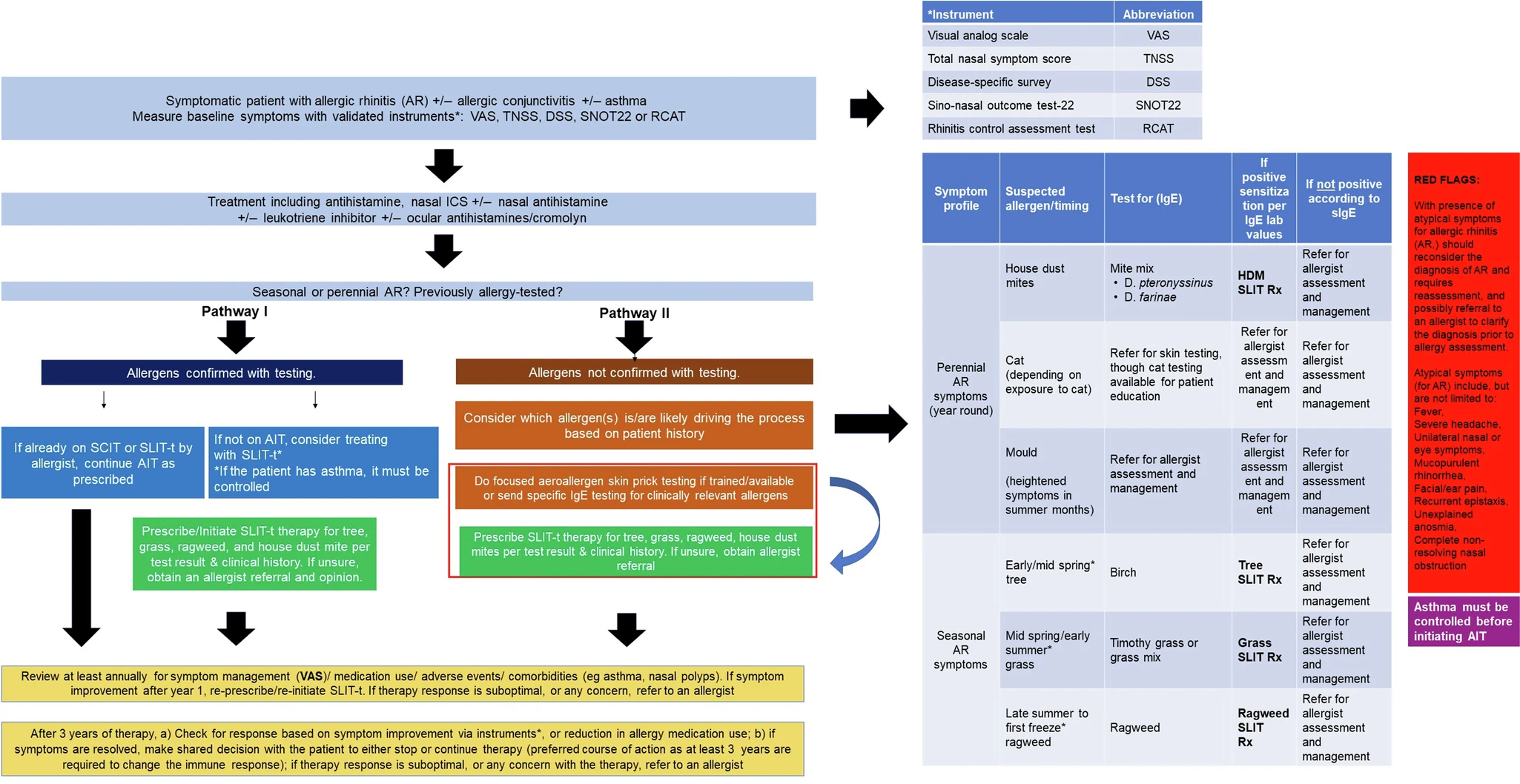
Proposed algorithm for prescribing allergen immunotherapy in the primary care setting.

Although patients presenting with allergies are first seen and treated in the primary care setting, gaps in training and the lack of available guidance for primary care practitioners have significantly impacted the quality of care for these patients with persistent AR symptoms, resulting in inefficient use of healthcare resources.