Tanimoto S, Kaliner M, Lockey RF, Ebisawa M, Koplowitz LP, Koplowitz B, Lowenthal R. Ann Allergy Asthma Immunol. 2023 Apr;130(4):508-514.e1. doi: 10.1016/j.anai.2022.10.024.
A blog that publishes updates and open access scientific papers about allergy, asthma and immunology. Editor: Juan Carlos Ivancevich, MD. Specialist in Allergy & Immunology
April 6, 2023
Pharmacokinetic and pharmacodynamic comparison of epinephrine, administered intranasally and intramuscularly An integrated analysis
Tanimoto S, Kaliner M, Lockey RF, Ebisawa M, Koplowitz LP, Koplowitz B, Lowenthal R. Ann Allergy Asthma Immunol. 2023 Apr;130(4):508-514.e1. doi: 10.1016/j.anai.2022.10.024.
April 1, 2023
Defining the window of opportunity and target populations to prevent peanut allergy
Background
Objective
Methods
March 30, 2023
Developing integrated care pathways for atopic dermatitis-Challenges and unmet needs
Zuberbier T, Beck LA, Bedbrook A, de Bruin-Weller M, Bousquet J, Cork M, Douladiris N, Katoh N, Mortz CG, Werfel T, Wojciech F, Wollenberg A, Siemens K, Stevanovic K, Worm M; AD-ICPs Working Group. Clin Transl Allergy. 2023 Mar;13(3):e12236. doi: 10.1002/clt2.12236.
Abstract
Background
GA2LEN-ADCARE is a branch of the largest multidisciplinary network of research centres and clinical care in allergy and asthma, GA2LEN, focussing on the field of atopic dermatitis (AD). AD is a chronic inflammatory skin disease with high burden and many comorbidities requiring different levels of treatment. The need for aligned information from all involved healthcare providers led to the discussion of an integrated care pathway (ICP) plan for AD patient care involving all stakeholders and considering the complexity and variability of the disease, with a particular focus placed on the large number of patients with milder forms of AD.
Methods
The GA2LEN ADCARE network and all stakeholders, abbreviated the AD-ICPs working group, were involved in the discussion and preparation of the AD-ICPs during a series of subgroup workshops and meetings in years 2020 and 2021.
March 29, 2023
A real-world characterization of a cohort with eosinophilic esophagitis: looking for severity biomarkers
Esteves Caldeira L, Limão R, Brás R, Pedro E, Costa C. Eur Ann Allergy Clin Immunol. 2023 Mar 28. doi: 10.23822/EurAnnACI.1764-1489.292.
Background. Eosinophilic esophagitis (EoE) is an immune-mediated chronic esophageal disease, with frequent association with atopy. A validated non/minimally invasive biomarker of disease severity has not been identified. We aimed to determine if sensitization to airborne and food allergens correlates with disease severity, and to evaluate the association between clinical and laboratory characteristics with the severity of EoE.
Modulation of pulmonary immune function by inhaled cannabis products and consequences for lung disease
- Review
- Open Access
Abstract
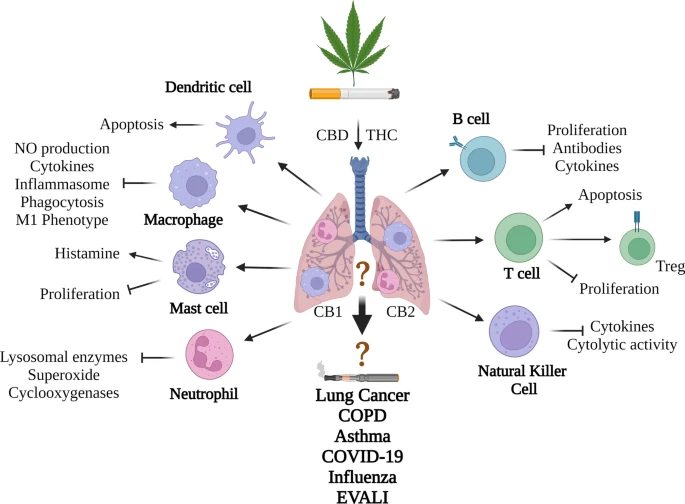
The lungs, in addition to participating in gas exchange, represent the first line of defense against inhaled pathogens and respiratory toxicants. Cells lining the airways and alveoli include epithelial cells and alveolar macrophages, the latter being resident innate immune cells important in surfactant recycling, protection against bacterial invasion and modulation of lung immune homeostasis.
Environmental exposure to toxicants found in cigarette smoke, air pollution and cannabis can alter the number and function of immune cells in the lungs. Cannabis (marijuana) is a plant-derived product that is typically inhaled in the form of smoke from a joint. However, alternative delivery methods such as vaping, which heats the plant without combustion, are becoming more common. Cannabis use has increased in recent years, coinciding with more countries legalizing cannabis for both recreational and medicinal purposes. Cannabis may have numerous health benefits owing to the presence of cannabinoids that dampen immune function and therefore tame inflammation that is associated with chronic diseases such as arthritis.March 27, 2023
IgE-Dependent Allergy in Patients with Celiac Disease: A Systematic Review.
Majsiak, E.; Choina, M.; Knyziak-Mędrzycka, I.; Bierła, J.B.; Janeczek, K.; Wykrota, J.; Cukrowska, B. Nutrients 2023, 15, 995. https://doi.org/10.3390/nu15040995
Abstract
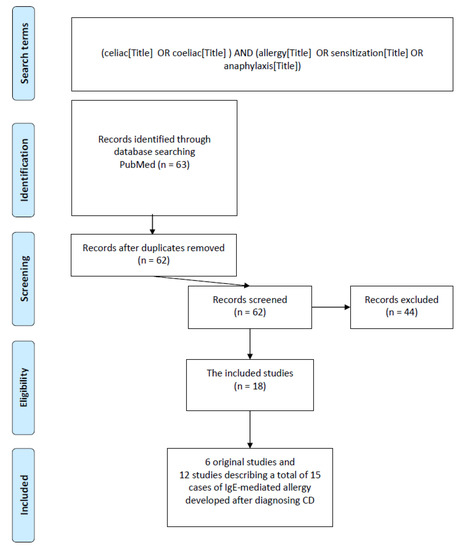
In order to answer the question if an IgE-mediated allergy (A-IgE) may occur in subjects with celiac disease (CD), a systematic review was performed of available publications collected in the United States National Institute for Biotechnology Information/National Institutes of Health/National Library of Medicine/PubMed database up to 28 December 2022, with the use of the following keywords “allergy&celiac/coeliac”, “sensitization&celiac/coeliac”, and “anaphylaxis&celiac/coeliac” compared in the form of a conjunction. In total, the search returned 2013 publications from these keywords in any section of the article.
As numerous review articles included the above-mentioned entries in the abstract, we decided to focus on the publications with the entries only in the title (n = 63). After rejecting studies unrelated to the topic, narrative reviews, book chapters, conference abstracts, symposium reports, letters to the editor, or non-English articles, 18 publications (6 observational original studies and 12 case reports describing a total of 15 cases of A-IgE developed after a diagnosis of CD) were included to this review. Our study is the first systematic review on allergy occurrence in CD patients.March 26, 2023
Allergen challenge tests in allergen immunotherapy: State of the art
Abstract
Introduction: Treatment effects in allergen immunotherapy (AIT) studies are based on symptomatic improvement, and evaluations of naturally exposed patients do often show weak efficacy. Allergen challenge tests, such as conjunctival (CAC), nasal (NAC), or bronchial (BAC) challenge tests, or challenges in allergen exposure chambers (AEC) are accepted by regulators for AIT phase II studies only.
Materials and methods: This review aims to describe different allergen challenge test methods, summarizes safety and limitations for each, and discusses their potential for use in AIT trials.
Results: Organ-specific allergen challenges provide information about individual reactivity, reaction threshold, and organspecific efficacy of AIT.
Cross-sectional study to describe allergic rhinitis flare-ups and associated airways phenotype in house dust mite sensitization.
Abstract
Objectives
To quantify and describe flare-ups of house dust mite allergic rhinitis (HDM-AR) which had occurred during the last 12 months in a population of adults and children candidate for Allergen ImmunoTherapy (AIT). Next, to identify associated clinical features.
Materials and methods
This was an observational, multicenter, cross-sectional study that included patients aged ≥ 5 years with HDM-AR eligible for AIT and without prior AIT for at least 12 months. Flare-ups were all period with impairment of quality of life (QoL) and requiring a change in their usual treatment. Data were collected using medical records and patient questionnaires.
March 23, 2023
A Scoping Review of Artificial Intelligence Research in Rhinology.
Osie G, Darbari Kaul R, Alvarado R, Katsoulotos G, Rimmer J, Kalish L, Campbell RG, Sacks R, Harvey RJ. Am J Rhinol Allergy. 2023 Mar 9:19458924231162437. doi: 10.1177/19458924231162437.
BACKGROUND: A considerable volume of possible applications of artificial intelligence (AI) in the field of rhinology exists, and research in the area is rapidly evolving.
OBJECTIVE: This scoping review aims to provide a brief overview of all current literature on AI in the field of rhinology. Further, it aims to highlight gaps in the literature for future rhinology researchers.
B cells and T cells abnormalities in patients with selective IgA deficiency
- Research
- Open Access
- Yasser Bagheri,
- Tannaz Moeini Shad,
- Shideh Namazi,
- Farzaneh Tofighi Zavareh,
- Gholamreza Azizi,
- Fereshteh Salami,
- Somayeh Sadani,
- Ali Hosseini,
- Mohsen Saeidi,
- Salar Pashangzadeh,
- Samaneh Delavari,
- Babak Mirminachi,
- Nima Rezaei,
- Hassan Abolhassani,
- Asghar Aghamohammadi &
- Reza Yazdani
Allergy, Asthma & Clinical Immunology volume 19, Article number: 23 (2023)
Abstract
Background
Selective IgA deficiency (SIgAD) is the most prevalent inborn errors of immunity with almost unknown etiology. This study aimed to investigate the clinical diagnostic and prognostic values of lymphocyte subsets and function in symptomatic SIgAD patients.
Methods
A total of 30 available SIgAD patients from the Iranian registry and 30 age-sex-matched healthy controls were included in the present study. We analyzed B and T cell peripheral subsets and T cell proliferation assay by flow cytometry in SIgAD patients with mild and severe clinical phenotypes.
March 22, 2023
Cross-reactive epitopes and their role in food allergy
Kamath SD, Bublin M, Kitamura K, Matsui T, Ito K, Lopata AL. J Allergy Clin Immunol. 2023 Mar 15:S0091-6749(23)00148-3. doi: 10.1016/j.jaci.2022.12.827.
Abstract: Allergenic cross-reactivity among food allergens complicates the diagnosis and management of food allergy. This can result in many patients being sensitized (having allergen-specific IgE) to foods without exhibiting clinical reactivity. Some food groups such as shellfish, fish, tree nuts, and peanuts have very high rates of cross-reactivity.
In contrast, relatively low rates are noted for grains and milk, whereas many other food families have variable rates of cross-reactivity or are not well studied.Perspectives on Non-IgE-Mediated Gastrointestinal Food Allergy in Pediatrics: A Review of Current Evidence and Guidelines.
Al-Iede M, Sarhan L, Alshrouf MA, Said Y. J Asthma Allergy. 2023 Mar 14;16:279-291. doi: 10.2147/JAA.S284825.
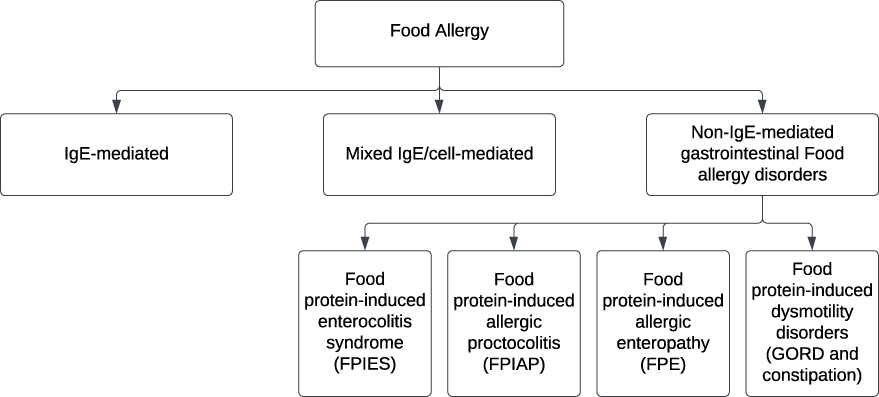
Abstract: Food allergy is an immune-mediated disease that can result in considerable morbidity and even mortality, with a significant negative impact on patients’ quality of life. It is characterized by allergic symptoms that can occur shortly after a relevant food allergen ingestion, or can be delayed or chronic, which make it more difficult for diagnosis.
The symptoms of this disease can range from mild to severe, and rarely can cause anaphylaxis, a life-threatening allergic reaction. The prevalence of non-immunoglobulin E (IgE)-mediated food allergy is poorly established outside of cow’s milk allergy, with an adjusted incidence ranging between 0.13% and 0.72%. Several disorders are classified as non-immunoglobulin E (IgE)-mediated food allergies that predominantly affect the gastrointestinal tract including food protein-induced enterocolitis syndrome (FPIES), food protein-induced allergic proctocolitis (FPIAP), food protein-induced allergic enteropathy (FPE), and food protein-induced dysmotility disorders (GORD and constipation). Eosinophilic esophagitis (EoE) is listed in this group, even though it considered by some authorities to be mixed reaction with both IgE and cell-mediated immune response to be involved in the reaction.March 19, 2023
A molecular sensitization map of European children reveals exposome- and climate-dependent sensitization profiles
Kiewiet MBG, Lupinek C, Vrtala S, et al. Allergy. 2023 Feb 23. doi: 10.1111/all.15689. Open Access.
Abstract
Background
Understanding differences in sensitization profiles at the molecular allergen level is important for diagnosis, personalized treatment and prevention strategies in allergy.
Methods
Immunoglobulin E (IgE) sensitization profiles were determined in more than 2800 sera from children in nine population-based cohorts in different geographical regions of Europe; north [BAMSE (Sweden), ECA (Norway)], west/central [PIAMA (the Netherlands), BiB (the United Kingdom), GINIplus (Germany)], and south [INMA Sabadell and Gipuzkoa (Spain) and ROBBIC Rome and Bologna (Italy)] using the MeDALL-allergen chip.
Results
Sensitization to grass pollen allergen, Phl p 1, and to major cat allergen, Fel d 1, dominated in most European regions whereas sensitization to house dust mite allergens Der p 1, 2 and 23 varied considerably between regions and were lowest in the north. Less than half of children from Sabadell which has a hot and dry climate were sensitized to respiratory allergens, in particular house dust mite allergens as compared to Gipuzkoa nearby with a more humid climate.March 18, 2023
Allergic March in Children: The Significance of Precision Allergy Molecular Diagnosis (PAMD@) in Predicting Atopy Development and Planning Allergen-Specific Immunotherapy
Nutrients. 2023 Feb; 15(4): 978. doi: 10.3390/nu15040978
Abstract:
The allergic march is a progression of naturally occurring symptoms whose nature changes with age. The classic allergic march typically begins in infancy and manifests in the form of atopic dermatitis and food allergy. As immune tolerance develops over time, these conditions may resolve by the age of 3–5 years; however, they may evolve into allergic rhinitis and bronchial asthma.
International consensus statement on allergy and rhinology: Allergic rhinitis - 2023.
Wise SK, Damask C, Roland LT, et al. Int Forum Allergy Rhinol. 2023 Apr;13(4):293-859. doi: 10.1002/alr.23090.
Abstract
Background
In the 5 years that have passed since the publication of the 2018 International Consensus Statement on Allergy and Rhinology: Allergic Rhinitis (ICAR-Allergic Rhinitis 2018), the literature has expanded substantially. The ICAR-Allergic Rhinitis 2023 update presents 144 individual topics on allergic rhinitis (AR), expanded by over 40 topics from the 2018 document. Originally presented topics from 2018 have also been reviewed and updated. The executive summary highlights key evidence-based findings and recommendation from the full document.
Methods
ICAR-Allergic Rhinitis 2023 employed established evidence-based review with recommendation (EBRR) methodology to individually evaluate each topic.