A blog that publishes updates and open access scientific papers about allergy, asthma and immunology. Editor: Juan Carlos Ivancevich, MD. Specialist in Allergy & Immunology
April 8, 2024
Poor rhinitis and asthma control is associated with decreased health-related quality-of-life and utilities: A MASK-air study
Knowledge and attitudes toward anaphylaxis to local anesthetics in dental practice
Cherrez-Ojeda I, Gallardo-Bastidas JC, Borrero GR et al. BDJ Open. 2024 Apr 4;10(1):28. doi: 10.1038/s41405-024-00210-x.
Abstract
Objective/aim
The absence of a comprehensive understanding of potential anaphylactic reactions to local anesthetics (LAs) and management can result in grave consequences. For this reason we aim to assess Latin American dentists’ knowledge, preparedness, and competency in managing anaphylactic reactions to LAs.
Materials and Methods
Design: A cross-sectional study was conducted from November 2021 to February 2022. Board-certified dentists answered a survey comprising 26 structured questions. Chi-square tests and logistic regression models were performed in Stata 17.0. Setting: Argentina, Brazil, Colombia, Costa Rica, Ecuador, Honduras, Mexico, Peru, Venezuela, and other Latin American countries.
April 5, 2024
Safety of omalizumab in chronic urticaria during pregnancy: a real-life study
Abstract
Background
Managing a pregnant patient with chronic spontaneous urticaria (CSU) is often challenging. Recent data have shown that most CSU treatments in pregnant patients are second-generation H1 antihistamines (sgAHs), while data on the safety of omalizumab are scant.
Objectives
To evaluate, in a routine clinical practice setting, the efficacy and safety of omalizumab in patients with severe CSU refractory to sgAHs who either became pregnant during treatment or who started the drug during pregnancy.
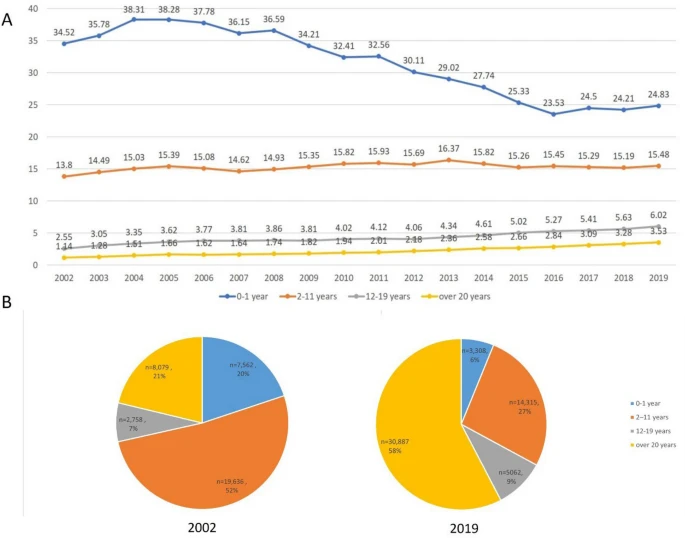
Population-based cohort study to investigate the changes in prevalence, severity profile, and treatment modalities used in Korean atopic dermatitis patients
Abstract
![]() |
| A) Change of annual prevalence of atopic dermatitis according to age group from 2002 to 2019, (B) distribution of atopic dermatitis patients by age group in 2002 and in 2019. |
April 4, 2024
Filaggrin loss-of-function variants are associated with atopic dermatitis phenotypes in a diverse, early life prospective cohort
![]() |
| Graphical Abstract |
Human Leukocyte Antigens and Sulfamethoxazole/Cotrimoxazole-Induced Severe Cutaneous Adverse Reactions: A Systematic Review and Meta-Analysis
Key Points
Question Is there an association between human leukocyte antigen (HLA) and sulfamethoxazole (SMX)/cotrimoxazole (CTX)–induced severe cutaneous adverse reactions (SCARs)?
Findings In this systematic review and meta-analysis of 6 studies involving 322 patients with SCARs, significant associations were identified between the HLA-A*11:01, HLA-B*13:01, HLA-B*15:02, HLA-B*38:02, and HLA-C*08:01 genotypes and SMX/CTX-induced SCARs. The HLA-B*15:02 and HLA-B*38:02 genotypes were significantly associated with SMX/CTX-induced Stevens-Johnson syndrome/toxic epidermal necrolysis (SJS/TEN), while the HLA-A*68:01 and HLA-B*39:01 genotypes were associated with SMX/CTX-induced drug reaction with eosinophilia and systemic symptoms; the HLA-B*13:01 allele showed an association with SMX/CTX-induced SJS/TEN and drug reaction with eosinophilia and systemic symptoms.
Meaning The results of this review suggest that multiple HLA alleles were associated with SMX/CTX-induced SCARs.
Abstract
Importance Sulfamethoxazole (SMX) and cotrimoxazole (CTX), a fixed-dose combination of SMX and trimethoprim in a 5:1 ratio, are antibacterial sulfonamides commonly used for treating various diseases.
Baseline Severity and Disease Duration Can Predict the Response to Allergen-specific Immunotherapy in Allergic Rhinitis
Li Y, Xiao H, Zeng Y, Tang Y, Zhou L, Liu W. Iran J Allergy Asthma Immunol. 2024 Feb 11;23(1):52-58. doi: 10.18502/ijaai.v23i1.14953.
AbstractAllergen-specific immunotherapy (AIT) has confirmed its efficacy in improving the symptoms of allergic rhinitis. However, no reliable biomarkers have been identified to predict the efficacy of AIT were found. We aimed to find clinical and immunological markers to predict efficacy in children after 2 years of sublingual immunotherapy (SLIT). A total of 285 children diagnosed with allergic rhinitis were recruited.
The clinical efficacy was evaluated by comparing endpoint and baseline symptom and medication scores (SMS). Baseline clinical and immunological markers (serum total and specific immunoglobulin [Ig]E) and their correlation with clinical efficacy were analyzed.