April 12, 2024

An integrated molecular risk score early in life for subsequent childhood asthma risk

Böck A, Urner K, Eckert JK et al.  Clin Exp Allergy. 2024 Mar 31. doi: 10.1111/cea.14475. 

Abstract

Background

Numerous children present with early wheeze symptoms, yet solely a subgroup develops childhood asthma. Early identification of children at risk is key for clinical monitoring, timely patient-tailored treatment, and preventing chronic, severe sequelae. For early prediction of childhood asthma, we aimed to define an integrated risk score combining established risk factors with genome-wide molecular markers at birth, complemented by subsequent clinical symptoms/diagnoses (wheezing, atopic dermatitis, food allergy).

Methods

Three longitudinal birth cohorts (PAULINA/PAULCHEN, n = 190 + 93 = 283, PASTURE, n = 1133) were used to predict childhood asthma (age 5–11) including epidemiological characteristics and molecular markers: genotype, DNA methylation and mRNA expression (RNASeq/NanoString). Apparent (ap) and optimism-corrected (oc) performance (AUC/R2) was assessed leveraging evidence from independent studies (Naïve-Bayes approach) combined with high-dimensional logistic regression models (LASSO).

Results

Asthma prediction with epidemiological characteristics at birth (maternal asthma, sex, farm environment) yielded an ocAUC = 0.65. Inclusion of molecular markers as predictors resulted in an improvement in apparent prediction performance, however, for optimism-corrected performance only a moderate increase was observed (upto ocAUC = 0.68).

COVID-19 and Asthma Onset in Children

James P. Senter, Laura K. Aisenberg, Jesse W. Dudley, Xianqun Luan, Jing Huang, Chén C. Kenyon, David A. Hill. Pediatrics 2024; e2023064615. 10.1542/peds.2023-064615

ABSTRACT

BACKGROUND AND OBJECTIVES:

Respiratory viral infections increase risk of asthma in infants and children. Infection with the severe acute respiratory syndrome coronavirus 2 (SARS-CoV-2) virus can cause severe lung inflammation and prolonged respiratory symptoms. We sought to determine whether SARS-CoV-2 infection modified pediatric incident asthma risk.

METHODS:

This retrospective cohort study examined children ages 1 to 16 within the Children’s Hospital of Philadelphia Care Network who received polymerase chain reaction (PCR) testing for SARS-CoV-2 between March 1, 2020 and February 28, 2021. Multivariable Cox regression models assessed the hazard ratio of new asthma diagnosis between SARS-CoV-2 PCR positive and SARS-CoV-2 PCR negative groups within an 18-month observation window. Models were adjusted for demographic characteristics, socioeconomic variables, and atopic comorbidities.

RESULTS:

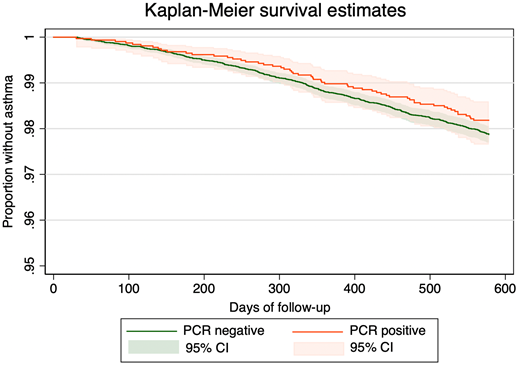
Kaplan-Meier survival curves comparing adjusted asthma-free survival between
SARS-CoV-2 positive and SARS-CoV-2 negative groups.
There were 27 423 subjects included in the study. In adjusted analyses, SARS-CoV-2 PCR positivity had no significant effect on the hazard of new asthma diagnosis (hazard ratio [HR]: 0.96; P = .79). Black race (HR: 1.49; P = .004), food allergies (HR: 1.26; P = .025), and allergic rhinitis (HR: 2.30; P < .001) significantly increased the hazard of new asthma diagnosis. Preterm birth (HR: 1.48; P = .005) and BMI (HR: 1.13; P < .001) significantly increased the hazard of new asthma diagnosis for children <5 years old.

April 11, 2024

Preventive allergen immunotherapy with inhalant allergens in children

Dwivedi V, Kopanja S, Schmidthaler K, Sieber J et al. Allergy. 2024 Apr 8. doi: 10.1111/all.16115. 

REVIEW - Open Access


Abstract

The efficacy and safety of preventive allergen immunotherapy (pAIT) in children are currently under investigation. Here, we provide an overview of pAIT with respiratory allergens concerning the prevention of new sensitizations, allergic disease onset and progression as well as further immunomodulatory effects.

Process of study selection
Three databases were searched for clinical pAIT studies in children. Selected publications were reviewed for preventive outcomes according to prevention level (primary, secondary, and tertiary), allergen type, administration route, dose, and treatment duration. The primary prevention approach appears safe but showed no allergen-specific effect on new sensitizations. Secondary prevention seems feasible and may induce regulatory T cell-mediated immunotolerance. The number of studies at these prevention levels is limited.

Exercise-induced bronchoconstriction, allergy and sports in children

Klain A, Giovannini M, Pecoraro L et al.  Ital J Pediatr. 2024 Mar 13;50(1):47. doi: 10.1186/s13052-024-01594-0.


Abstract

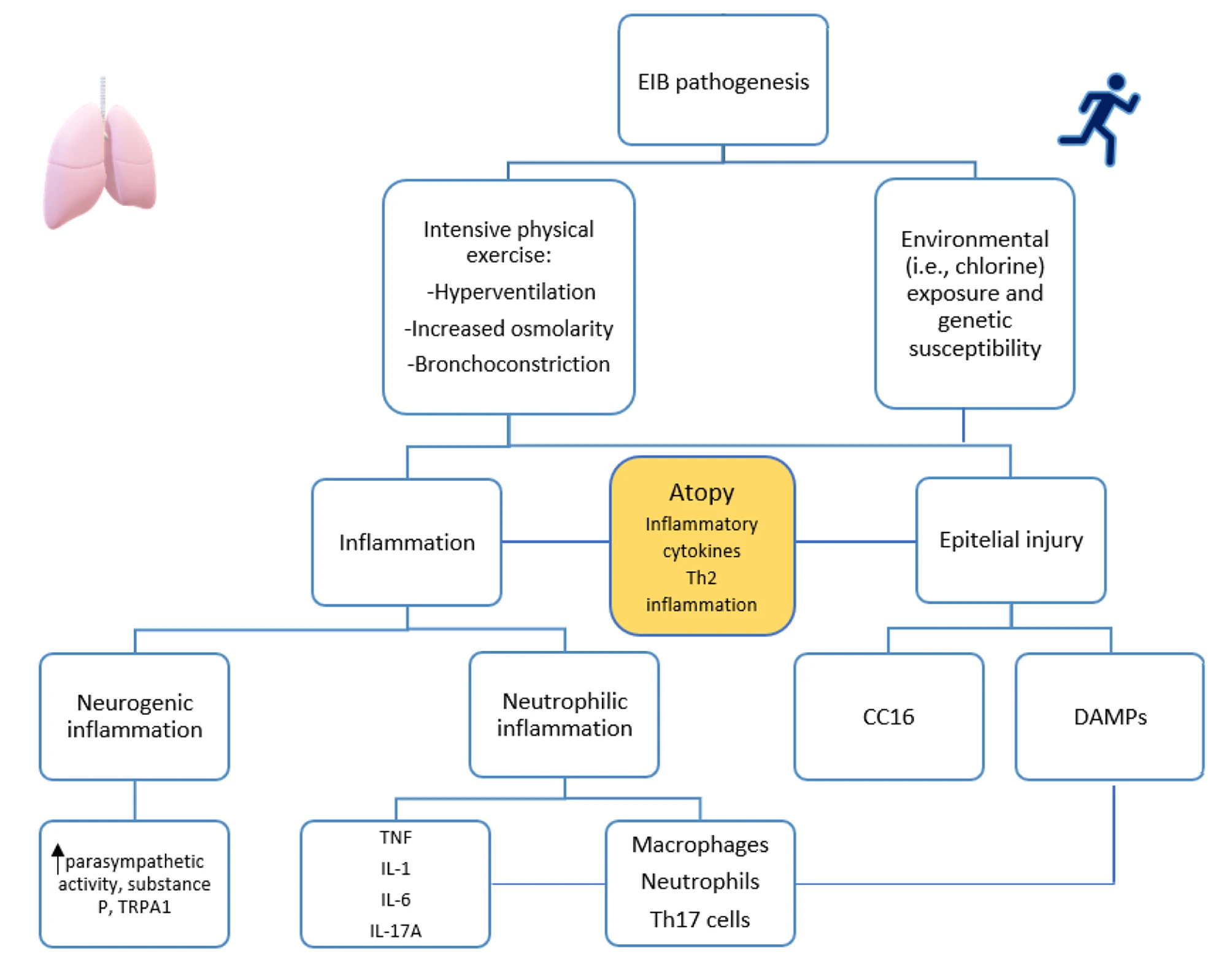
EIB pathogenesis and the central role of atopy
Exercise-induced bronchoconstriction (EIB) is characterized by the narrowing of airways during or after physical activity, leading to symptoms such as wheezing, coughing, and shortness of breath. Distinguishing between EIB and exercise-induced asthma (EIA) is essential, given their divergent therapeutic and prognostic considerations. EIB has been increasingly recognized as a significant concern in pediatric athletes. Moreover, studies indicate a noteworthy prevalence of EIB in children with atopic predispositions, unveiling a potential link between allergic sensitivities and exercise-induced respiratory symptoms, underpinned by an inflammatory reaction caused by mechanical, environmental, and genetic factors.

Emerging and Novel Elicitors of Anaphylaxis: Collegium Internationale Allergologicum Update 2024

Treudler R. Emerging and Novel Elicitors of Anaphylaxis: Collegium Internationale Allergologicum Update 2024. Int Arch Allergy Immunol. 2024 Mar 25:1-9. doi: 10.1159/000537958.

Abstract

Background: 

Anaphylaxis represents the most severe end of the spectrum of allergic reactions. Frequent elicitors of anaphylaxis are insects, foods, and drugs. This paper summarizes recent development with regard to emerging and novel elicitors of anaphylaxis.

Summary: 

Allergens in selected plant foods with increasing importance in anaphylaxis cases
Food allergens on the rise include pulses (like pea, chickpea), seeds (hemp, chia), nuts (cashew), pseudograins (buckwheat, quinoa), fruits, and microalgae. Novel foods are foods that were not consumed to any significant extent in the European Union before May 1997, which includes four edible insects (mealworm, migratory locust, house cricket, and buffalo worm). Recent investigations have pointed out the risk of anaphylaxis associated with the consumption of yellow mealworm for people allergic to shellfish and house dust mites.

April 8, 2024

Predicting the Outcome of Pediatric Oral Food Challenges for Determining Tolerance Development


Kim H, Jeong K, Park M et al.  Allergy Asthma Immunol Res. 2024 Mar;16(2):179-190. doi: 10.4168/aair.2024.16.2.179.

Abstract

Purpose: Despite the risk of anaphylaxis, oral food challenges (OFCs) are performed clinically for various indications, particularly to confirm tolerance development. This study aimed to assess OFCs by relevant indications and build an outcome prediction model to help determine when to perform OFCs in children who are likely to have developed immune tolerance.

Methods: In total, 432 pediatric OFCs were retrospectively analyzed according to indications. Clinical characteristics, serum total immunoglobulin (Ig) E, blood eosinophils, and specific IgE and IgG4 levels for food allergens were noted and compared. Machine learning was utilized to select the most important variables in determining the passage of the OFCs, and prediction models were constructed using the selected variables.

Distribution of oral food challenge results based on age
and food-specific immunoglobulin E for egg white and cow’s milk.
 
Results: OFCs were most commonly performed to confirm tolerance development (number, %; 267, 61.8%). The most common food allergens tested were egg (191, 44.2%) and milk (135, 31.3%).

Poor rhinitis and asthma control is associated with decreased health-related quality-of-life and utilities: A MASK-air study

Vieira RJ, Leemann L, Briggs A et al. J Allergy Clin Immunol Pract. 2024 Mar 30:S2213-2198(24)00329-5. doi: 10.1016/j.jaip.2024.03.036.

Highlights box:
What is already known about this topic?
National estimates of patients' quality-of-life based on control of asthma/allergic rhinitis are lacking. Real-world data may provide insights into quality-of-life of patients with asthma/allergic rhinitis and improve the ability to provide care to these patients.
What does this article add to our knowledge?
This study provides country-specific estimates (per disease control level) for quality-of-life in patients with allergic rhinitis or asthma across multiple European countries, using EQ-5D utility index scores and EQ-5D visual analogue scale.
How does this study impact current management guidelines?
This study points to the importance of achieving a good rhinitis and asthma control.
It also provides insights into patients’ preferences regarding different control levels and comorbid status, which are essential for guideline development.

Abstract
Background
Allergic rhinitis (AR) and asthma may impact health-related quality-of-life. However, national estimates on the quality-of-life of patients with AR or asthma are lacking.

Knowledge and attitudes toward anaphylaxis to local anesthetics in dental practice

Cherrez-Ojeda I, Gallardo-Bastidas JC, Borrero GR et al. BDJ Open. 2024 Apr 4;10(1):28. doi: 10.1038/s41405-024-00210-x.

Abstract

Objective/aim

The absence of a comprehensive understanding of potential anaphylactic reactions to local anesthetics (LAs) and management can result in grave consequences. For this reason we aim to assess Latin American dentists’ knowledge, preparedness, and competency in managing anaphylactic reactions to LAs.

Materials and Methods

Design: A cross-sectional study was conducted from November 2021 to February 2022. Board-certified dentists answered a survey comprising 26 structured questions. Chi-square tests and logistic regression models were performed in Stata 17.0. Setting: Argentina, Brazil, Colombia, Costa Rica, Ecuador, Honduras, Mexico, Peru, Venezuela, and other Latin American countries.