May 30, 2024

Chronic Pruritus A Review

Butler DC, Berger T, Elmariah S, et al. JAMA. Published online May 29, 2024. doi:10.1001/jama.2024.4899 

Abstract

Importance  Chronic pruritus, defined as itch experienced for 6 weeks or longer, affects approximately 22% of people in their lifetime. Approximately 1% of physician visits are for the chief concern of chronic pruritus. Chronic pruritus is associated with adverse outcomes, including impaired sleep and reduced quality of life.

Categories of Chronic Pruritus
Observations  Chronic pruritus can be categorized by etiology into inflammatory, neuropathic, or a combination of inflammatory and neuropathic pruritus. Chronic pruritus is due to inflammation in approximately 60% of patients and may be caused by eczema, psoriasis, or seborrheic dermatitis. Chronic pruritus is due to a neuropathic or mixed etiology in approximately 25% of patients. Neuropathic causes of chronic pruritus include postherpetic neuralgia and notalgia paresthetica and are typically due to localized or generalized nerve dysregulation.

May 29, 2024

Relevance of individual bronchial symptoms for asthma diagnosis and control in patients with rhinitis: A MASK-air study

Sousa-Pinto B, Louis G, Vieira RJ, et al. Clin Transl Allergy. 2024;e12358. https://doi.org/10.1002/clt2.12358

Abstract

Rationale

It is unclear how each individual asthma symptom is associated with asthma diagnosis or control.

Objectives

To assess the performance of individual asthma symptoms in the identification of patients with asthma and their association with asthma control.

Methods

Flow chart illustrating participants' selection.
In this cross-sectional study, we assessed real-world data using the MASK-air® app. We compared the frequency of occurrence of five asthma symptoms (dyspnea, wheezing, chest tightness, fatigue and night symptoms, as assessed by the Control of Allergic Rhinitis and Asthma Test [CARAT] questionnaire) in patients with probable, possible or no current asthma. We calculated the sensitivity, specificity and predictive values of each symptom, and assessed the association between each symptom and asthma control (measured using the e-DASTHMA score). Results were validated in a sample of patients with a physician-established diagnosis of asthma.

May 28, 2024

Serum eosinophil-derived neurotoxin: a new promising biomarker for cow’s milk allergy diagnosis.

Bahbah, W.A., Abo Hola, A.S., Bedair, H.M. et al.  Pediatr Res (2024). https://doi.org/10.1038/s41390-024-03260-x

Abstract

Background

Cow’s Milk Allergy (CMA) diagnosis is often a challenge due to the non-specific nature of symptoms and lack of a confirmatory diagnostic test. To our knowledge no previous studies investigated serum Eosinophil-Derived Neurotoxin (sEDN) in CMA. So, we aimed to assess the role of sEDN in CMA diagnosis.

Methods

Forty-five infants with CMA were compared to 45 infants with functional gastrointestinal disorders (FGIDs) and 45 healthy controls. For all participants, Cow’s Milk-related Symptom Score (CoMiSS) was documented, and sEDN level with hematological parameters were measured before starting elimination diet.

Results

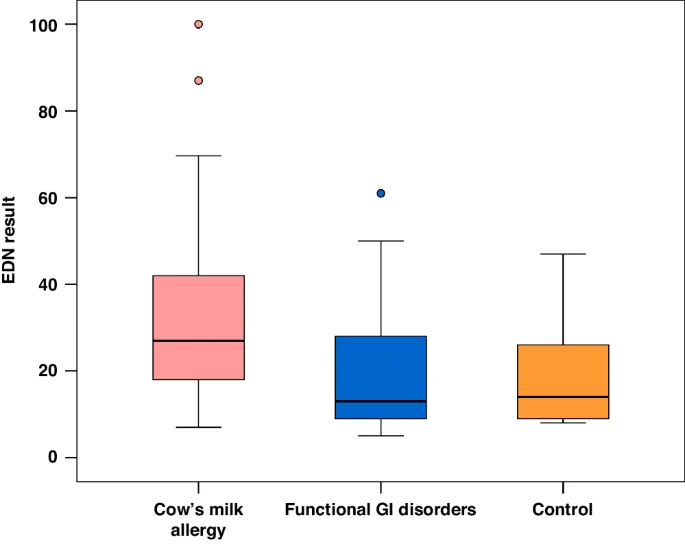
Serum Eosinophil-Derived Neurotoxin level among the 3 studied groups.
Receiver operation characteristic (ROC) curve identified sEDN > 14 ng/mL and CoMiSS > 9 as the optimal cut-off points to discriminate CMA from other groups with sensitivity 86.67%, 97.78% and specificity 60.00%, 78.89% respectively. Additionally, absolute neutrophil count (ANC) showed the highest sensitivity and specificity (80.0% and 78.89%) among hematological parameters.

Factors Affecting Usage of a Digital Asthma Monitoring Application by Old-Age Asthmatics Living in Inner Central Portugal

Abreu MIT, Santos AF, Gama JMR, Valente S, Valente MJ, Pereira H, Regateiro F, Sousa-Pinto B, Ventura MT, Bousquet J, Taborda-Barata L. Clin Interv Aging. 2024;19:971-979

Purpose: To analyse factors affecting the ability to use the digital asthma monitoring application Mask-Air® in old-age individuals living in inland Portugal.

Patients and Methods: In this observational study, patients with medically confirmed asthma who agreed to participate were interviewed and subdivided into Non-users Group: those who could not use the application and Users Group: those who could. Sociodemographic and psychological data, comorbidities, and asthma status were compared between groups. Assessment of reasons for refusal was based on a 6-item questionnaire.

Reasons for not using MASK-Air App by Non-users Group asthmatics.
Most frequent reasons given by Non-users Group (44 patients) for not using
MASK-air;these results show lack of possibility to use the 
App versus not
wanting to use the 
App (A).
Venn diagram showing specific reasons and combinations of reasons
given by Non-users Group (44 patients) for not using MASK-Air 
App (B)
Results: Among the 72 sequentially recruited patients (mean age±SD 73.26± 5.43 yrs; 61 women; 11 men), 44 (61.1%; mean age±SD 74.64± 5.68 yrs; 38 women; 6 men)) were included in Non-users Group and 28 (38.9%; mean age±SD 71.11± 4.26 yrs; 23 women; 5 men) in Users Group. Non-users Group patients were significantly older, had lower socioeconomic level, and more frequently had severe asthma (25% vs 3.6%; Odds ratio=0.08 (95% CI=0.01– 0.81; p=0.033)) and diabetes (32.6% vs 7.4%; Odds ratio=0.17 (95% CI=0.03– 0.80; p=0.025)) than Users Group.

May 27, 2024

Immunotherapy and biologics in the management of IgE-mediated food allergy: Systematic review and meta-analyses of efficacy and safety

Riggioni C, Oton T, Carmona L, Du Toit G, Skypala I, Santos AF, the EAACI Food Allergy Guidelines Expert Group and the EAACI Research and Outreach Committee FA Group  Allergy. 2024; 00: 1-31. doi:10.1111/all.16129

Abstract

Food allergy (FA) is a potentially life-threatening chronic condition that is becoming an increasing public health problem worldwide. This systematic review (SR) was carried out to inform the development of clinical recommendations on the treatment of IgE-mediated FA with biologics and/or IT for the update of the EAACI guidelines. A SR of randomized-controlled trials or quasi-controlled trials was carried out. Studies were identified via comprehensive search strategies in Medline, Embase, and Cochrane Library, up to April 2022. Population: Human adults, children, and adolescents with IgE-mediated FA. Intervention: IT and/or biologics. Comparator: Placebo or standard-of-care (allergen avoidance).

Metanalysis of omalizumab versus placebo in IgE-mediated food allergies:
Primary outcome (Desensitization)
Outcome: Efficacy (desensitization, sustained unresponsiveness (SU), remission), quality of life, and safety (systemic and local adverse reactions (AR)). The Cochrane RoB tool was used to assess the risk of bias. It was reported according to PRISMA and registered in PROSPERO CRD4202229828.

May 25, 2024

The Multiple Trajectories of the Allergic March.


de Las Vecillas L, Quirce S.  J Investig Allergol Clin Immunol. 2024 Apr 12;34(2):75-84. doi: 10.18176/jiaci.0983.


Abstract

Etiologic features and risk factors related to the development of the allergic march and preventive
interventions to impact its course. TH2 indicates type 2 helper T cell; AIT, allergen immunotherapy
The allergic march comprises the sequential appearance of a series of allergic comorbidities. However, variability in the onset and progression of allergic diseases generates a heterogeneous scenario that does not follow a linear and single trajectory.

Almost half of the pediatric population presents at least 1 allergy symptom. However, only 4%-6% present multimorbidity, with several allergic diseases co-occurring. It has recently been shown that although they share etiological mechanisms and risk factors, allergic diseases arise independently. In most cases, progression is not consecutive, or at least not the same in all patients.

AM-301, a barrier-forming nasal spray, versus saline spray in seasonal allergic rhinitis: A randomized clinical trial

Becker S, Deshmukh S, De Looze F, et al. Allergy. 2024; 00: 1-10. doi:10.1111/all.16116

Abstract

Rationale

Saline nasal sprays are frequently used in the management of seasonal allergic rhinitis (SAR) for the cleansing and clearing of aeroallergens from the nasal cavity. Also using a drug-free approach, AM-301 nasal spray is forming a thin film barrier on the nasal mucosa to prevent contact with allergens, trap them, and facilitate their discharge. A clinical trial compared the efficacy, safety, and tolerability of AM-301 and saline spray in SAR.

Methods

A total of 100 patients were randomized 1:1 to self-administer AM-301 or saline 3 × daily for 2 weeks. Primary efficacy endpoint: reduction in mean daily reflective Total Nasal Symptom Score (rTNSS). Secondary efficacy endpoints: reduction in mean instantaneous TNSS and Rhinoconjunctivitis Quality of Life Questionnaire (RQLQ), global impression of efficacy.

May 24, 2024

Baricitinib Improvement Across Regions in Atopic Dermatitis Patients with Baseline Body Surface Area up to 40% and Severe Itch

Carrascosa JM, Narcisi A, Nomura T, Ständer S, Vestergaard C, Sabatino S, Grond S, Koppelhus U, Elrayes M, Chen YF, Liu C, Wollenberg A.  Dermatol Ther (Heidelb). 2024 May 22. doi: 10.1007/s13555-024-01171-7. 

Abstract

Introduction: Patients with moderate-to-severe atopic dermatitis (AD) who are most likely to respond to the Janus kinase (JAK) 1/2 inhibitor baricitinib (BARI) are known to have an impacted body surface area (BSA) ≤ 40% and severe itch (numerical rating scale [NRS] ≥ 7], collectively termed 'BARI itch-dominant' patients. Our objective is to build on our previous work by providing a body region-specific, clinical characterization of the BARI itch-dominant patient at baseline and their response to BARI 4 mg.

Methods: BREEZE-AD7 was a phase 3 trial in adults with moderate-to-severe AD receiving placebo or 2 mg or 4 mg BARI in combination with topical corticosteroids. Assessing only data from BARI itch-dominant patients, we summarized the baseline characteristics and conducted body region-specific analyses on Eczema Area and Severity Index (EASI) data in order to report the response to placebo versus BARI 4 mg within this patient subtype.