
Abstract
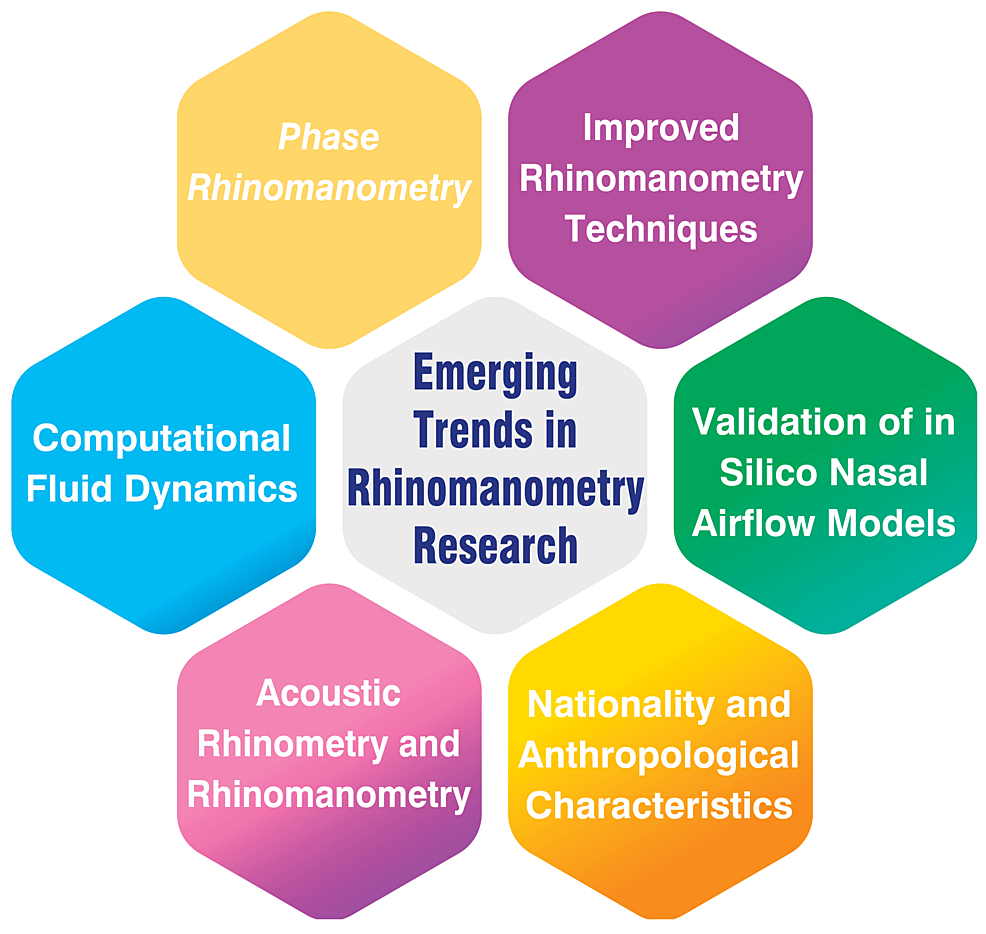 |
| Emerging trends in rhinomanometry research |
Abstract
|
| Emerging trends in rhinomanometry research |

 |
| Potential mechanisms underlying the association between AD and aging. |
Butler DC, Berger T, Elmariah S, et al. JAMA. Published online May 29, 2024. doi:10.1001/jama.2024.4899
Abstract
Importance Chronic pruritus, defined as itch experienced for 6 weeks or longer, affects approximately 22% of people in their lifetime. Approximately 1% of physician visits are for the chief concern of chronic pruritus. Chronic pruritus is associated with adverse outcomes, including impaired sleep and reduced quality of life.
 |
| Categories of Chronic Pruritus |

Abstract
Rationale
It is unclear how each individual asthma symptom is associated with asthma diagnosis or control.
Objectives
To assess the performance of individual asthma symptoms in the identification of patients with asthma and their association with asthma control.
Methods
 |
| Flow chart illustrating participants' selection. |
Abstract
Background
Cow’s Milk Allergy (CMA) diagnosis is often a challenge due to the non-specific nature of symptoms and lack of a confirmatory diagnostic test. To our knowledge no previous studies investigated serum Eosinophil-Derived Neurotoxin (sEDN) in CMA. So, we aimed to assess the role of sEDN in CMA diagnosis.
Methods
Forty-five infants with CMA were compared to 45 infants with functional gastrointestinal disorders (FGIDs) and 45 healthy controls. For all participants, Cow’s Milk-related Symptom Score (CoMiSS) was documented, and sEDN level with hematological parameters were measured before starting elimination diet.
Results
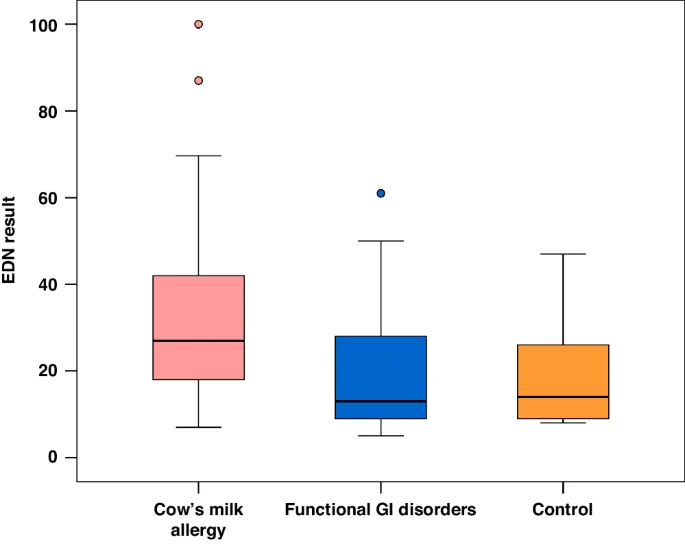 |
| Serum Eosinophil-Derived Neurotoxin level among the 3 studied groups. |
Purpose: To analyse factors affecting the ability to use the digital asthma monitoring application Mask-Air® in old-age individuals living in inland Portugal.
Patients and Methods: In this observational study, patients with medically confirmed asthma who agreed to participate were interviewed and subdivided into Non-users Group: those who could not use the application and Users Group: those who could. Sociodemographic and psychological data, comorbidities, and asthma status were compared between groups. Assessment of reasons for refusal was based on a 6-item questionnaire.
 |
| Reasons for not using MASK-Air App by Non-users Group asthmatics. Most frequent reasons given by Non-users Group (44 patients) for not using MASK-air;these results show lack of possibility to use the App versus not wanting to use the App (A). Venn diagram showing specific reasons and combinations of reasons given by Non-users Group (44 patients) for not using MASK-Air App (B) |

Food allergy (FA) is a potentially life-threatening chronic condition that is becoming an increasing public health problem worldwide. This systematic review (SR) was carried out to inform the development of clinical recommendations on the treatment of IgE-mediated FA with biologics and/or IT for the update of the EAACI guidelines. A SR of randomized-controlled trials or quasi-controlled trials was carried out. Studies were identified via comprehensive search strategies in Medline, Embase, and Cochrane Library, up to April 2022. Population: Human adults, children, and adolescents with IgE-mediated FA. Intervention: IT and/or biologics. Comparator: Placebo or standard-of-care (allergen avoidance).
 |
| Metanalysis of omalizumab versus placebo in IgE-mediated food allergies: Primary outcome (Desensitization) |

Abstract
 |
| Etiologic features and risk factors related to the development of the allergic march and preventive interventions to impact its course. TH2 indicates type 2 helper T cell; AIT, allergen immunotherapy |
Almost half of the pediatric population presents at least 1 allergy symptom. However, only 4%-6% present multimorbidity, with several allergic diseases co-occurring. It has recently been shown that although they share etiological mechanisms and risk factors, allergic diseases arise independently. In most cases, progression is not consecutive, or at least not the same in all patients.

