June 20, 2024

Transition between subcutaneous and sublingual allergen immunotherapy: Recommendations of the Brazilian Association of Allergy and Immunology (ASBAI)

Aarestrup, Fernando Monteiro et al. Journal of Allergy and Clinical Immunology: Global, Volume 3, Issue 3, 100281

Abstract

The use of allergen immunotherapy (AIT) in Brazil has specific regional conditions owing to the pattern of allergen sensitization, as well as to genetic, socioeconomic, and cultural characteristics. This review article aims to discuss the clinical practice of AIT by the subcutaneous or sublingual route in Brazil, addressing the possibilities of transition between these forms of administration. A systematic review using the PubMed and Cochrane databases was performed, and the websites of major allergy and immunology organizations were consulted.

The Association between Migration and Prevalence of Allergic Diseases: A Systematic Review and Meta-Analysis

Qi Yi Ambrose Wong; Fook Tim Chew Int Arch Allergy Immunol 1–24.  JUNE 20 2024 https://doi.org/10.1159/000539382

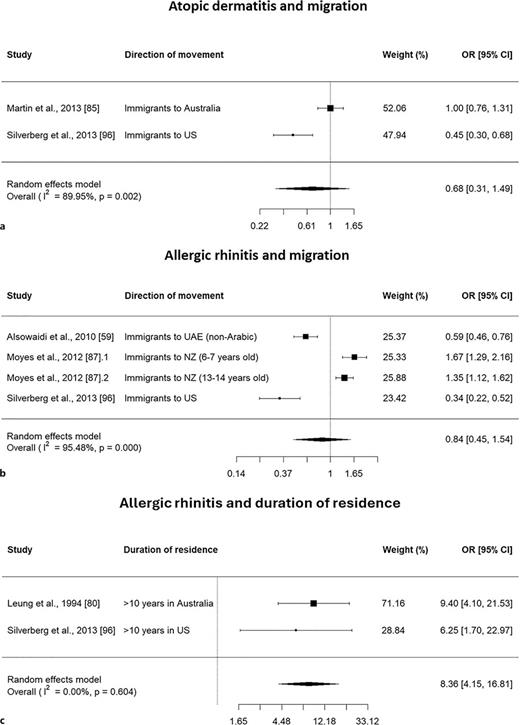
Introduction: Allergic diseases remain of concern due to their increasing prevalence worldwide. Intrinsic and environmental risk factors have been implicated in the pathogenesis of allergic disease. Among the possible risk factors, migration has been associated with the manifestation of allergic diseases. We aimed to consolidate the existing evidence, review the hypotheses for the relationship between environmental factors and allergic disease, and provide a direction for future work. Methods: This systematic review and meta-analysis complied with Preferred Reporting Items for Systematic Reviews and Meta-Analyses (PRISMA) guidelines. The Web of Science database was searched in September 2023 to retrieve publications investigating the relationship between allergic rhinitis (AR), atopic dermatitis (AD), or asthma and the following factors: (i) migrant status (i.e., migrants vs. natives) or (ii) duration since migration among migrants.

June 19, 2024

Biomarkers of peanut allergy in children over time.

Foong R-X, Du Toit G, van Ree R, et al.  Allergy. 2024; 00: 1-12. doi:10.1111/all.16193

Abstract

Background

Various biomarkers are used to define peanut allergy (PA). We aimed to observe changes in PA resolution and persistence over time comparing biomarkers in PA and peanut sensitised but tolerant (PS) children in a population-based cohort.

Methods

Participants were recruited from the EAT and EAT-On studies, conducted across England and Wales, and were exclusively breastfeed babies recruited at 3 months old and followed up until 7–12 years old. Clinical characteristics, skin prick test (SPT), sIgE to peanut and peanut components and mast cell activation tests (MAT) were assessed at 12 months, 36 months and 7–12 years. PA status was determined at the 7–12 year time point.

Contribution of MASK-air® as an mHealth Tool for Digitally Enabled Person-Centered Care in Rhinitis and Asthma

Sousa-Pinto B, Fonseca JA, Bousquet J. J Investig Allergol Clin Immunol. 2024 May 14:0. doi: 10.18176/jiaci.0994. 


Abstract:

 How MASK-air® can contribute to research and clinical practice.
GDPR indicates General Data Protection Regulation.
In chronic diseases, mHealth apps help to improve clinical management and provide valuable real-world scientific evidence. In allergic rhinitis, a market research study identified only 4 mHealth apps that were multilingual, resulted in scientific publications, and displayed a comprehensive list of medications. Of these 4 apps, MASK-air® generated the highest number of scientific publications. MASK-air was launched in 2015 and is currently available in 30 countries, with data collected from more than 30 000 users. It comprises a daily monitoring questionnaire, enabling patients to register their daily allergy symptoms by means of visual analog scales and their medication use.

June 17, 2024

Development of an efficient, effective, and economical technology for proteome analysis

Martin KR, Le HT, Abdelgawad A, Yang C, Lu G, Keffer JL, Zhang X, Zhuang Z, Asare-Okai PN, Chan CS, Batish M, Yu Y. Cell Rep Methods. 2024 Jun 10:100796. doi: 10.1016/j.crmeth.2024.100796.

Highlights

• Rapid, robust, and cost-effective alternative to proteomics sample preparation
• Versatile filter devices can meet a wide range of proteomics analysis needs
• On-filter in-cell digestion facilitates low-input proteomics
• Ready-to-go E3 and E4 filter devices are available

Motivation
Conventional proteomics sample processing methods often have high technical barriers to broad biomedical scientists, leading to difficulties for quick adoption and standardization. Existing protocols are also typically associated with costly reagents and accessories, making them less feasible for resource-limited settings as well as for clinical proteomics and/or core facilities where large numbers of samples are usually processed. Thus, there is a strong unmet need for an easy-to-use, reliable, and low-cost approach for general proteomics sample preparation.

Summary
We present an efficient, effective, and economical approach, named E3technology, for proteomics sample preparation. By immobilizing silica microparticles into the polytetrafluoroethylene matrix, we develop a robust membrane medium, which could serve as a reliable platform to generate proteomics-friendly samples in a rapid and low-cost fashion. We benchmark its performance using different formats and demonstrate them with a variety of sample types of varied complexity, quantity, and volume.

Could Corticosteroid/Antihistamine Combination Nasal Sprays Be Used as Anti-Inflammatory Reliever Therapy for Allergic Rhinitis?

Lipworth BJ, Stewart K, Kuo CR, Chan R. J Allergy Clin Immunol Pract. 2024 Jun;12(6):1434-1435. doi: 10.1016/j.jaip.2024.01.024.

EDITORIAL

Current guidelines advocate using regular treatment with intranasal corticosteroid/antihistamine (CS/AH) combination sprays as step-up therapy for adolescent and adult patients with moderate to severe persistent allergic rhinitis (AR) where there is suboptimal control with intranasal CS alone.1 

Rationale for using low-dose intranasal corticosteroid/antihistamine (CS/AH)
combination as on-demand anti-inflammatory reliever therapy for allergic rhinitis (AR).
Patients would escalate and de-escalate the dose according to symptoms,
prevailing triggers, and attendant disease severity.
The therapeutic rationale here is that the CS component is effective at suppressing symptoms attributable to type 2 (T2) inflammation mediated by eosinophils, whereas the AH provides additional activity on T2 symptoms mediated by IgE and mast cells. The evidence from clinical studies shows superior clinical efficacy based on symptom scores when comparing twice-daily CS/AH combination versus twice-daily CS alone, demonstrating additivity of response for the 2 moieties.2,3

Smartphone applications supporting self-management programme for adults with Chronic Obstructive Pulmonary Disease: A Scoping Review.

Glynn L, Mc Cann M, Mc Cabe C. PLOS Digit Health. 2024 Jun 13;3(6):e0000532. doi: 10.1371/journal.pdig.0000532.

Abstract

Introduction: Chronic Obstructive Pulmonary Disease (COPD) significantly impacts on both the quality and quantity of life for patients due to frequent exacerbations requiring hospital admissions resulting in increased morbidity and mortality. A self-management programme purpose is to increase one's knowledge, confidence, and skills to self-manage their chronic illness such as COPD.
Objective: The objective of this review will therefore answer the following research question: What is the current literature pertaining to the use of a smartphone app in supporting a comprehensive self-management programme among COPD patients? A preliminary search was conducted in, Medline, Embase and CINAHL databases to ascertain index terms and keywords. Following this a rigorous search was carried out on Medline, Embase, CINAHL, Web of Science and ASSIA. The findings from this search are presented in tabular form using the PRSIMA flow diagram.

June 16, 2024

Allergic Conjunctivitis Management: Update on Ophthalmic Solutions.

Leonardi A, Quintieri L, Presa IJ, LLoves JM, Montero J, Benítez-Del-Castillo JM, Lestón FJS, González-Mancebo E, Asero R, Groblewska A, Kuna P. Curr Allergy Asthma Rep. 2024 Jun 13. doi: 10.1007/s11882-024-01150-0. 

Abstract

Purpose of review: The aim of this review, is to present an updated revision of topical management of SAC and PAC, based on the available scientific evidence and focused on the impact of ophthalmic solution formulations on eye surface.

Recent findings: Physicians treating ocular allergy should be aware of tear film and tear film disruption in SAC and PAC, and how eye drop composition and additives affect the physiology of the allergic eye. Seasonal and perennial allergic conjunctivitis (SAC and PAC) are the most frequent causes of ocular allergy (OA), and both conditions are underdiagnosed and undertreated.