October 31, 2024

The epithelial barrier theory and its associated diseases

Sun N, Ogulur I, Mitamura Y, et al. Allergy. 2024; 00: 1-46. doi:10.1111/all.16318

Abstract

The prevalence of many chronic noncommunicable diseases has been steadily rising over the past six decades. During this time, over 350,000 new chemical substances have been introduced to the lives of humans. In recent years, the epithelial barrier theory came to light explaining the growing prevalence and exacerbations of these diseases worldwide. It attributes their onset to a functionally impaired epithelial barrier triggered by the toxicity of the exposed substances, associated with microbial dysbiosis, immune system activation, and inflammation. 

Exposome and/or risk factors in contact with neuropsychiatric diseases, airway diseases, skin diseases, and digestive tract diseases.

October 30, 2024

Comparative Study of Inhaled Corticosteroids and Leukotriene Receptor Antagonists As Controller Options for Mildly to Moderately Persistent, Stable Asthma

Shah J, Siddiqui F, Adnan S, et al. (October 27, 2024) Cureus 16(10): e72490. doi:10.7759/cureus.72490

Abstract

Introduction: Asthma is a chronic inflammatory disease of the airways characterized by bronchoconstriction, airway hyperresponsiveness, and variable airflow limitation. This results in symptoms such as wheezing, difficulty breathing, chest tightness, chest pain, and coughing.

Objectives: The primary objective of the study is to compare the efficacy of inhaled corticosteroids (ICS) versus leukotriene receptor antagonists (LTRA) in improving asthma control, lung function, and quality of life in patients with mild to moderate persistent asthma.

Methodology: This prospective comparative study was conducted at Khyber Teaching Hospital and Dow University Hospital from January 2018 to July 2021. 210 patients suffering from asthma were included in the study. Patients aged 18 years and older, diagnosed with mild to moderate persistent asthma as per Global Initiative for Asthma (GINA) guidelines, and requiring pharmacological intervention were included in the study.

October 28, 2024

Causal relationships between allergic and autoimmune diseases with chronic rhinosinusitis

Tu, J., Zhang, Z., Jiang, F. et al. Sci Rep 14, 25406 (2024). https://doi.org/10.1038/s41598-024-77131-0

Abstract

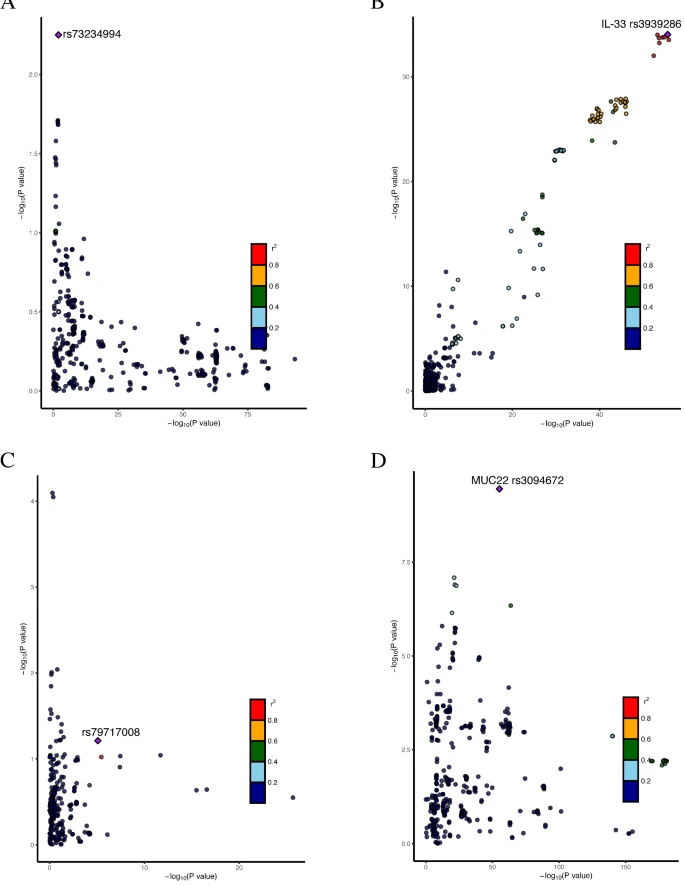
Colocalization analysis results for (A) AR,
(
B) asthma, (C) AD, (D) Psoriasis and CRS.
Chronic rhinosinusitis (CRS) is a prevalent inflammatory airway disease affecting over 10% of the global population, leading to considerable socio-economic impacts, especially in developing countries. The pathogenesis of CRS is multifactorial, involving potential contributions from both genetic and environmental factors. While the influence of allergic and autoimmune diseases on CRS has been observed, the causal relationships between these diseases and CRS remain unclear. We extracted data from large-scale genome-wide association studies (GWAS) and utilized a bidirectional two-sample Mendelian randomization (MR) analysis to explore the causal relationships between CRS and ten autoimmune and allergic diseases, including asthma, allergic rhinitis (AR), atopic dermatitis (AD), psoriasis, type 1 diabetes (T1D), hypothyroidism, celiac disease (CeD), multiple sclerosis (MS), rheumatoid arthritis (RA), and systemic lupus erythematosus (SLE). Additionally, we conducted colocalization analysis to determine whether the allergic/autoimmune diseases showing statistical causal relationships with CRS are driven by the same genetic variants.

October 26, 2024

Long-term waning of vaccine-induced immunity to measles in England: a mathematical modelling study

Robert, Alexis et al. The Lancet Public Health, Volume 9, Issue 10, e766 - e775

Summary

Background
Among people infected with measles in England between 2010 and 2019, the proportion of cases who had previously received two doses of vaccine has increased, especially among young adults. Possible explanations include rare infections in vaccinated individuals who did not gain immunity upon vaccination, made more common because fewer individuals in the population were born in the endemic era, before vaccination was introduced, and exposed as part of endemic transmission, or the waning of vaccine-induced immunity, which would present new challenges for measles control in near-elimination settings.

October 25, 2024

Assessing Disease Control in Patients with Atopic Dermatitis by Using the Atopic Dermatitis Control Tool in Daily Practice

Rui Chen, Laura Loman, Lian F. van der Gang, Manon M. Sloot, Marjolein S. de Bruin-Weller, Marie L.A. Schuttelaar; Dermatology 2024; https://doi.org/10.1159/000541466

ABSTRACT

INTRODUCTION: Atopic dermatitis (AD) is a chronic inflammatory skin disease, placing a significant burden on patients' quality of life (QoL). The validated Atopic Dermatitis Control Tool (ADCT) is recommended to assess AD control in adults. The aim of this study was to assess AD control and explore associations with demographic characteristics, patient-reported outcome measures (PROMs), and treatment.

METHODS: In this cross-sectional study, questionnaires were sent to 2,066 adults from two tertiary referral centers who had previously physician-diagnosed AD and had visited the outpatient clinic at least once between 2020 and 2022. Questionnaires were completed between May and October 2022. AD control was assessed by the ADCT, with a score ≥7 indicating uncontrolled AD. AD severity, QoL, and weekly average pruritus were simultaneously measured using the Patient-Oriented Eczema Measure (POEM), Dermatology Life Quality Index (DLQI), and numeric rating scale (NRS), respectively, with higher scores indicating more severe symptoms.

Higher maternal bread and thiamine intakes are associated with increased infant allergic disease

Pretorius RA, McKinnon E, Palmer DJ. Pediatr Allergy Immunol. 2024; 35:e14237. doi:10.1111/pai.14237

Abstract

Background

A mother's diet during pregnancy may influence her infant's immune development. However, as potential interactions between components of our dietary intakes can make any nutritional analysis complex, here we took a multi-component dietary analysis approach.

Methods

Nutritional intake data was collected from 639 pregnant women using a validated semi-quantitative food frequency questionnaire to reflect their dietary intakes during 32–36 weeks of gestation. To investigate their dietary intake pattern, we calculated Dietary Inflammatory Index scores. Maternal consumption of 12 food groups, 20 individual whole foods, and 18 specific nutrient intakes, along with any vitamin and mineral supplementation, were determined. Infant outcomes included eczema, allergen sensitization, and IgE-mediated food allergy. Regression-based analyses with covariates adjustment were applied.

Results

The multi-component dietary analysis approach is illustrated
along with the main consistent study findings that higher maternal
intakes of thiamine (vitamin B1), and thiamine-fortified bread
and thiamine-rich legumes were associated with increased
risk of child eczema and food allergy.
Women with higher white bread consumption were more likely to have an infant with doctor-diagnosed eczema (adjusted relative risk [aRR] 1.16; 95% CI 1.08, 1.24; p < .001) and IgE-mediated food allergy (aRR 1.14; 95% CI 1.02, 1.28; p = .02). Higher maternal intakes of fiber-rich bread (aRR 1.14; 95% CI 1.04, 1.25; p = .01) and legumes (aRR 1.11; 95% CI 1.02, 1.21; p = .02) were also associated with infant doctor-diagnosed eczema.

October 23, 2024

Adrenaline Auto-Injectors for Preventing Fatal Anaphylaxis

Sim, M., Sharma, V., Li, K., Gowland, M., Garcez, T., Shilladay, C., Pumphrey, R., Patel, N., Turner, P. and Boyle, R. (2024), Clin Exp Allergy. https://doi.org/10.1111/cea.14565

ABSTRACT

Anaphylaxis affects up to 5% of people during their lifetime. Although anaphylaxis usually resolves without long-term physical consequences, it can result in anxiety and quality of life impairment. Rarely and unpredictably, community anaphylaxis can cause rapid physiological decompensation and death. Adrenaline (epinephrine) is the cornerstone of anaphylaxis treatment, and provision of adrenaline autoinjectors (AAI) has become a standard of care for people at risk of anaphylaxis in the community. In this article, we explore the effectiveness of AAIs for preventing fatal outcomes in anaphylaxis, using information drawn from animal and human in vivo studies and epidemiology. We find that data support the effectiveness of intravenous adrenaline infusions for reversing physiological features of anaphylaxis, typically at doses from 0.05 to 0.5 μg/kg/min for 1–2 h, or ~ 10 μg/kg total dose. Intramuscular injection of doses approximating 10 μg/kg in humans can result in similar peak plasma adrenaline levels to intravenous infusions, at 100–500 pg/mL.

CD169+ Macrophages Mediate the Immune Response of Allergic Rhinitis Through the Keap1/Nrf2/HO-1 Axis

W. Qi, C. Liu, L. Shi, H. Li, X. Hou, H. Du, L. Chen, X. Gao, X. Cao, N. Guo, Y. Dong, C. Li, F. Yuan, Z. Teng, H. Hu, F. Zhu, X. Zhou, L. Guo, M. Zhao, M. Xia. Adv. Sci. 2024, 2309331. https://doi.org/10.1002/advs.202309331


Abstract

Immunofluorescence and flow cytometry were used
to detect the expression of CD169+ macrophages
in the spleen, lymph nodes, and nasal lavage fluid
of mice.
CD169+ macrophages are a newly defined macrophage subpopulation that can recognize and bind with other cells through related ligands, playing an essential role in antigen presentation and immune tolerance. However, its role in Allergic Rhinitis (AR) is still unclear. To investigate the characteristics of CD169+ macrophages in AR, this work first detects their expression patterns in the nasal mucosa of clinical patients. These results show a significant increase in CD169+ macrophages in the nasal mucosa of patients with AR. Subsequently, this work establishes an animal AR model using CD169 transgenic mice and compared the advantages of the two models. Moreover, this work also demonstrates the effects of CD169 knockout on eosinophils, Th cells, Treg cells, and the migration of dendritic cells (DCs).