December 16, 2024

Double-blind, placebo-controlled trial of the efficacy and safety of azelastine hydrochloride in children with perennial allergic rhinitis

Jean Bousquet, Ludger Klimek, Hans-Christian Kuhl, Duc Tung Nguyen, Rajesh Kumar Ramalingam, G. Walter Canonica, William Berger;  Int Arch Allergy Immunol 2024; https://doi.org/10.1159/000542054

Abstract

Background: Allergic rhinitis (AR) affects up to 40% of the pediatric population. The US practice parameter recommends the use of INAH or INCS as first-line therapy for the treatment of AR. Although not directly targeted to children, the recent US Practice Parameters proposed intranasal antihistamines as first-line therapy whereas the ARIA guidelines did not. Methods: This was a randomized, double-blind, parallel-group study with a duration of 28 days. It compared Azelastine hydrochloride 0.10% and 0.15% to placebo of one spray per nostril twice daily in pediatric subjects with moderate-to-severe symptomatic perennial allergic rhinitis (PAR).

Results: A total of 486 subjects were included in the study. The change from baseline rTNSS was statistically significant for 0.15% AZE (P = .005) and 0.10% AZE (P = .015) vs. placebo.

Efficacy and Safety of Montelukast+Levocetirizine Combination Therapy Compared to Montelukast Monotherapy for Allergic Rhinitis in Children

Kim CK, Hwang Y, Song DJ, Yu J, Sohn MH, Park YM, Lim DH, Ahn K, Rha YH. Allergy Asthma Immunol Res. 2024 Nov;16(6):652-667. https://doi.org/10.4168/aair.2024.16.6.652

Abstract

Purpose

The combination therapy of leukotriene receptor antagonists and antihistamines may alleviate allergic rhinitis (AR) symptoms better than monotherapy. This study aimed to investigate the safety and efficacy of Monterizine®, a fixed-dose combination of montelukast and levocetirizine, compared to montelukast monotherapy in pediatric patients with AR.

Methods

One hundred seventy-six children aged 6 to 14 years with perennial AR symptoms were recruited. One hundred forty-seven subjects were randomized into 1 of 2 groups: the mont+levo group (fixed-dose combination of montelukast [5 mg] + levocetirizine [5 mg]) or the mont group (montelukast single agent [5 mg]).

December 12, 2024

When patient-reported respiratory symptoms shed light on pathophysiology in adult asthma: a cross-sectional study

Louis G, Pétré B, Sousa-Pinto B, Bousquet J, Van Ganse É, Schleich F, Louis R.  Sci Rep. 2024 Dec 2;14(1):29997. doi: 10.1038/s41598-024-81745-9.

Abstract

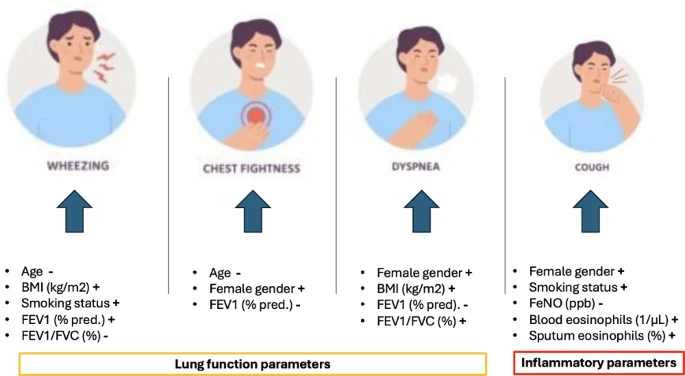
Schematic representation of the relationship between demographics,
functional, inflammatory features and asthma symptoms.
+Corresponds to a positive association,
while −corresponds to a negative association.
While studies have demonstrated the impact of asthma symptoms on quality of life, very few studies have investigated the relationship between detailed asthma symptoms, as reported by the patient, and lung function and inflammation. A cross-sectional study was conducted on treated (ICS/LABA) adult (> 18 years) asthma patients recruited from the Liege University Hospital Asthma Clinic (Belgium) between 2018 and 2023 (n = 505). The intensity of asthma symptoms (dyspnea, wheezing, chest tightness, cough, and airway secretion) was measured using five-point Likert scales (5 expressing the greatest intensity).

December 11, 2024

Successful Introduction of Peanut in Sensitized Infants With Reported Reactions at Home

Verhoeven DHJ, Benjamin-van Aalst O, Klok T, de Weger WW, Breukels M, Hendriks T, Gerth van Wijk R, de Groot H.  J Allergy Clin Immunol Pract. 2024 Dec;12(12):3363-3369. doi: 10.1016/j.jaip.2024.08.047. 

Abstract

Background and objective

Previous studies have shown efficacy of early introduction of peanut to prevent peanut allergy. It is currently unknown which diagnostic pathway is optimal after parental-reported reactions to peanut at home after early introduction.

Methods

The PeanutNL cohort study included high-risk infants who were referred for early introduction of peanut. A subgroup of 186 infants with reactions to peanut at home underwent peanut skin prick tests and a supervised open oral food challenge (OFC) at a median age of 8 months. After a negative OFC, peanut was introduced at home.

Results

Evaluating peanut allergy and reintroduction of peanut in infants
with reactions to peanut at first introduction.
Sensitization to peanut was detected in 69% of 186 infants, of whom 80% had >4 mm wheals in skin prick tests. An OFC with a cumulative dose of 4.4 g of peanut protein was performed in 163 infants with Sampson severity score grade I-III reactions at home; 120 challenges were negative. Peanut was subsequently introduced at home in infants with a negative challenge outcome.

Psychological Stress and Urticaria: Pathophysiologic and Therapeutic Updates

Xiang, YK., Türk, M., Ojeda, I.C. et al. Curr Treat Options Allergy 11, 194–210 (2024). https://doi.org/10.1007/s40521-024-00375-8

Abstract

Purpose of review

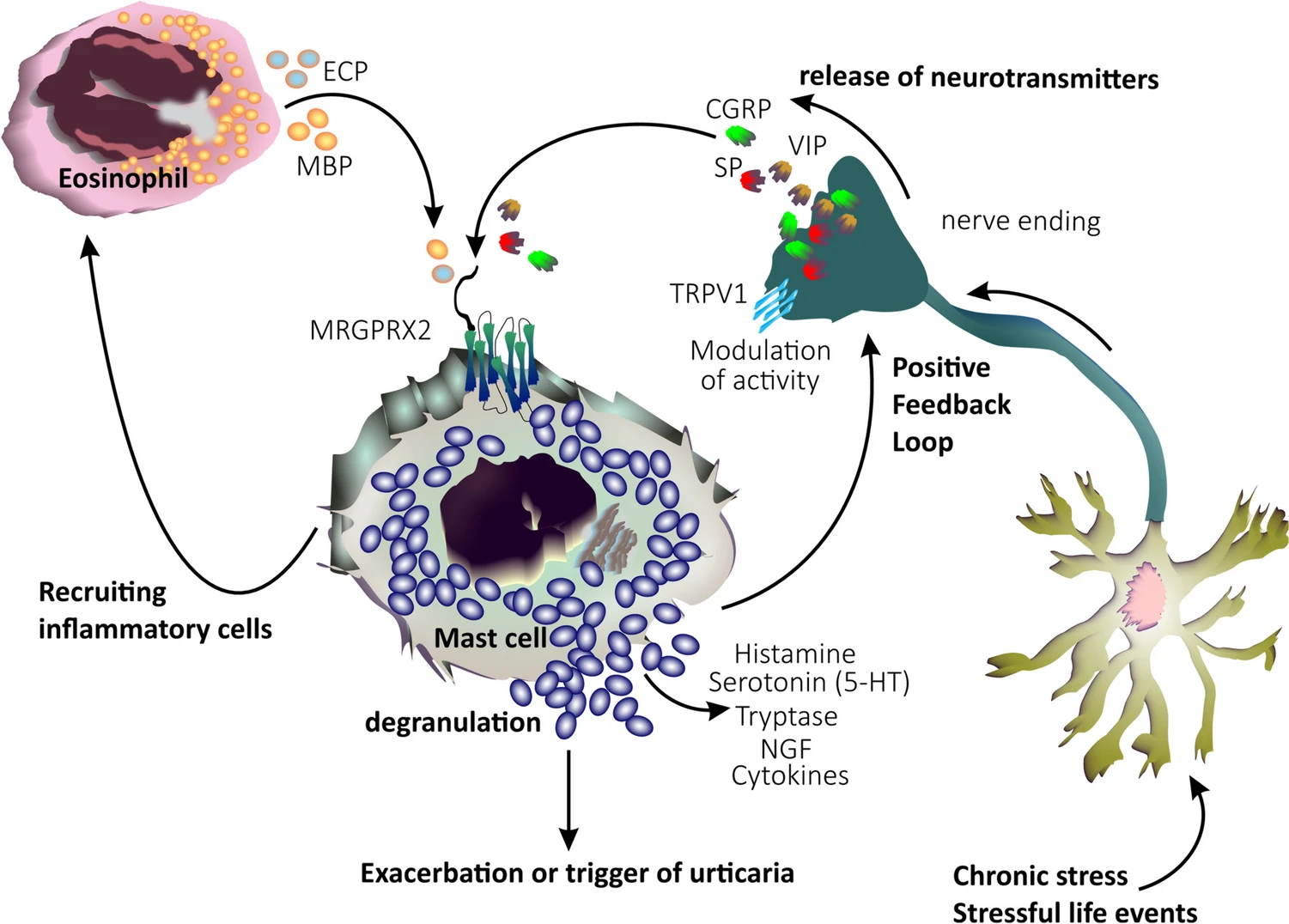
The goal of this review is to examine the relationship between psychological stress and chronic urticaria (CU), focusing on the underlying mechanisms and potential therapeutic interventions. The paper seeks to answer how stress exacerbates CU and the neuro-immunological pathways involved, providing insight into improving therapeutic strategies by considering the psychological dimensions of the disease.

Recent findings

Recent studies highlight the significant role of stress in aggravating CU through the dysregulation of the hypothalamic-pituitary-adrenal axis and neurogenic inflammation. Increased levels of neuropeptides like substance P and calcitonin gene-related peptide, as well as upregulated expression of the MRGPRX2 receptor, are implicated in the neuro-immune interactions that worsen CU symptoms.

December 10, 2024

OM-85 attenuates high-fat diet-induced obesity, insulin resistance, gut dysbiosis and nonalcoholic steatohepatitis in a murine model

Hewady S, Manuel CR, Pasquali C, Koya J, Reznik SE. Biomed Pharmacother. 2024 Dec 2;181:117710. doi: 10.1016/j.biopha.2024.117710.

Highlights

• OM-85 prevents obesity and insulin resistance in high-fat diet mice.

• OM-85 alters the intestinal microbiome and prevents gut dysbiosis.

• OM-85 attenuates non-alcoholic steatohepatitis.

• Immune modulators should be explored for their therapeutic effects on metabolism.

Graphical Abstract
Abstract

Background

Obesity is a global epidemic that is tied to a wide range of human disorders. Chronic consumption of a high-fat diet is linked to disruption of the intestinal microbiome, which drives obesity-related pathophysiology. Broncho-Vaxom® (OM-85), a bacterial lysate used for prophylaxis of recurrent respiratory tract infections, has both immunostimulatory and immunomodulatory functions.

Methods

Male C57Bl/6 mice were maintained on normal control vs. high-fat diets for 8 weeks and treated or untreated with OM-85 or with the probiotic Lactobacillus plantarum,

December 9, 2024

Perceptions of the impact of individual allergic rhinitis symptoms: A survey of ARIA clinical experts

Gil-Mata, SaraAsllani, Julijana et al.

Abstract

Background
Allergic rhinitis (AR) is a highly prevalent disease. We aimed to assess the symptoms that physicians who see patients with AR perceive as the most bothersome in their patients.

Methods
We performed a cross-sectional study based on an online questionnaire sent to all members of the Allergic Rhinitis and its Impact on Asthma (ARIA) initiative. The survey included questions on the physicians' perceptions of patients’ AR symptoms as well as of their own AR symptoms.

Results
Most frequent (A) and most bothersome (B and C) allergic rhinitis
symptoms perceived in patients by ARIA members
and reported by ARIA members.
Among 401 respondents, 155 (38.7%) reported having AR. ARIA members reported nasal symptoms to be the most frequent (89.7%) and bothersome (80.0%) symptoms experienced by themselves. Likewise, nasal symptoms were reported by ARIA members as the most frequent (94.8% in members with AR vs 96.0% in members without AR) and bothersome (57.0% in members with AR vs 67.9% in members without AR) in their patients.

December 7, 2024

Allergen-Specific Immunotherapy and Trained Immunity

Martín-Cruz, L. and Palomares, O. (2024). Allergy. https://doi.org/10.1111/all.16423

ABSTRACT

The high prevalence of allergic diseases reached over the last years is attributed to the complex interplay of genetic factors, lifestyle changes, and environmental exposome. Allergen-specific immunotherapy (AIT) is the single therapeutic strategy for allergic diseases with the potential capacity to modify the course of the disease. Our knowledge of the mechanisms involved in allergy and successful AIT has significantly improved. Recent findings indicate that long-term allergen tolerance upon AIT discontinuation not only relies on the generation of proper adaptive immune responses by the generation of allergen-specific regulatory T and B cells enabling the induction of different isotypes of blocking antibodies but also relies on the restoration of proper innate immune responses.

Mechanisms underlying trained immunity (TRIM).
Trained immunity (TRIM) is the process by which innate immune cells acquire memory by mechanisms depending on metabolic and epigenetic reprogramming, thus conferring the host with increased broad protection against infection.