February 4, 2025

Assessment of the underreporting of rhinitis in patients with asthma: A MASK-air® real-world study


Sousa-Pinto B, Louis G, Vieira RJ et al. Pulmonology. 2025 Dec 31;31(1):2419216. doi: 10.1080/25310429.2024.2419216.


Abstract

Rhinitis control in the three clusters of patients with
self-reported asthma and no reported rhinitis.
Rhinitis is a common comorbidity in patients with asthma. However, the frequency of underreported rhinitis in asthma is not known. In this study, we aimed to assess the characteristics of patients with self-reported asthma and no self-reported rhinitis, as well as the extent of the underreporting of rhinitis. We performed a cross-sectional study of all MASK-airⓇ users (2015-2022, 27 countries), comparing reported symptoms and medication use in patients with (i) self-reported asthma without rhinitis ("asthma alone"), (ii) self-reported rhinitis+asthma and (iii) self-reported rhinitis without asthma ("rhinitis alone").

January 30, 2025

Roads to remission: evolving treatment concepts in type 2 inflammatory diseases

Lommatzsch M, Blumchen K, Beck LA, Bousquet J, Brusselle GG, Fokkens WJ, Hamelmann E, Lau S, Ott H, Pfaar O, Sampson HA, Smolen JS, Taube C, Tarner IH, Wagenmann M, Werfel T, Worm M, Renz H. EClinicalMedicine. 2025 Jan 8;80:103050. doi: 10.1016/j.eclinm.2024.103050.

Summary

Biomarkers and anti-inflammatory strategies in type 2 diseases.
Non-communicable diseases (NCDs) characterised by type 2 inflammation, including asthma, allergic rhinitis, chronic rhinosinusitis with nasal polyps, atopic dermatitis, food allergies and eosinophilic esophagitis, are increasing in prevalence worldwide. Currently, there is a major paradigm shift in the management of these diseases, towards the concept of disease modification and the treatment goal remission, regardless of severity and age.

January 29, 2025

Technical validation of controlled exposure to cat dander in the specialized particulate control environmental exposure unit (SPaC-EEU)

Hossenbaccus, L., Walker, T. & Ellis, A.K. Allergy Asthma Clin Immunol 21, 6 (2025). https://doi.org/10.1186/s13223-024-00928-1


To the Editor,


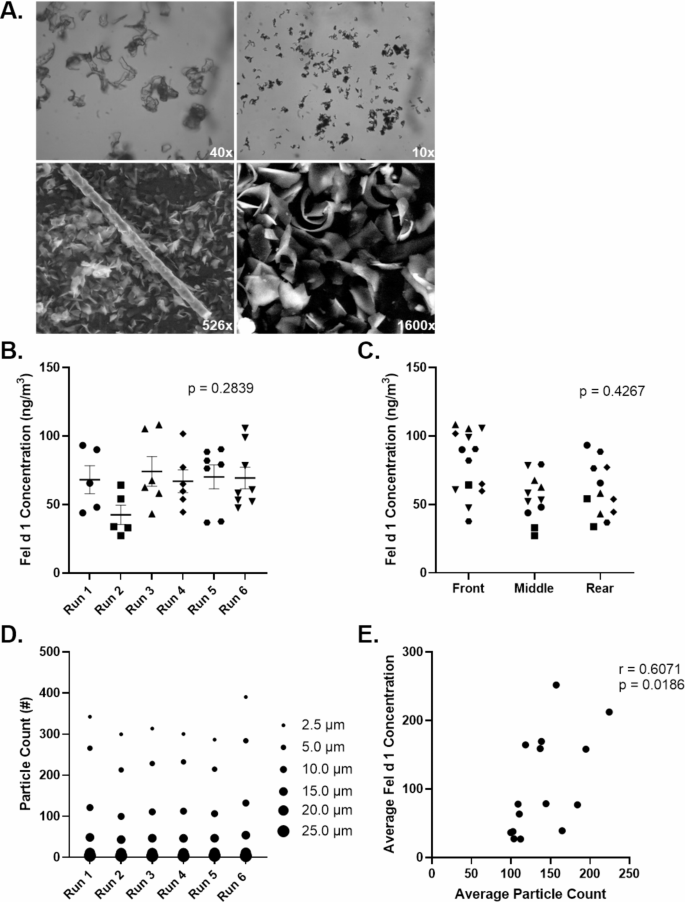
Consistent Fel d 1 concentrations and particle counts
were observed across runs in the Specialized Particulate
ControlEnvironmental Exposure Unit.
The Environmental Exposure Unit (EEU) is a 3500 square feet controlled allergen exposure facility located at the Kingston General Hospital site of Kingston Health Science Centre –in Kingston, Canada, which has been operating in this location since 1995. It is an internationally recognized model of prolonged allergen exposure, that can seat up to 120 participants at one time, with control of variables such as temperature, humidity, air flow, CO2 levels, and allergen type and concentration [1, 2]. The EEU is used to study mechanisms of, and treatments for allergic rhinitis (AR) and has been employed extensively with ragweed, grass, and birch pollens [3,4,5,6].

For the study of perennial allergens, the Specialized Particulate Control Environmental Exposure Unit (SPaC-EEU; formerly known as the house dust mite (HDM)-EEU) has been established.

January 26, 2025

Connecting electronic health records to a biomedical knowledge graph to link clinical phenotypes and molecular endotypes in atopic dermatitis

Frau, F., Loustalot, P., Törnqvist, M. et al. Sci Rep 15, 3082 (2025). https://doi.org/10.1038/s41598-024-78794-5

Abstract

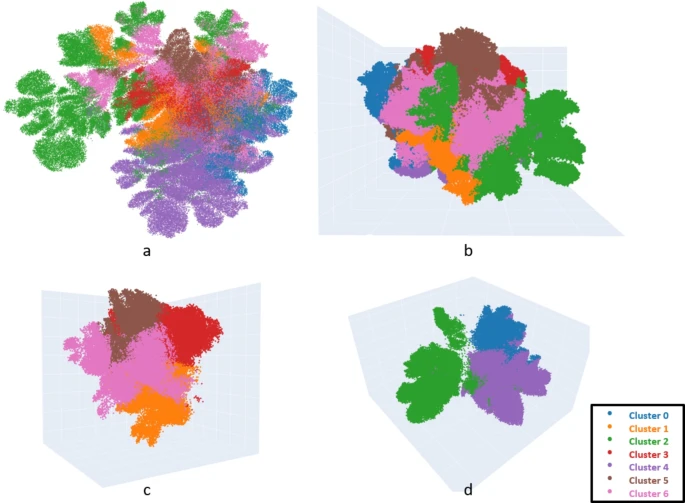
UMAP projections in two dimensions (a) and three dimensions
(
bcd)of all clusters of AD patients
Precision medicine is defined by the U.S. Food & Drug Administration as “an innovative approach to tailoring disease prevention and treatment that considers differences in people’s genes, environments, and lifestyles”. To succeed in providing personalized medicine to patients, it will be necessary to integrate medical, biological and molecular data in order to identify all complex disease subtypes and understand their pathobiological mechanism. Since biomedical knowledge graphs (BKGs) are limited to the integration of prior knowledge data and do not integrate real-world data (RWD) that would allow for the incorporation of patient level information, we propose a first step towards using RWD, BKGs and graph machine learning (ML) to enable a fully integrated precision medicine strategy.

January 25, 2025

Allergic Rhinitis and its Impact on Asthma (ARIA) Classes in MASK-air Users

Sousa-Pinto B, Savouré M, Vieira RJ et al. J Investig Allergol Clin Immunol. 2025 Jan 23:0. doi: 10.18176/jiaci.1047.

Abstract

Background and objectives: The Allergic Rhinitis and its Impact on Asthma (ARIA) guidelines classify rhinitis as "intermittent" or "persistent" and "mild" or "moderate-severe". To assess ARIA classes in a real-world study in terms of phenotypic differences and their association with asthma.

Methods: We performed a cross-sectional real-world study based on users of the MASK-air® app who reported data for at least 3 different months. We assessed the frequency of users according to the ARIA classes and compared these classes in terms of rhinitis symptoms, use of comedication, frequency of comorbid asthma, and the association between comorbid asthma and rhinitis control.

Maximum (A) and median (B) values of rhinitis visual analog
scales (VAS)in patients with no evidence of asthma (R)
and in patients withprobable asthma(R+A) across the different 
Allergic Rhinitis and its Impact on Asthma (ARIA) clases
Results:
A total of 2273 users (180 796 days) were assessed. Most users had moderate-severe rhinitis (n=2003; 88.1%) and persistent rhinitis (n=1144; 50.3%). The frequency of patients with probable asthma was 35.7% (95%CI, 34.5%-37.0%) for intermittent rhinitis and 48.5% (95%CI, 47.1%-49.9%) for persistent rhinitis.

Dupilumab and House Dust Mite Immunotherapy in Patients with Atopic Dermatitis: A Preliminary Study

Bogacz-Piaseczyńska A, Bożek A, Krupka-Olek M, Kawczyk-Krupka A, Zalejska-Fiolka J, Canonica GW.  Vaccines (Basel). 2024 Sep 13;12(9):1046. doi: 10.3390/vaccines12091046. 

Abstract

Background: Severe atopic dermatitis (AD) is a complex disease requiring systemic treatment. This study aimed to assess the effectiveness of combined therapy consisting of dupilumab and sublingual dust mite allergen immunotherapy (SLIT-HDM) in patients with severe AD and HDM allergies. Methods: Patients diagnosed with severe AD were included in this randomised, placebo-controlled, double-blind 12-month trial; they received SLIT for HDMs and/or dupilumab for 12 months and were compared with patients on cyclosporine.
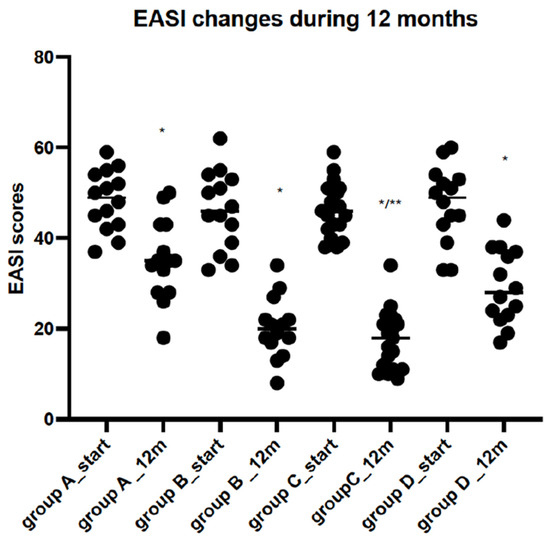
EASI score changes before and after 12 months of observation.
The primary outcomes for the treatment arms were changes in the Eczema Area and Severity Index (EASI), body surface area (%BSA), and Investigator Global Assessment (IsGA) over 12 months.

January 24, 2025

Chronic rhinosinusitis with nasal polyps: key considerations in the multidisciplinary team approach

Pfaar O, Peters AT, Taillé C, et al. Clin Transl Allergy. 2025;e70010. https://doi.org/10.1002/clt2.70010

Abstract

Background

Chronic rhinosinusitis with nasal polyps (CRSwNP) is a recurrent inflammatory disease associated with several comorbidities and a significant disease burden for patients. Treatments include corticosteroids and sinonasal surgery, but these can be associated with the risk of adverse events and nasal polyp recurrence. Biologic treatments such as mepolizumab can be used as an add-on treatment and are effective at reducing surgery and corticosteroid use.

Main text

Patient scenarios illustrating where the MDT approach
may be applied for patients with CRSwNP
and comorbid severe asthma
Patients with CRSwNP may be seen by a specialist in one of several different areas and often experience delayed diagnosis due to the need to see multiple physicians, as well as misdiagnosis resulting from lack of sufficient expertise within any one speciality.

January 23, 2025

Drug allergy

Jeimy, S., Wong, T., Ben-Shoshan, M. et al. Allergy Asthma Clin Immunol 20 (Suppl 3), 78 (2024). https://doi.org/10.1186/s13223-024-00936-1


Abstract

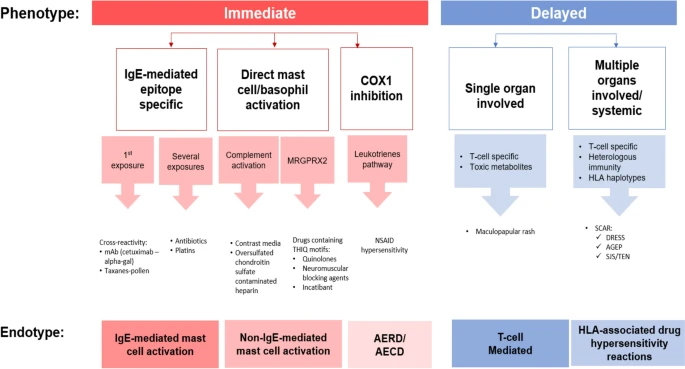
Drug allergy classification based on phenotypes and endotypes
Drug allergy encompasses a spectrum of immunologically-mediated hypersensitivity reactions (HSRs) with varying mechanisms and clinical presentations. This type of adverse drug reaction (ADR) not only affects patient quality of life, but may also lead to delayed treatment, unnecessary investigations, and increased morbidity and mortality. Given the spectrum of symptoms associated with the condition, diagnosis can be challenging. Therefore, referral to an allergist experienced in the diagnosis and management of drug allergy is recommended if a drug-induced allergic reaction is suspected. Diagnosis relies on a careful history and physical examination and, in some instances, skin testing or in vitro testing and drug challenges.