July 22, 2025

Is there a role of genetics in acute and chronic urticaria—A systematic review and meta-analysis

Konstantinou GNPodder IDhabal A Clin Transl Allergy2025;e70072. https://doi.org/10.1002/clt2.70072

Abstract

Background

Chronic urticaria (CU) is a heterogeneous skin disorder whose genetic drivers are incompletely defined

Objective

To systematically review and meta-analyse genetic and epigenetic factors that influence susceptibility and treatment response in acute and CU.

Methods

Following Preferred Reporting Items for Systematic Reviews and Meta-Analyses guidelines, PubMed, Scopus and Web of Science were searched from inception to 31 July 2024. Original human studies reporting genetic or epigenetic associations with any urticaria subtype were eligible. Random-effects meta-analyses were undertaken when at least three comparable datasets were available.

Results

Forest plot summarizing the association between HLA-B44 and chronic urticaria.
Sixty-one studies met the inclusion criteria. Associations were confirmed for HLA-B44 (pooled Odds Ratio 8.15, 95% Confidence Interval 1.61–41.29; I2 = 86%) and vitamin-D-receptor polymorphisms FokI, TaqI and BsmI, each conferring a 1.5- to 2.1-fold increased risk.

July 21, 2025

Impact of Nasal and Inhaled Corticosteroids on SARS-CoV-2 Infection Susceptibility

Rosas-Salazar, Christian et al. Journal of Allergy and Clinical Immunology, Volume 0, Issue 0

Abstract

Background

It is unknown whether nasal (NCS) or inhaled corticosteroid (ICS) use impacts the susceptibility to SARS-CoV-2 infection.

Objectives

To examine the associations of NCS and ICS use with the risk of SARS-CoV-2 infection among individuals with allergic rhinitis or asthma.

Methods

This is a prospective, multicenter, SARS-CoV-2 surveillance study of households with children. Nasal swabs were obtained from participants every two weeks with additional collections based on COVID-19-related symptoms. In our primary adjusted models, we examined the association of NCS or ICS use at study entry (in participants with allergic rhinitis or asthma, respectively) with the time to the first SARS-CoV-2 positive quantitative PCR testing using Cox proportional hazard regression.

Results

Effect modification of age on the association of
using topical airway corticosteroids (nasal [NCS]
and inhaled [ICS] corticosteroids) with the risk
of SARS-CoV-2 infection.
 

There were 2,211 participants in 1,113 households included. The associations of NCS and ICS use with the risk of SARS-CoV-2 infection were modified by age (p for both interactions<0.05). NCS and ICS use were individually associated with higher risks of SARS-CoV-2 infection among adults (adjusted hazard ratio [aHR]=1.88, 95% CI=1.14-3.12, p=0.01, and aHR=2.15, 95% CI=1.003-4.63, p=0.049, respectively).

Drago®: An innovative mobile application to improve adherence and complience of house dust mite allergen immunotherapy

Luciana Kase Tanno , Pham Thao Van Luong, Éric Fromentin, Édouard Sève, Mickaël Poulequin , Hoai-Bich Trinh, Julien Cottet, Pascal Demoly. 

Journal of Allergy and Hypersensitivity Diseases Volume 6, April–June 2025, 100041

Highlights

• Allergen immunotherapy (AIT; allergen desensitization) is the only disease-modifying treatment for IgE allergies.

• Only 18 % patients complete the required 3-year treatment course.

• A novel app Drago® aims at tracking treatment adherence and burden of respiratory disease.

• The app empowers patients to self-monitor symptoms, share decisions with physicians and access education for AIT management.

• Drago® app in France boosts AIT use via education, tracking, and gamified adherence, modeling e-health in clinical care.

Abstract

Background

House dust mite (HDM) allergens constitute the most frequent cause of persistent allergic rhinitis and asthma. Allergen immunotherapy (AIT) is the only disease-modifying treatment for patients suffering from IgE-mediated allergic conditions. The Drago® application is a free application to optimize the use of AIT through education modules, timing track and implementation of adherence based on games and avatar evolution.

Methods

Graphical Abstract
Consecutive patients were offered to voluntarily use the application simultaneously to their AIT. We evaluated data related to patients’ adherence to HDM AIT over 3 years. Data generated were anonymized and stored following the French regulations. Compliance referred to the ratio of the number of doses taken by the patient to the duration of APP use by the patient, expressed as a percentage.

July 18, 2025

At-Home Evaluation of Both Wearable and Touchless Digital Health Technologies for Measuring Nocturnal Scratching in Atopic Dermatitis: Analytical Validation Study

Avey S, Morris M, Sargsyan D, Lucas MV, O'Brisky A, Mosca K, Elias A, Fountoulakis N, Boukhechba M, Kok XH, Jain S, Oghbaie M, Manyakov NV, Wang M, Aguilar Z, Yieh L. J Med Internet Res 2025;27:e72216 doi: 10.2196/72216

Abstract

Background:

The most common symptom of atopic dermatitis (AD) is pruritus, which is often exacerbated at night and leads to nocturnal scratching and sleep disturbance. The quantification of nocturnal scratching provides an objective measure, which could be used as a clinical trial endpoint tracking this AD-related behavior. However, it is not clear how digital health technologies (DHTs) intended to measure scratching perform in the real-world environment of patient homes.

Objective:

In this study, we present the analytical validation of 2 DHTs: the GENEActiv wristband with Philips sleep and scratch algorithms (“Philips”) and the Emerald radio frequency touchless sensor (“Emerald”) to measure nocturnal scratching in adults with AD.

Methods:

Study design.
Thirty-one participants (15 with moderate AD, 11 with mild AD, and 5 healthy volunteers) were enrolled in the study. Nocturnal scratching was assessed by each DHT in the study participant’s home environment over a 4-week observation period. Infrared videos were recorded during sleep twice per week and manually annotated for the intended sleep window (total sleep opportunity [TSO]) and scratching events.

Comparative Efficacy of Montelukast–Levocetirizine Combination Therapy Versus Monotherapy in Allergic Rhinitis: A Systematic Review and Meta-analysis

Ji-Sun Kim, Gulnaz Stybayeva, Se Hwan Hwang; Int Arch Allergy Immunol 2025; https://doi.org/10.1159/000547410

Abstract

Introduction:
Combination therapy with antihistamines and leukotriene receptor antagonists (LTRAs) is frequently used in allergic rhinitis (AR), particularly in patients with persistent or inadequately controlled symptoms. However, supporting evidence has been inconsistent. This meta-analysis assessed the efficacy of montelukast combined with levocetirizine in patients with allergic rhinitis by directly comparing the combination therapy with each monotherapy and evaluating individual symptom domains.

Methods: A systematic review and meta-analysis of randomized controlled trials (RCTs) was conducted, with database searches performed through March 2025. Outcomes included daytime and nighttime total symptom scores, individual nasal symptoms, rhinoconjunctivitis-related quality of life (RQLQ), and treatment-emergent adverse events (TEAEs). Pooled effects were calculated using standardized mean differences (SMDs) and odds ratios (ORs) with 95% confidence intervals (CIs).

July 17, 2025

Risk of anaphylaxis on commercial flights

Turner, Paul J. Current Opinion in Allergy and Clinical Immunology ():10.1097/ACI.0000000000001090, July 14, 2025. | DOI: 10.1097/ACI.0000000000001090

Abstract

Purpose of review 

Air travel has now returned to prepandemic levels, with over 10.5 billion passengers in 2024. Many of these passengers have food allergies, and there is a perception that allergic reactions are common during commercial flights.

Recent findings 

Estimated rates of food-induced allergic reactions
in people with known food allergy during
commercial flights
 
A recent systematic review and meta-analysis reported an incidence of in-flight medical events due to allergic reactions of 0.7 (95% CI 0.4–1.1) events per million passengers. For those with food allergies, the incidence of allergic reactions is around 10–100 times lower than that reported for reactions ‘on the ground’ – equivalent to one reaction per 3600 food-allergic passengers in any 1-year period. Reassuringly, there is no evidence that this rate had increased over the past 30 years, despite significant increases in both the prevalence of food allergy and passenger numbers.

Summary 

Allergic reactions during commercial flights are uncommon

July 16, 2025

Advances in Shellfish Allergy Therapy: From Current Approaches to Future Strategies

Heidari, S., Ruethers, T., Karnaneedi, S. et al. Clinic Rev Allerg Immunol 68, 65 (2025). https://doi.org/10.1007/s12016-025-09077-8

Abstract

Shellfish allergy, triggered by immune reactions to crustacean and mollusk proteins upon consumption/inhalation, is one of the most severe and persistent food allergies, affecting approximately 1%–3% of the general population worldwide. Shellfish is among the “big nine” food allergens responsible for over 90% of food allergy cases worldwide. Its diagnosis poses major challenges due to regional species diversity and a lack of reliable diagnostic tools. Management strategies generally emphasize strict avoidance and provision of emergency adrenaline autoinjectors; however, these approaches are inconvenient and insufficient for both patients and healthcare providers. Given the rising prevalence of shellfish allergy, there is an urgent need for targeted therapies that focus on key allergens, particularly tropomyosin—a major pan-allergen.

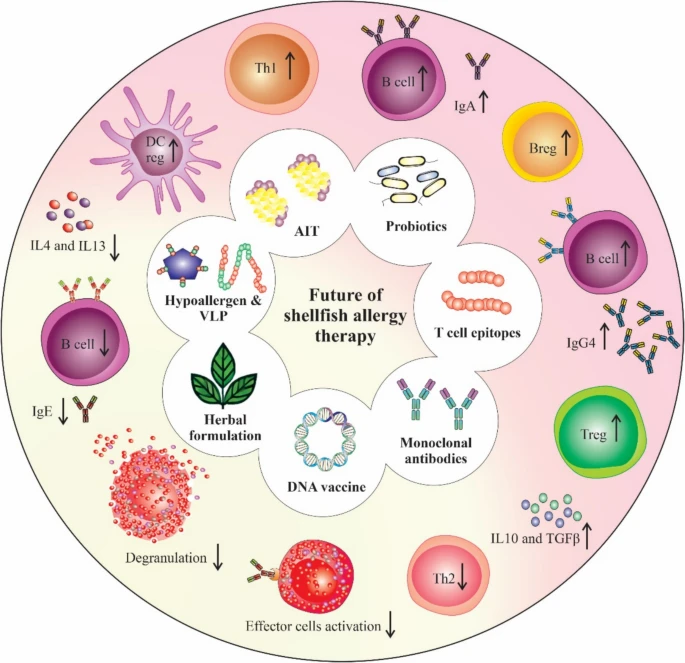
Future directions in shellfish allergy therapy.
As the primary target in current immunotherapy approaches, tropomyosin plays a central role in driving shellfish-induced immune responses.

July 14, 2025

Methotrexate and ciclosporin both reduce levels of circulating IL-4 and IL-13 expressing CD4+ memory T-cells in childhood atopic dermatitis

Anton Olsson, Kathryn Steel, Rachael Cooper, Ashley P Jones, Kaitlyn R Chan, Graham Ogg, Alan D Irvine, Carsten Flohr, Leonie S Taams, on behalf of the TREAT trial team, Clinical and Experimental Dermatology, 2025;, llaf301, https://doi.org/10.1093/ced/llaf301

Abstract

Atopic dermatitis (AD) is a chronic dermatosis characterised by type-2 inflammatory responses, skin barrier anomalies, and microbiome dysregulation. The variation of AD presentation necessitates a better understanding of the underlying disease mechanisms and the modulation of immune markers over a treatment course. Globally the most used systemic therapies for moderate-to-severe AD are methotrexate (MTX) and ciclosporin (CyA).

Gating strategy for identification and analysis of
cytokine-expressing CD4+ T 4 cells in peripheral blood
from TREAT participants.
The TReatment of severe Atopic Eczema in children Trial (TREAT) was a randomised controlled trial assessing the efficacy and safety of methotrexate and ciclosporin. Peripheral blood samples from n=18 TREAT participants were analysed in a longitudinal immunological study with a focus on cytokine-expressing CD4+ T-cells.