August 2, 2025

Urticaria Voices: Real-World Treatment Patterns and Outcomes in Chronic Spontaneous Urticaria.

Bernstein, J.A., Winders, T.A., McCarthy, J. et al.  Dermatol Ther (Heidelb) 15, 2201–2215 (2025). https://doi.org/10.1007/s13555-025-01461-8

Abstract

Introduction

Chronic spontaneous urticaria (CSU) is characterized by itchy wheals/hives and/or angioedema lasting longer than 6 weeks. Herein, we describe patients’ perspectives from the global Urticaria Voices study reporting treatment patterns, disease burden, treatment satisfaction, and expectations.

Methods

This global, cross-sectional online survey was conducted from February to September 2022 in patients with CSU. Eligible patients had a self-reported clinician-provided diagnosis of CSU. Data were analyzed descriptively and reported as percentages (n/N), means (standard deviation [SD]), or 95% confidence intervals.

Results
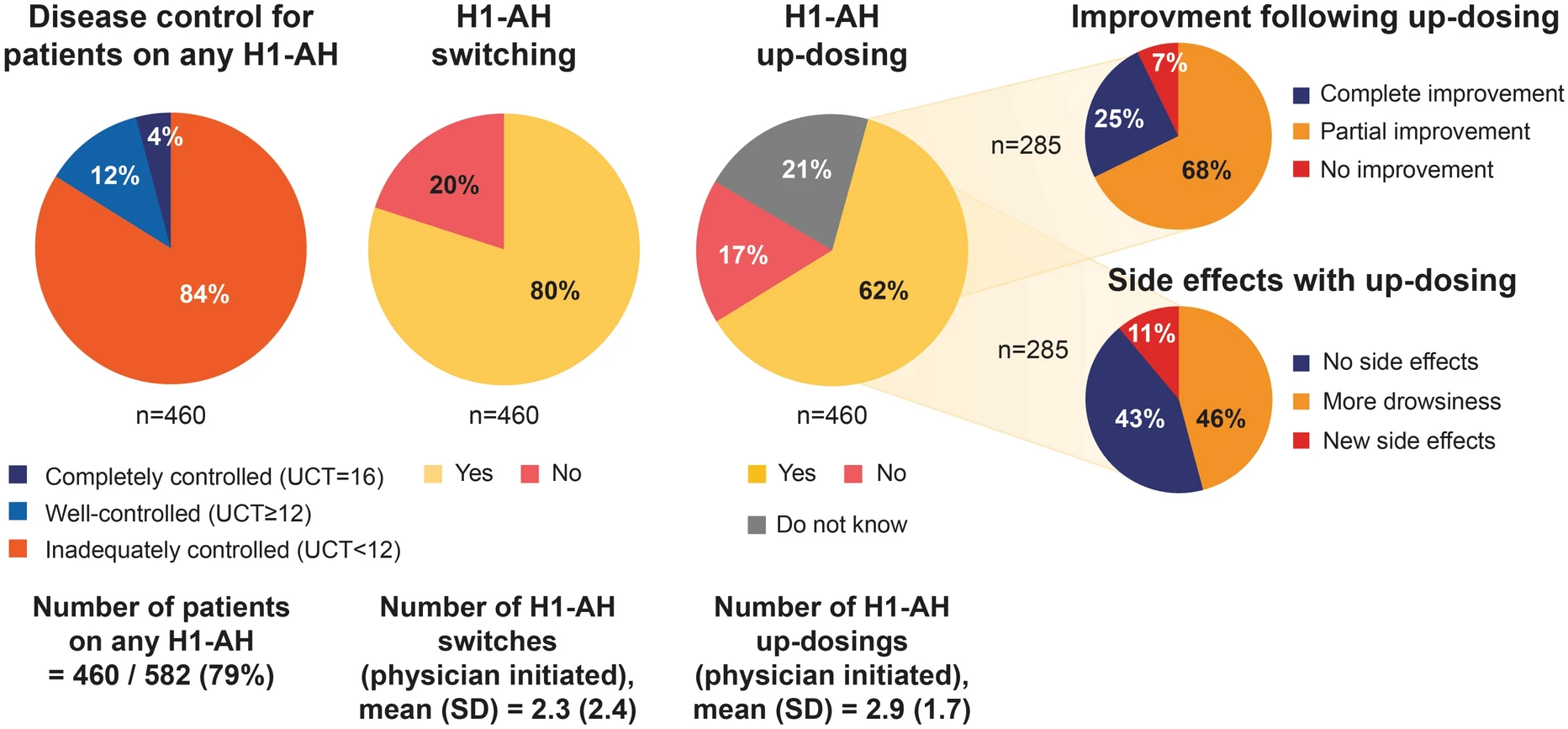
Patient-reported disease control with H1-antihistamines
Overall, 582 patients with CSU were included in this analysis (62% women; mean [SD] age: 42.0 [11.9] years). At the time of the survey, patients reported taking 2.9 (2.6) concomitant therapies; most patients (79%) were prescribed H1-antihistamines (H1-AH), of which 42% took first-generation H1-AH and 52% took second-generation H1-AH.

July 30, 2025

Perspectives in the Molecular Mechanisms Underlying Anaphylaxis

Esteban V, Skrabski F, Perales-Chorda C, Puente-Crespo Y, Muñoz-Cano R, Cardona V; Anaphylaxis Committee of the Spanish Society of Allergy and Immunology (SEAIC).                   J Investig Allergol Clin Immunol. 2025 Jul 29;35(4):251-266. doi: 10.18176/jiaci.1080.

Abstract

The complexity of anaphylaxis in terms of clinical features and etiology-pathogenesis makes it difficult to establish precise endotypes that correspond to specific phenotypes. Therefore, interest in unravelling the cellular and molecular mechanisms underlying anaphylactic reactions has grown.
A large group of anaphylactic reactions are characterized by the classical immunological mechanism of type I hypersensitivity, which leads to IgE-mediated activation of mast cells and basophils.

July 29, 2025

Hypersensitivity Reactions to Gadolinium-Based Contrast Agents: Update From an Allergist's Point of View

Losa F, Paoletti G, Costanzo G, et al.  Clin Transl Allergy. 2025;e70086. https://doi.org/10.1002/clt2.70086

ABSTRACT

Background

The increasing use of Magnetic Resonance Imaging (MRI) has led to a rise in the administration of gadolinium-based contrast agents (GBCAs), accompanied by a growing number of reported adverse events (AEs).

Objective

This review aims to provide an updated overview of hypersensitivity reactions (HSRs) to GBCAs, focusing on diagnostic and management strategies from an allergological perspective.

Cross-reactivity patterns in IgE- and T-cell-mediated hypersensitivity
reactions to gadolinium-based contrast agents (GBCAs).
Methods

We reviewed recent literature concerning the classification, clinical presentation, and pathophysiological mechanisms of HSRs to GBCAs. Particular attention was given to current recommendations for diagnosis, risk stratification, and prevention.

July 28, 2025

Exploring the impact of chronic urticaria profile as a key predictor of alexithymia: A cross-sectional study

Ojeda IC, Thomsen SF, Gimenez-Arnau AM et al. Clin Transl Allergy. 2025 Jul;15(7):e70075. doi: 10.1002/clt2.70075.

Abstract

Introduction

The relationship between chronic urticaria (CU) and alexithymia, a cognitive-affective impairment characterized by difficulty in identifying and expressing emotions, is complex and underexplored. This study aimed to identify predictors of alexithymia in CU patients by focusing on the impact of coexisting mental illnesses and antihistamine use.

Methods

An online survey was distributed to specialized allergy and dermatology centers from 2021 to 2022. The survey included the TAS-20, UAS-7, UCT, CU-Q2oL, and demographic information. Participants were 18–80 years old, diagnosed with CU, and had no prior diagnosis of alexithymia.

Tropomyosin-based cross-reactivity and asymptomatic shellfish sensitization in patients with perennial allergy

Hollstein MM, Schuppe MC, Hahn KK et al.  Front Allergy. 2025 Jun 27;6:1598583. doi: 10.3389/falgy.2025.1598583.

Abstract

Background: Mite, cockroach, and shellfish (crab, clam, and shrimp) proteins share allergenic epitopes. The determination of specific IgE (sIgE) against cockroach (Blattella germanica, relevant in asthma) and shellfish allergens (relevant in food allergy) using whole-body extracts necessitates detailed knowledge of IgE cross-reactivity.

Objective: This study aimed to evaluate whether cross-reactivity between aeroallergens and food allergens is clinically relevant and whether subjects with mite and/or cockroach sensitization are at risk of false-positive results in shellfish food allergy diagnostics.

Methods: In this cross-sectional, single-center study, we recruited 200 patients with elevated sIgE against ≥1 allergen at random from our outpatient clinic and assessed allergic comorbidity.

July 25, 2025

Current Insights Into Individualized Diagnosis and Treatment of Allergic Rhinitis Based on Phenotype and Endotype

Gu, Y., Shu, L.-L., Lu, T., Guan, D.-Y., Zheng, B.-W., Xiong, P.-H., Shen, Y. and Yang, Y.-C. (2025),  World Journal of Otorhinolaryngology - Head and Neck Surgery. https://doi.org/10.1002/wjo2.70035


ABSTRACT

Medications recommended based on endotype or phenotype
Allergic rhinitis (AR) is a chronic inflammatory disease of the nasal mucosa characterized by allergen sensitization and the involvement of multiple inflammatory mediators. Currently, the treatment of AR mainly includes symptomatic relief, anti-inflammatory therapy, and nerve desensitization.

July 24, 2025

Emollients to Prevent Pediatric Eczema: A Randomized Clinical Trial

Simpson ELMichaels LCRamsey K, et al. JAMA Dermatol. Published online July 23, 2025. doi:10.1001/jamadermatol.2025.2357

Key Points

Question  Does daily emollient application from age 9 weeks to 24 months help to prevent atopic dermatitis (AD) in a population unselected for risk?

Findings  In this randomized, pragmatic, decentralized clinical trial of 1247 infant-parent dyads, those who were assigned to the daily moisturizer group had a lower cumulative incidence of AD compared with the standard of care group.

Meanings  The trial results suggest that applying emollient daily for infants may be a feasible way to reduce the incidence of AD.

Abstract

 Emollients to Prevent Pediatric Eczema
Visual Abstract.

Importance  Atopic dermatitis (AD) imposes a global health burden for children and is a risk factor for developing food allergy and asthma. Few studies have evaluated emollient intervention for primary AD prevention in infants not selected for risk.

July 23, 2025

Neonatal BCG vaccination to prevent asthma: Results from the MIS BAIR randomized controlled trial

Pittet LF, Forbes EK, Donath S, et al. Pediatr Allergy Immunol. 2025; 36:e70110. doi:10.1111/pai.70110

Abstract

Background

Asthma has a significant impact worldwide, but prevention strategies remain limited. We aimed to evaluate the efficacy of neonatal BCG vaccination in preventing asthma by modulating early-life immunity.

Methods

The Melbourne Infant Study: BCG for Allergy and Infection Reduction (MIS BAIR) was a phase 3 multicentre randomized controlled trial in Victoria, Australia. Infants were randomly assigned to receive the BCG-Denmark vaccine or no intervention within 10 days of birth. The incidence of asthma at 5 years of age was estimated using the International Study of Asthma and Allergies in Childhood questions. ClinicalTrial.gov (NCT01906853).

Results

Difference in presence and severity of asthma between BCG and
control groups, assessed at 5 years of age. 
A total of 1272 infants were randomized. The adjusted incidence of asthma was 14.4% in the BCG group compared to 16.0% in the control group (adjusted risk difference [aRD] −1.7 percentage points; 95%CI −7.4, 3.9). Secondary outcomes, including severe asthma and use of preventer medication, showed similar trends, with an aRD of −3.9 (95%CI −7.7, 0.0), and −5.6 (95%CI −10.9, −0.4), respectively, favoring the BCG group.