September 1, 2025

Early-life allergic sensitization and respiratory infection—Two hits on lung function?

Wadhwa V, Dharmage SC, Wurzel D, et al. Pediatr Allergy Immunol. 2025; 36:e70115. doi:10.1111/pai.70115

Abstract

Background

Allergic sensitization and respiratory infections commonly occur in childhood. Interplay between them in asthma development is known as the ‘two-hit’ hypothesis. There has been no previous investigation of this hypothesis on adult lung function.

Objective

In a birth cohort at high risk for allergic diseases, we investigated interactions between these two factors and lung function outcomes into adulthood.

Methods

Allergic sensitization was assessed at age 24 months by skin prick testing to aero and food allergens. Respiratory infection was defined as cough, rattle or wheeze measured by frequent questionnaires up to age 24 months. Regression models were utilized to identify interactions between these exposures and associations with lung function at ages 12, 18 and 25 years.

Results

Association between respiratory infection (increasing number of
months) and allergic sensitization with change in lung function
z-scores (post-bronchodilator)—sensitization status at 2 years.
At age 25 years, those sensitized at age 2 years(n = 118) demonstrated reductions in pre-bronchodilator FEV1 of 0.06(95% CI: −0.12, 0.00, z-score units, p = .055) for each additional month of respiratory infections.

August 30, 2025

RSV Vaccine Effectiveness Against Hospitalization Among US Adults Aged 60 Years or Older During 2 Seasons

Surie D, Self WH, Yuengling KA, et al. . JAMA. Published online August 30, 2025. doi:10.1001/jama.2025.15896

Key Points

Question  What is the effectiveness of 1 dose of respiratory syncytial virus (RSV) vaccine against RSV-associated hospitalization among adults aged 60 years or older during 2 RSV seasons and by time since vaccination?

Findings  In this multicenter, test-negative, case-control study of 6958 adults with RSV, estimated RSV vaccine effectiveness against RSV-associated hospitalization during 2 seasons was 58%. Vaccine effectiveness was 69% when vaccination occurred in the same season before illness onset and 48% when vaccination occurred in the prior season; these estimates were not statistically significantly different.

August 29, 2025

Validation and Acceptability of the Mobile App Version of the Control of Allergic Rhinitis and Asthma Test for Children (CARATKids): Cross-Sectional Study

Abreu da Mata D, Pais-Cunha I, Ferraz SC, da Rocha Couto D, Ferraz C, Silva S, Valente JC, Vieira-Marques P, A Fonseca J, Azevedo I, Jácome C.  JMIR Pediatr Parent. 2025 Jul 31;8:e73531. doi: 10.2196/73531. 

Abstract

Background: The electronic version of the Control of Allergic Rhinitis and Asthma Test for Children (CARATKids) has the potential to enhance pediatric telemonitoring but has not yet been validated.

Objective: This study aimed to validate the electronic version of CARATKids against the paper-based version.

Methods: A cross-sectional study was conducted between April and December 2024 in a tertiary hospital in northern Portugal. Children with asthma or allergic rhinitis and their caregivers were recruited during pulmonology outpatient appointments.

August 27, 2025

The role of complement in long COVID pathogenesis

Bayarri-Olmos R, Bain W, Iwasaki A.  JCI Insight. 2025 Aug 22;10(16):e194314. doi: 10.1172/jci.insight.194314.


Abstract

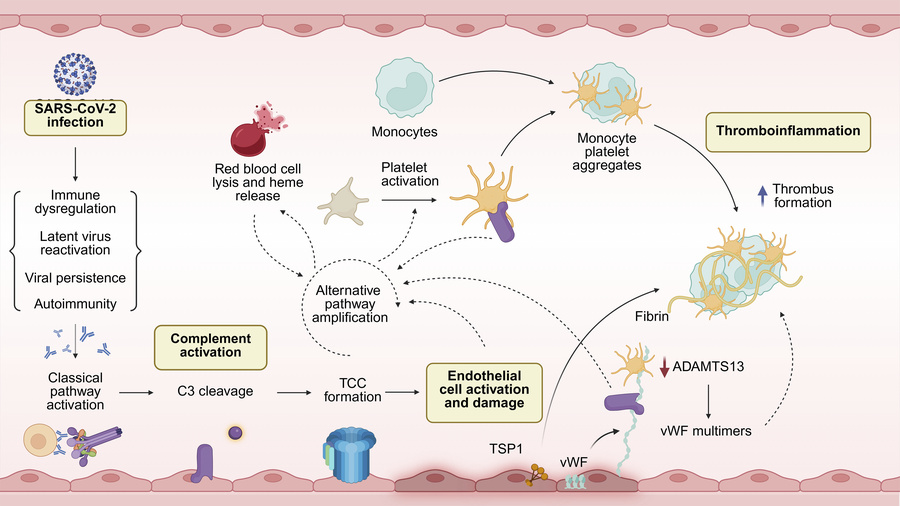
Proposed drivers of complement activation in long COVID
Long COVID is a debilitating condition that can develop after a SARS-CoV-2 infection and is characterized by a wide range of chronic symptoms, including weakness, neurocognitive impairment, malaise, fatigue, and many others, that affect multiple organ systems. At least 10% of individuals with a previous infection may develop long COVID, which affects their ability to perform daily functions and work.

August 25, 2025

Distinct trajectories of childhood atopic dermatitis are associated with differences in long-term inflammatory and cardiometabolic disease risks

Florian Thaçi, Philip Curman, Katja Bieber, Henning Olbrich, Diamant Thaçi, Ralf J. Ludwig

This article is a preprint and has not been certified by peer review. It reports new medical research that has yet to be evaluated and so should not be used to guide clinical practice.

Abstract

Importance
Atopic dermatitis (AD) is a common childhood inflammatory skin disease which occurs frequently in the early childhood and is later linked to type 2 diseases but also other systemic comorbidities. The role of different AD-disease trajectories on long-term health outcomes remains unclear, as prior studies have rarely conducted direct comparisons between distinct AD trajectories.

Objective To assess how different childhood AD trajectories - persistent, transient - or none, are associated with long-term risks of other type 2 inflammatory diseases (T2IDs), autoimmune diseases, and cardiometabolic disorders by performing all pairwise comparisons to identify trajectory-specific risk patterns.

Advances in Atopic Dermatitis Treatment: From Pathogenesis to Natural Product-Based Therapies

Fan, X., Z. Liu, W. Yang, et al. 2025. Phytotherapy Research 1–30. https://doi.org/10.1002/ptr.70056.


ABSTRACT

Graphical Abstract
Atopic dermatitis (AD), a widespread and chronic inflammatory skin disorder, profoundly affects patients' quality of life, imposes significant psychological strain, and adds to the public health burden. Recent studies have shown that AD is characterized by complex interactions between multiple signaling pathways and targets, including allergies, inflammation, oxidative stress, apoptosis, and their interactions. This complex pathogenesis poses challenges for effective treatment but also contributes to the discovery of new therapeutic targets and the development of novel therapeutic drugs, which have important clinical significance.

August 24, 2025

Impact of Co-morbidities on Hypersensitivity Reactions to COVID-19 Vaccines

Pelin KORKMAZ, Deniz EYICE KARABACAK, Ilkim Deniz TOPRAK, Osman Ozan YEGIT, Derya UNAL, Semra DEMIR, Asli AKKOR. ASTHMA ALLERGY IMMUNOLOGY. Early Access. doi: 10.21911/aai.2025.759.

Background and Aim: Coronavirus disease of 2019 (COVID-19), also known as SARS Coronavirus-2, is an infectious disease caused by a single-stranded RNA (ssRNA) virus that emerged in Wuhan, China, in December 2019, leading to a global pandemic. Among the vaccines developed for COVID-19, BioNTech, CoronaVac, and TURKOVAC™ have been administered in Türkiye. While they were the best way to control the pandemic, allergic reactions associated with these vaccines have been reported. We aimed to evaluate the possible risk factors by examining the demographic and clinical characteristics of patients who showed hypersensitivity reactions to BioNTech and CoronaVac vaccines, and especially any concomitant diseases. TURKOVAC™ was not administered to any of the patients who presented to our clinic.

Materials and Methods: This retrospective study included 45 patients who presented with hypersensitivity reactions to COVID-19 vaccines at the Istanbul Faculty of Medicine`s adult allergy clinic.

August 23, 2025

Statistical Analysis in Allergy and Immunology: A Review With Practical Examples

Ordak M, Paoletti G, Di Bona D, Sousa-Pinto B, Martini M, Bognanni A, Bousquet J, Canonica GW. Allergy. 2025 Aug 23. doi: 10.1111/all.70013. Epub ahead of print.

ABSTRACT

Statistical analysis plays a critical role in biomedical research, ensuring that data are interpreted appropriately and that conclusions are both valid and reproducible. In allergy and immunology, where studies increasingly rely on complex data structures and analytical approaches, clarity on biostatistical methods is essential to support transparency and scientific rigor. However, inconsistent statistical reporting and misuse of analytical techniques remain persistent challenges in the field. This review provides a structured and practice-oriented overview of key statistical aspects relevant to research in allergy and immunology.