September 25, 2025

What has changed with subcutaneous immunotherapy against house dust mites? Eight-year, single-center real-world data

Bulbul, Lida; Toprak, Ali; Nursoy, Mustafa A. Asia Pacific Allergy 15(3):p 176-185, September 2025. | DOI: 10.5415/apallergy.0000000000000202

Abstract

Introduction:

We aimed to investigate clinical and laboratory parameters that can predict clinical response in patients who completed subcutaneous immunotherapy (SCIT) against house dust mites (HDM) and to determine parameters associated with systemic adverse effects (SAE).

Methods:
In total, 108 patients who had complete medical data were evaluated.

Results:
Laboratory values and symptom scores before and after SCIT
Around 54.6% of patients were male; mean age was 11.7 ± 3.1 years. All patients had allergic rhinitis, 86% had asthma, and 22% had atopic dermatitis. After SCIT, mean symptom score (SS) for allergic rhinitis had decreased in 86% of patients, asthma severity had decreased in 35.5% of asthma patients. After SCIT, median eosinophil count and HDM skin prick test (SPT) diameters decreased, there was not statistically significant change in total IgE (P = 0.001, 0.001, and 0.824, respectively). No statistically significant difference was detected between the SS change groups (decreased, same, or increased) in terms of age, gender, disease duration, presence and severity of asthma, presence of atopic dermatitis, duration of SCIT, time after SCIT, initial sensitization status, total IgE, eosinophil and basophil counts, and SPT diameter for HDM.

Machine learning in allergy research: A bibliometric review

Kong E, Cucco A, Custovic A, Fontanella S. Immunol Lett. 2025 Sep 8;277:107088. doi: 10.1016/j.imlet.2025.107088.


Summary
Word clouds for topics obtained by Latent Dirichlet allocation (LDA)
The emergence of big data and analytic approaches initiated research efforts to characterise different subtypes of allergic diseases, including tracking disease progression and identifying patterns that may offer insight into their development and progression. Triangulation from different data sources and study types may help to elucidate the directionality of relationships between variables at a very individual level by modelling the complex interdependencies between multiple dimensions (e.g., genome, transcriptome, epigenome, microbiome, and metabolome), thereby moving away from associative to a more causal analysis.

September 24, 2025

The evolution of food protein-induced enterocolitis syndrome (FPIES): Global trends, emerging triggers, and natural history.

Anvari S, Gupta M, Nicolaides R et al. Ann Allergy Asthma Immunol. 2025 Sep 19:S1081-1206(25)01160-3. doi: 10.1016/j.anai.2025.09.006.


Abstract

Graphical timeline of our understanding of FPIES.
Food protein-induced enterocolitis syndrome (FPIES) is a non-IgE-mediated food allergy characterized by delayed gastrointestinal symptoms. It is thought that immune and neuroimmune mechanisms drive FPIES pathophysiology, but this remains incompletely understood. There are no specific biomarkers to confirm the FPIES diagnosis, monitor for resolution, or assess reactivity to additional food triggers.

Social Determinants of Health in Pediatric Asthma and Allergic Diseases: A Systematic Review

Koumpagioti, D., Moriki, D., Boutopoulou, B.et al. (2025).  Epidemiologia, 6(3), 56. https://doi.org/10.3390/epidemiologia6030056

Abstract

PRISMA diagram for the study selection process.
Objectives:
This study aimed to synthesize evidence of the influence of multilevel social determinants of health (SDOHs) on asthma and allergic disease outcomes and healthcare utilization in children and adolescents, with a specific focus on how these determinants generate or widen health inequities, through a systematic review of the current literature and evidence. 
Methods: A literature search was performed in the PubMed, EBSCO, and Scopus databases. The search period for all databases was from 1 January 2020 to 15 January 2025. Studies published in English that evaluated the association between at least one SDOH, as a primary exposure or effect modifier, and asthma and/or allergic disease outcomes and healthcare utilization in children and adolescents aged ≤ 18 years were included.

September 23, 2025

Artificial Intelligence Diagnostic Accuracy and Clinical Utility in Allergic Rhinitis: Systematic Review

Dana A. Alrezq, Abdulaziz M. Aldaghmani, Jana J. Alali, et al.  Authorea. September 12, 2025.

DOI: 10.22541/au.175766646.65353803/v1

Abstract

Allergic rhinitis (AR) is one of the most common outpatient conditions, diagnosed through operator-dependent and resource-intensive methodologies. Consequently, there has been a surge in the development of diagnostic strategies using artificial intelligence (AI). This review aims to explore how AI can enhance diagnostic accuracy, personalize treatment, and support clinical decisions in AR care. The review followed PRISMA guidelines and was registered in PROSPERO. PubMed, Cochrane Central, Embase, and Google Scholar were searched for studies published between 2002 and 2025. Out of 1,109 identified studies, eight studies met the inclusion criteria.

September 22, 2025

Cost-effective care in anaphylaxis prevention and management

Sanders J, Boldt C, Kumar BP, Shaker M.  Pediatr Allergy Immunol. 2025; 36:e70176. doi:10.1111/pai.70176

Abstract

Anaphylaxis is a serious hypersensitivity reaction that may be life-threatening. Data suggest that fatal anaphylaxis is a very rare event; however, anaphylaxis and fear of anaphylaxis are associated with high societal burden and cost. Cost-effectiveness analyses can facilitate a model of value-based care; in this review, we aim to highlight key health-economic analyses in anaphylaxis. Health economic evaluations suggest that screening approaches to prevent anaphylaxis have low value.

Investigating the Use of Melatonin in Children With Atopic Dermatitis: A Cross-Sectional Study

S. Lee, E. J. Kim, J. LeBovidge, et al. Pediatric Dermatology (2025): 1–7, https://doi.org/10.1111/pde.70041.

ABSTRACT

Background/Objectives

Children with atopic dermatitis (AD) frequently experience sleep disturbances. Melatonin, an over-the-counter supplement, is increasingly used in the general pediatric population; however, its prevalence and perceived effectiveness in children with AD remain unclear.

Methods

Caregivers of pediatric patients (ages 1–17 years) with physician-diagnosed AD completed surveys on melatonin use, Patient Oriented Eczema Measure (POEM), and age-appropriate sleep questionnaires.

Results

Among 102 total respondents, 27.5% reported a history of melatonin use, with 10.8% using it in the past 30 days. Gummies were the most common formulation (85.7%), though brands and dosages varied widely (0.5–10 mg; median: 3 mg).

Comparative Efficacy of Montelukast-Levocetirizine Combination Therapy versus Monotherapy in Allergic Rhinitis: A Systematic Review and Meta-Analysis

Kim JS, Stybayeva G, Hwang SH.  Int Arch Allergy Immunol. 2025 Jul 15:1-14. doi: 10.1159/000547410.

Abstract

Introduction: Combination therapy with antihistamines and leukotriene receptor antagonists (LTRAs) is frequently used in allergic rhinitis (AR), particularly in patients with persistent or inadequately controlled symptoms. However, supporting evidence has been inconsistent. This meta-analysis assessed the efficacy of montelukast combined with levocetirizine in patients with AR by directly comparing the combination therapy with each monotherapy and evaluating individual symptom domains. 

Methods: A systematic review and meta-analysis of randomized controlled trials (RCTs) was conducted, with database searches performed through March 2025. Outcomes included daytime and nighttime total symptom scores, individual nasal symptoms, rhinoconjunctivitis-related quality of life (RQLQ), and treatment-emergent adverse events (TEAEs). Pooled effects were calculated using standardized mean differences (SMDs) and odds ratios (ORs) with 95% confidence intervals (CIs). 
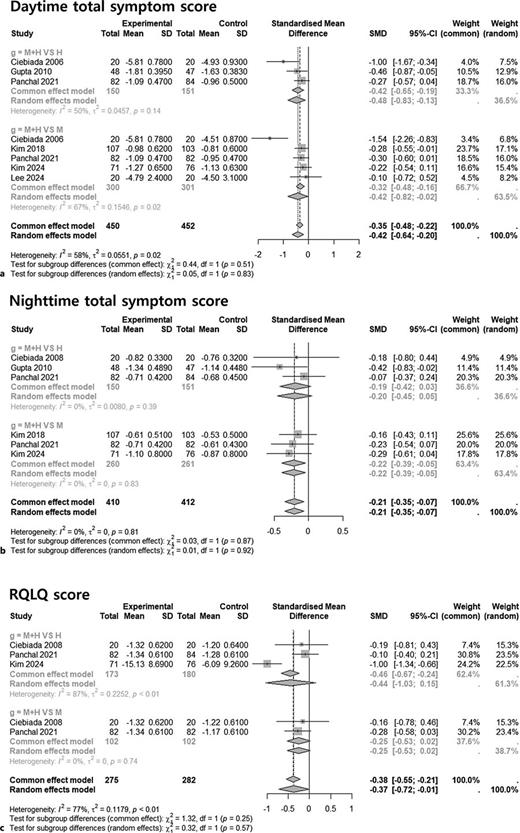
Forest plots comparing changes in daytime total symptom score (a),
nighttime total symptom score (b), and rhinoconjunctivitis quality of
lifequestionnaire (RQLQ) scores (c) between combination therapy
(montelukast-levocetirizine) and monotherapy.
Results: Seven RCTs (n = 887) were included. Combination therapy resulted in greater improvement in daytime symptoms (SMD [95% CI]: −0.42 [–0.64 to −0.20]), rhinorrhea (SMD [95% CI]: −0.69 [–1.09 to −0.30]), and nasal congestion (SMD [95% CI]: −0.64 [–1.05 to −0.24]) compared to monotherapy.