
Abstract
Background: Mite, cockroach, and shellfish (crab, clam, and shrimp) proteins share allergenic epitopes. The determination of specific IgE (sIgE) against cockroach (Blattella germanica, relevant in asthma) and shellfish allergens (relevant in food allergy) using whole-body extracts necessitates detailed knowledge of IgE cross-reactivity.
Objective: This study aimed to evaluate whether cross-reactivity between aeroallergens and food allergens is clinically relevant and whether subjects with mite and/or cockroach sensitization are at risk of false-positive results in shellfish food allergy diagnostics.
Methods: In this cross-sectional, single-center study, we recruited 200 patients with elevated sIgE against ≥1 allergen at random from our outpatient clinic and assessed allergic comorbidity.
We analyzed sIgE against mites (Dermatophagoides pteronyssinus, Dermatophagoides farinae, or Blomia tropicalis), German cockroach (B. germanica), crab, clam, and shrimp whole allergen extract, as well as sIgE against mite tropomyosin Der p 10 and shrimp tropomyosin Pen a 1 (in a subpopulation), using automated ImmunoCAP Specific IgE Tests.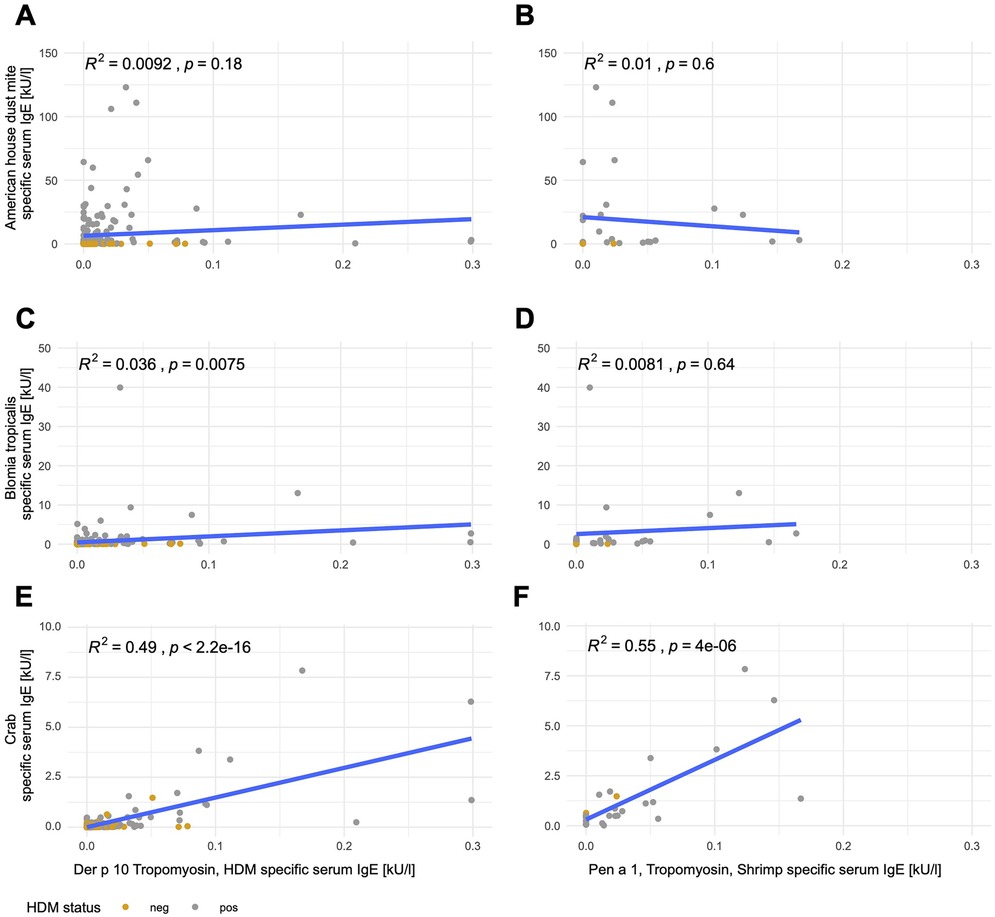 |
| Tropomyosin sIgE correlates with crab sIgE but not mite sIgE. |
Conclusion: Patients with mite sensitization have higher asymptomatic sIgE levels to shellfish. Even in patients with anti-tropomyosin sIgE levels below the cutoff level, anti-tropomyosin sIgE correlates strongly with sIgE against German cockroach, crab, clam, and shrimp. Our findings suggest large-scale false-positive results for sIgE to shellfish when analyzing patients with mite- or cockroach sensitization.


No comments:
Post a Comment