
Abstract
Background: Montelukast, a selective leukotriene receptor antagonist, is widely used in the treatment of bronchial asthma and allergic rhinitis (AR). Although it is a well-tolerated drug, there are reports of possible central nervous system side effects, including, for example, mood changes and suicidal thoughts. Therefore, we conducted a meta-analysis to test the effects of montelukast on the mental health of patients taking montelukast and to test its effectiveness in treating asthma and AR.
Methods: PubMed, Web of Science, and the Cochrane Central Register of Controlled Trials databases were searched to find articles of control-compared randomized clinical trials, which investigated the efficacy of montelukast treatment as well as articles about mental disorders after this treatment. The relative risk with 95% confidence interval (CI) and the standardized mean difference with 95% CI were calculated to compare the effect. A random effects model was used to calculate effect sizes.
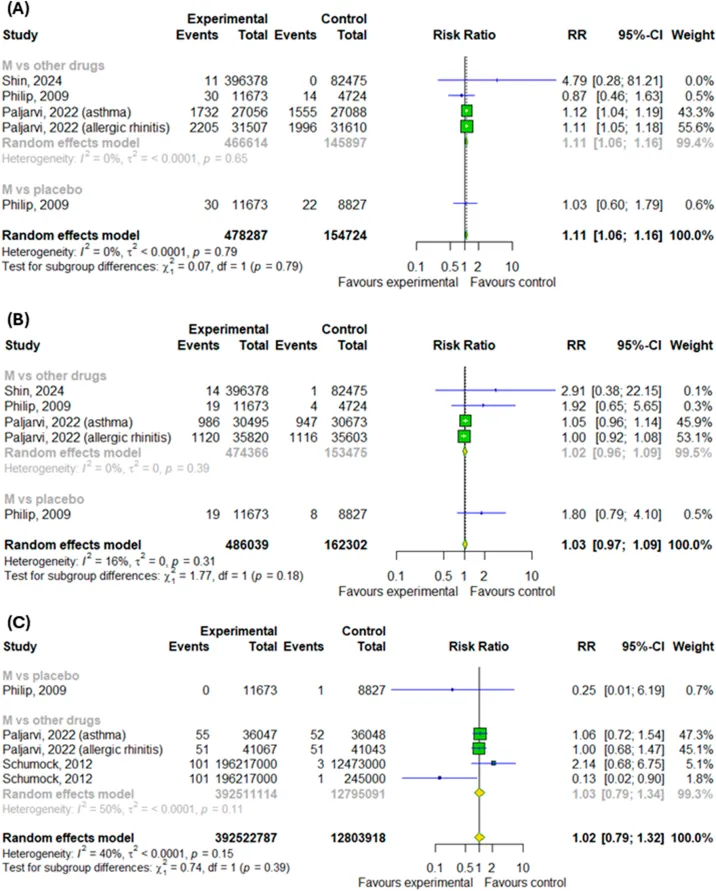 |
| Risk of (A) anxiety, (B) depression and (C) suicidal and self-injurious behaviors,nonfatal self-harm or completed suicides after montelukast treatmentcompared to control. |
Conclusion: In terms of treating asthma and allergic rhinitis, montelukast shows comparable efficacy to other drugs, such as inhaled corticosteroids or second-generation antihistamines. Furthermore, montelukast was associated with a modestly increased risk of anxiety, while no consistent evidence was found for an increased risk of depression or suicidal behaviors, considering the limited data.


No comments:
Post a Comment