Beiner, L., Boehm, I. Insights Imaging 16, 216 (2025). https://doi.org/10.1186/s13244-025-02099-y
Abstract
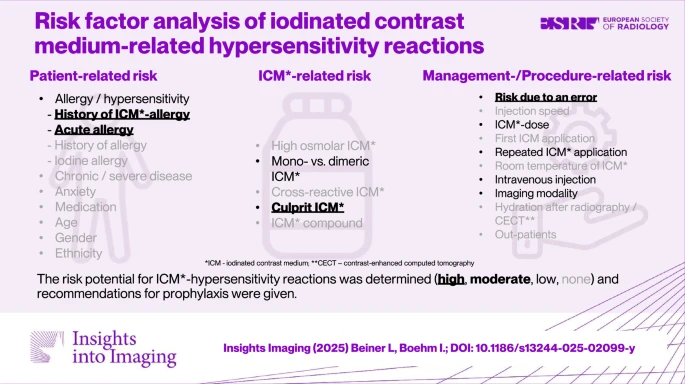 |
| Graphical Abstract |
Hypersensitivity reactions caused by iodinated contrast media (ICM) are by definition type B adverse reactions and therefore, they are not predictable. To partially limit this uncertainty, since the 1980s, risk factors have been defined and published. Currently, there are so many risks that any patient undergoing a contrast-enhanced imaging examination would have at least one risk. This is not helpful and instead leads to uncertainty again. From both studies and clinical experience, we know that only a small percentage of patients develop hypersensitivity reactions after ICM administration. Therefore, we subjected the risks published to a critical analysis. Based on 126 publications, we identified 43 risks, which were divided into three categories (patient-related, contrast agent-related and management-related risks). We have also mentioned the appropriate management for each risk. After critical assessment, the risk status remains with a history of an ICM-hypersensitivity reaction, acute allergic symptoms, the culprit ICM and documentation errors (e.g., if an iodine allergy is mentioned, a latex allergy is incorrectly suspected as an ICM-allergy or the wrong trigger is documented). In addition, we found that several risks have been named differently, although they cover the same risk situation (e.g., chronic/severe disease and frequent ICM applications). Furthermore, for several of the published risks, no mitigation measures are available. Taken together, of the large number of published risks, only those with risk status should be used clinically in the future. Known risk factors do not influence the nature of type B reactions.Critical relevance statement For patient safety, it would be advisable in the future to consider the following three risks: a history of an ICM-hypersensitivity reaction, acute allergic symptoms and documentation errors (e.g., if an iodine allergy is mentioned, a latex allergy is incorrectly suspected as an ICM-allergy or the wrong trigger is documented).
Key Points
- Risk factors are intended to limit the unpredictability of ICM hypersensitivity reactions.
- Currently, risks are nonspecific and ultimately apply to all patients.
- We found that identical factors are published under different names.
- Four risks are relevant: history of ICM-HSR, acute allergy, the culprit ICM and documentation/management errors.
PDF


No comments:
Post a Comment