
Abstract
Background
Hypersensitivity reactions to iodinated contrast media (ICM) are rare but can be life-threatening. Management typically involves avoidance of the offending agent and the use of alternative imaging strategies. The phenomenon of a transient refractory period—wherein a patient does not exhibit an allergic response upon re-exposure to the allergen shortly after an initial reaction—has been proposed but is not well-documented in the context of ICM.
Case presentation
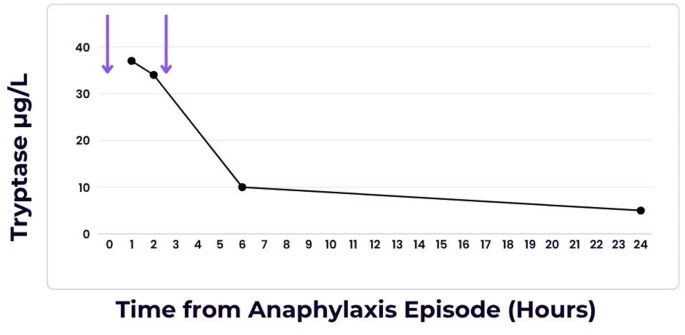 |
| Serum Tryptase versus Time from Anaphylaxis Episode. Purple arrows represent the two time points at which iodinated contrast media was administered. |
Conclusions
This case suggests the presence of a transient refractory period following a severe hypersensitivity reaction to ICM, during which re-exposure to the allergen does not elicit an immediate response. Understanding this phenomenon could have significant implications for the management of urgent imaging needs in patients with known ICM hypersensitivity.


No comments:
Post a Comment