A blog that publishes updates and open access scientific papers about allergy, asthma and immunology.
Editor: Juan Carlos Ivancevich, MD. Specialist in Allergy & Immunology
Cutaneous manifestations of hypocomplementemic urticarial vasculitis
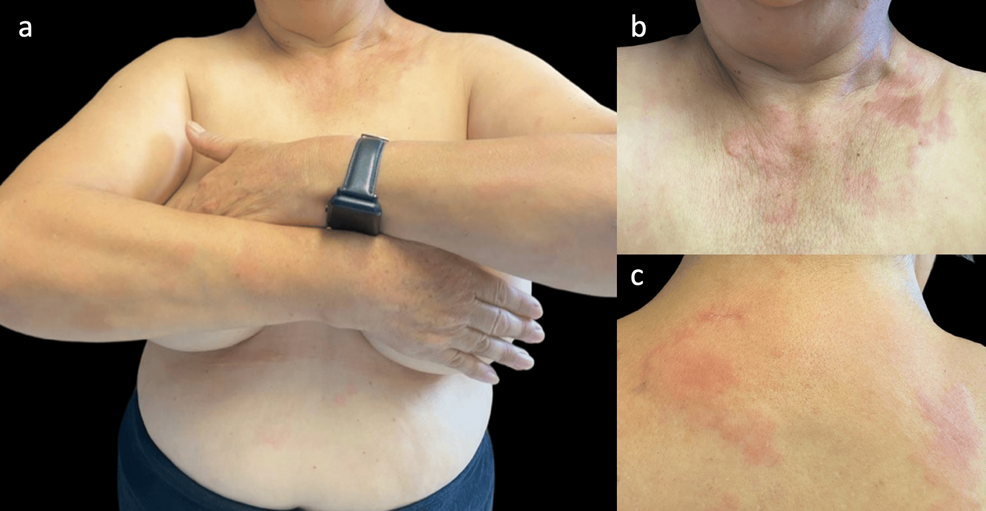
Urticarial vasculitis (UV) is an inflammatory condition that affects small vessels, generating urticarial lesions with wheals lasting >24 hours. It can be divided into two main groups: normocomplementemic (NUV) and hypocomplementemic urticarial vasculitis (HUV). The latter is a rare condition, whose association with autoimmune diseases, primarily systemic lupus erythematosus (SLE), makes its diagnosis difficult. We present a 67-year-old female patient with a family history of SLE. She presented with disseminated dermatosis of eight months' duration with wheals lasting >24 hours. Due to a suspected diagnosis of UV, laboratory studies and a skin biopsy were performed, revealing a predominantly neutrophilic perivascular infiltrate, nuclear dust, and mild fibrinoid necrosis, as well as low serum complement levels. Meanwhile, anti-Smith, anti-double-stranded DNA, anti-Ro/SSA, and anti-La/SSB antibodies were all negative. A low-titer ANA (1:100) was detected, although this nonspecific finding is common in healthy individuals and lacks diagnostic significance. Anti-C1q antibodies could not be assessed due to unavailability within the institution. Despite this limitation, the constellation of clinical, laboratory, and histopathological findings supported the diagnosis of HUV, and a favorable therapeutic response was achieved with prednisone at a dose of 0.5 mg/kg per day with a weekly taper of 5 mg until discontinuation, accompanied by close clinical monitoring, including quarterly dermatologic evaluations and semiannual rheumatologic assessments supported by laboratory testing. This case highlights the importance of early identification, the need for a multidisciplinary approach, as well as the exclusion of systemic involvement while ensuring close follow-up, as a high percentage of patients may develop SLE.



No comments:
Post a Comment