Beck, L.A., Simpson, E.L., Thaçi, D. et al. Adv Ther (2026). https://doi.org/10.1007/s12325-026-03582-8Abstract
Introduction
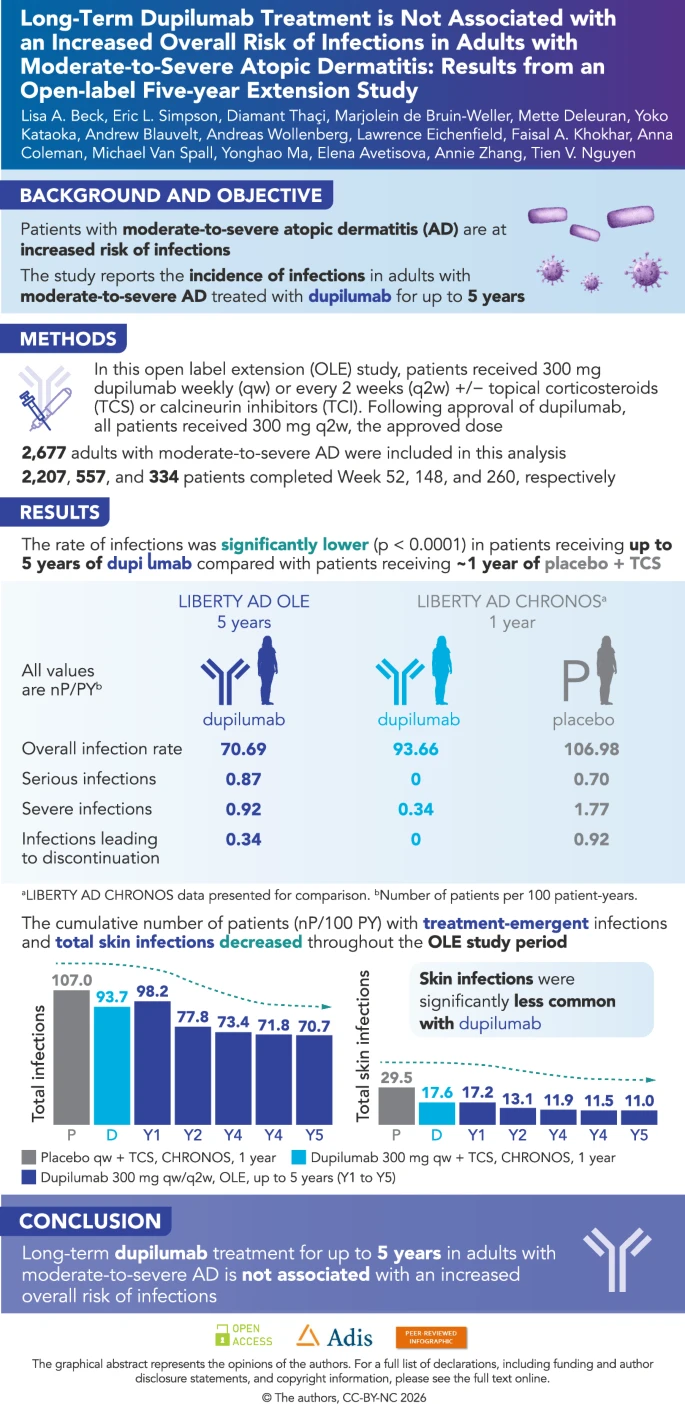
Patients with atopic dermatitis (AD) are at an increased risk for infections. Here, we report a confirmatory follow-up study analyzing the incidence of infections in adults with moderate-to-severe AD treated with dupilumab for up to 5 years.
Methods
Infections in adults with moderate-to-severe AD treated with dupilumab 300 mg weekly (qw) or every 2 weeks (q2w; approved regimen) were assessed for up to 5 years in the open-label extension study, LIBERTY AD OLE. Topical corticosteroids (TCS) and calcineurin inhibitors (TCI) were permitted. Exposure-adjusted incidence rates [number of patients with at least one event per 100 patient-years (nP/100 PY)] are reported. Since the OLE had no control arm, safety results from the placebo + TCS arm of the 1-year LIBERTY AD CHRONOS study are included for comparisons.
Results
Of the 2677 patients included, 2207 (82.4%) completed up to week 52, 557 (20.8%) up to week 148, and 334 (12.5%) up to week 260; 226 patients (8.4%) switched from qw to q2w during the trial due to a protocol amendment. Overall infections (70.69 nP/100 PY), serious infections (0.87 nP/100 PY), severe infections (0.92 nP/100 PY), and infections leading to treatment discontinuation (0.34 nP/100 PY) were consistent with previous 4-year open-label extension (OLE) analyses and were low compared with 1-year results from the CHRONOS placebo + TCS arm. The cumulative number of patients with treatment-emergent serious or severe infections, non-herpetic or herpetic infections, and total skin infections decreased throughout the OLE study period. Limitations of this study include the absence of a placebo arm in the OLE, decreasing sample size at later time points, inclusion of qw dosing analyses (different from approved q2w dosing), and possible confounding effects of TCS/TCI use that may impact infection rates.
Conclusions
Long-term dupilumab treatment for up to 5 years in adults with moderate-to-severe AD is not associated with an increased overall risk of infections.
PDF



No comments:
Post a Comment