January 31, 2024

Tacrolimus Ointment in Periorbital Atopic Dermatitis

Alzahrani M, Kamal Y F, Akram M A. Tacrolimus Ointment in Periorbital Atopic Dermatitis. Cureus 16(1): e53055. doi:10.7759/cureus.53055

Abstract

Periorbital atopic dermatitis (AD) is a common sign in ophthalmological practice and usually has a persistent and relapsing course. Treatment with topical corticosteroids has various side effects associated with their usage. Tacrolimus topical ointment has unique immunomodulatory properties that decrease skin inflammation and pruritus in AD. In this case series, we present a prospective case series of five patients (three males and two females) who received topical application of tacrolimus ointment 0.1-0.03% in the periorbital area twice daily for one to four weeks.

January 30, 2024

The Efficacy and Safety of High Dose (10 mg) of Desloratadine (Dazit® 10) in the Treatment of Chronic Spontaneous Urticaria in India: A Phase III, Multicentric, Open-Label, Single-Arm Study

Kapadia S, Nageswaramma S, Shah K, et al. Cureus 16(1): e53125. doi:10.7759/cureus.53125

Abstract

Background: Chronic spontaneous urticaria (CSU) is a debilitating affliction that affects diverse quality of life (QoL) parameters such as sleep, self-esteem, and daily activities. Second-generation antihistamines, such as desloratadine, are more effective and safer in managing CSU. Desloratadine is a nonsedating, potent, and highly selective H1 receptor antagonist. At its daily dose of 5 mg, almost half of CSU patients do not show symptomatic improvement. European Academy of Allergy and Clinical Immunology (EAACI)/Global Allergy and Asthma European Network (GA2LEN)/European Dermatology Forum (EDF) (EuroGuiDerm)/Asia Pacific Association of Allergy, Asthma and Clinical Immunology (APAAACI) guidelines recommend increasing the dosage to up to four times in such nonresponsive patients. However, there is insufficient clinical evidence in Indian settings.

Method: We evaluated the efficacy and safety of 10 mg desloratadine (OD) in 256 nonresponsive patients with moderate to severe CSU.

January 26, 2024

Unveiling the potent effect of vitamin D: harnessing Nrf2/HO-1 signaling pathways as molecular targets to alleviate urban particulate matter-induced asthma inflammation

Dandan Ge, Qihong Chen, Xiaohua Xie, Qiyuan Li & Yungang Yang . BMC Pulmonary Medicine volume 24, Article number: 55 (2024) 

Abstract

Background

Asthma is the most common allergic disease characterized by an inflammatory response in the airways. Mechanismly, urban particulate matter (PM) is the most widely air pollutant associated with increased asthma morbidity and airway inflammation. Current research found that vitamin D is an essential vitamin with anti-inflammatory, antioxidant and other medical efficacy. Inadequate or deficient vitamin D often leads to the pathogenesis and stability of asthma. NGF exacerbates airway inflammation in asthma by promoting smooth muscle cell proliferation and inducing the Th2 immune response. Activation of the Nrf2/HO-1 signaling pathway can exert a protective effect on the inflammatory response in bronchial asthma. However, the specific mechanism of this pathway in PM-involved asthmatic airway smooth muscle cells remains unclear.

January 23, 2024

Resource utilization and cost assessment of a proactive penicillin allergy de-labeling program for low-risk inpatients

Lanoue, D., Mir, A., van Walraven, C. et al.  Allergy Asthma Clin Immunol 20, 7 (2024). https://doi.org/10.1186/s13223-023-00864-6

Abstract

Background

Resource utilization and costs can impede proactive assessment and de-labeling of penicillin allergy among inpatients.

Methods
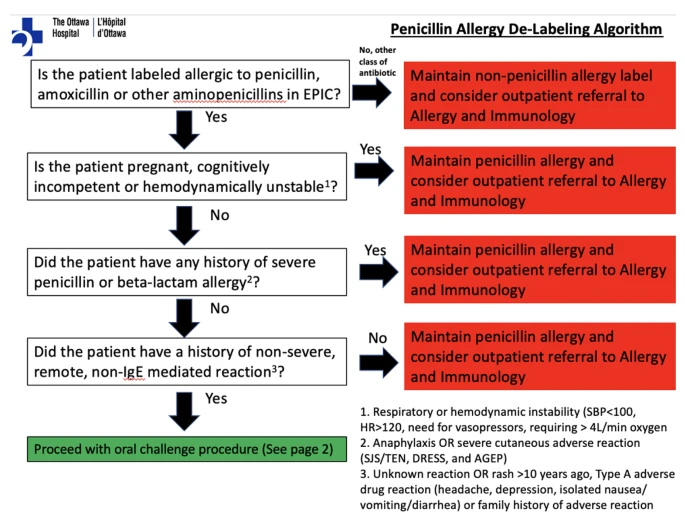
The Ottawa Hospital Penicillin Allergy Risk Stratification Algorithm
Our pilot intervention was a proactive penicillin allergy de-labeling program for new inpatients with penicillin allergy. Patients deemed appropriate for a challenge with a low-risk penicillin allergy history were administered 250 mg amoxicillin and monitored for 1 h. We performed an explorative economic evaluation using various healthcare professional wages.

Results

Over two separate 2-week periods between April 2021 and March 2022, we screened 126 new inpatients with a penicillin allergy. After exclusions, 55 were appropriate for formal assessment. 19 completed the oral challenge, and 12 were directly de-labeled, resulting in a number needed to screen of 4 and a number needed to assess of 1.8 to effectively de-label one patient.

January 21, 2024

Prevalence and incidence of hand eczema in healthcare workers: A systematic review and meta-analysis.

Yüksel YT, Symanzik C, Christensen MO, et al. Contact Dermatitis. 2024; 1-12. doi:10.1111/cod.14489

Abstract

Healthcare workers (HCWs) are considered a high-risk group for developing hand eczema (HE), mainly owing to wet work and contact with allergens at work. To meta-analyse the prevalence and incidence of HE in HCWs, as well as mapping the prevalence of atopic dermatitis (AD) and HE severity in HCWs. A systematic review and meta-analysis was performed following the Preferred Reporting Items for Systematic Reviews and Meta-analyses 2020 guidelines.

January 20, 2024

Treatment of atopic dermatitis: Recently approved drugs and advanced clinical development programs.

Müller S, Maintz L, Bieber T. Allergy. 2024; 00: 1-15. doi:10.1111/all.16009

Abstract

Atopic dermatitis (AD) represents the most common skin disease characterized by heterogeneous endophenotypes and a high disease burden. In Europe, six new systemic therapies for AD have been approved: the biologics dupilumab (anti-interleukin-4 receptor (IL-4R) α in 2017), tralokinumab (anti-IL-13 in 2021), lebrikizumab (anti-IL-13 in 2023), and the oral janus kinase (JAK) inhibitors (JAKi) targeting JAK1/2 (baricitinib in 2020 in the EU) or JAK1 (upadacitinib in 2021 and abrocitinib in 2022).
 
Overview of systemic therapies already approved for atopic
dermatitis in Europe or in Phase III clinical trials

Latex Allergy in Children


Arasi S, Barni S, Caminiti L, Castagnoli R, Giovannini M, Liotti L, Mastrorilli C, Mori F, Pecoraro L, Saretta F, Gelsomino M, Klain A, Miraglia Del Giudice M, Novembre E. J Clin Med. 2023 Dec 25;13(1):124. doi: 10.3390/jcm13010124.

Abstract

Notwithstanding the efforts made in the last decades to mitigate the consequences of natural rubber latex allergy, this disease continues to be a major health problem, especially in developing countries. The categories of patients with greater and frequent exposure to latex (such as health care professionals and, in the pediatric field, subjects who undergo repeated surgery, e.g., those suffering from spina bifida and urogenital malformations) have an increased risk of developing sensitization and allergy to latex. Herein we provide an overview of the current knowledge and practical recommendations with a focus on epidemiology, diagnostics, and management (including both prevention and therapy) in order to guide a correct recognition and containment of this potentially fatal condition.

January 17, 2024

Asthma May Not be a Potential Risk Factor for Severe COVID-19 Illness: A Scoping Review

Abstract

The coronavirus disease 2019 (COVID-19) is a respiratory disease caused by severe acute respiratory syndrome coronavirus-2 (SARS-CoV-2), but whether the asthmatic patients are at increased risk for severe COVID-19 illness than non-asthmatic patients has remained unclear. This scoping review aimed to assess the available evidence to determine if asthmatic patients are at a higher risk for severe COVID-19 illness. Searching several electronic databases and adhering to the PRISMA guidelines, we conducted a scoping review of 70 articles and using defined inclusion-exclusion criteria, 21 articles were analyzed in-depth and included in this scoping review.

The findings of this scoping review point to a lack of relationship between asthma and severe COVID-19 illness. While a limited number of studies (n = 4) identified asthma as a risk factor, most studies (n = 17) found no independent association between asthma and severe COVID-19 illness.