
Mititelu A, Onisâi MC, Roșca A, Vlădăreanu AM. Int J Mol Sci. 2024 Feb 10;25(4):2163. doi: 10.3390/ijms25042163.
Abstract
 |
| Pathogenesis of immune thrombocytopenia and targets for drug action |
Abstract
|
| Pathogenesis of immune thrombocytopenia and targets for drug action |

Abstract
Introduction: Exposure to respiratory viruses is a significant cause of morbidity and affects virus-specific antibody levels. Little is known about determinants associated with immune response to these viruses. We aimed to investigate the determinants of respiratory syncytial virus (RSV)- and rhinovirus (RV)- specific IgG responses in both children and adults.
Methods: The study is based on the EGEA cohort, composed of 530 samples of children in EGEA1 (1991-95) and 1241 samples of adults in EGEA2 (2003-07). Cumulative RV-specific IgG levels (species A, B and C) and IgG levels to RSV-G protein were measured by using micro-array technoloy. Multiple linear mixed models (random effect to account for familial dependence) were performed to assess associations between age, sex, body mass index (BMI), tobacco smoke exposure and season of blood sampling with RSV-and RV-specific IgG levels.
 |
| Associations of RSV and RV-specific IgG levels with personal determinants and seasons of blood sampling in children (EGEA1, n=531) and adults (EGEA2, n=1241). |
Background: Hay fever, characterized by seasonal allergic reactions, poses a significant health challenge. Existing therapies encompass standard drug regimens, biological agents, and specific immunotherapy. This study aims to assess and compare the effectiveness of anti-IgE (omalizumab), medication therapy, and subcutaneous immunotherapy (SCIT) for hay fever.
Methods: Conducted as a retrospective cohort study, this research involved 98 outpatient hay fever patients who underwent routine medication, omalizumab treatment, or SCIT before the onset of the spring pollen season. A follow-up was performed one month after the start of the pollen season. The comprehensive symptoms and drug scores were used to evaluate patients with different intervention methods, facilitating a comparative analysis of therapeutic outcomes.
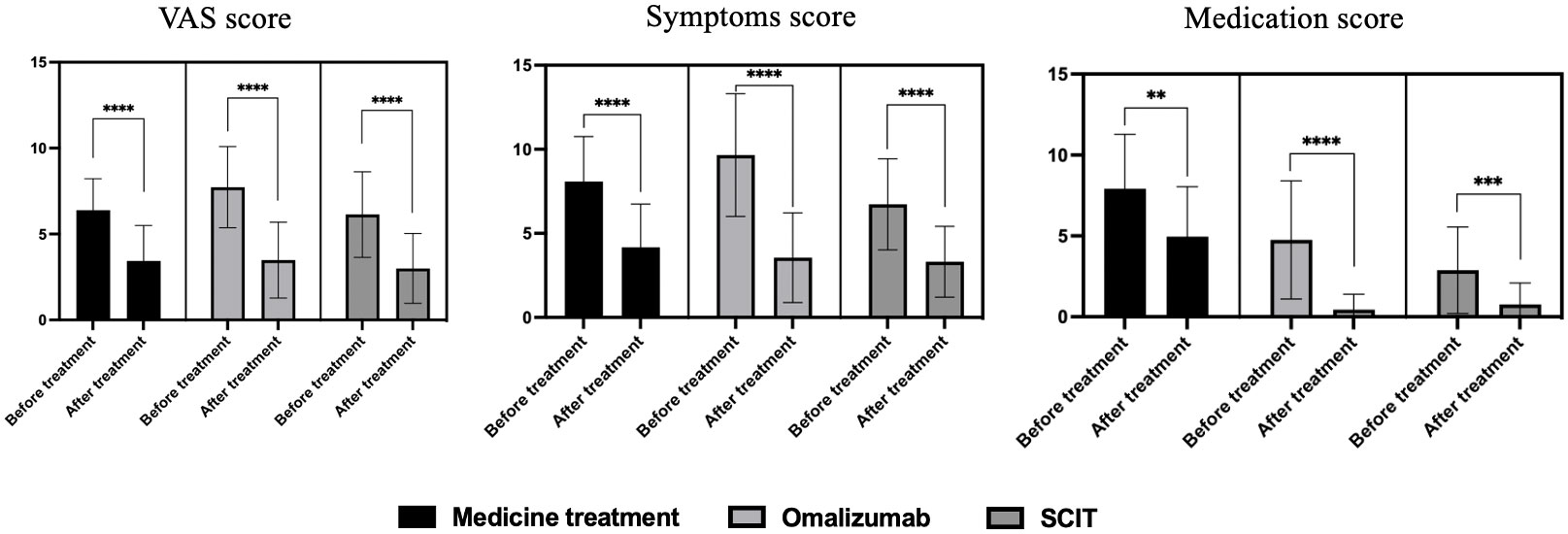 |
| VAS score, symptom score, and medication score before and after treatment of three therapies on hay fever patients. |

Abstract
 |
| Biochemical analysis of recombinant and lipidated Phl p 5 allergens. A–C Analysis of Phl p 5 for EDC coupling. |

Abstract


Chen N, Xie QM, Song SM, Guo SN, Fang Y, Fei GH, Wu HM. Int Immunopharmacol. 2024 Mar 8;131:111791. doi: 10.1016/j.intimp.2024.111791.
Abstract
Purpose
Asthma can not be eradicated till now and its control primarily relies on the application of corticosteroids. Recently, glycolytic reprogramming has been reportedly contributed to asthma, this study aimed to reveal whether the effect of corticosteroids on asthma control is related to their regulation of glycolysis and glycolysis-dependent protein lactylation.
Methods
Ovalbumin (OVA) aeroallergen was used to challenge mice and stimulate human macrophage cell line THP-1 following dexamethasone (DEX) treatment. Airway hyperresponsiveness, airway inflammation, the expressions of key glycolytic enzymes and pyroptosis markers, the level of lactic acid, real-time glycolysis and oxidative phosphorylation (OXPHOS), and protein lactylation were analyzed.
Results

Abstract


Abstract
Background:
Role of complement fraction 5a (C5a), interleukin (IL)-9, and apolipoprotein (apo) A-IV as biomarkers of disease severity and antihistamine response in chronic spontaneous urticaria (CSU) remains elusive.
Objective:
To identify the role of C5a, IL-9, and apo A-IV as potential biomarkers in predicting disease severity and antihistamine response in CSU patients.
Methods:
This was a prospective observational study of 95 patients and 42 controls. Serum analysis of C5a, IL-9, and apo A-IV was done using enyzme linked immunosorbent assay kits. Also, serum IgE and anti-thyroid peroxidase (TPO) levels were assessed in all patients. All patients were started on oral levocetirizine 5 mg at baseline and dose was titrated upwards to maximum of 20 mg based on response. Patients were categorized into antihistamine responders or nonresponders as per their disease response.

