June 8, 2024

Metabolomics of IgE-Mediated Food Allergy and Oral Immunotherapy Outcomes based on Metabolomic Profiling


Yamini V. Virkud, Jennifer N. Styles, Rachel S. Kelly, Sarita U. Patil, Bert Ruiter, Neal P. Smith, Clary Clish, Craig E. Wheelock, Juan C. Celedón, Augusto A. Litonjua, Supinda Bunyavanich, Scott T. Weiss, Erin S. Baker, Jessica A. Lasky-Su, Wayne G. Shreffler medRxiv 2024.05.31.24308233; doi: https://doi.org/10.1101/2024.05.31.24308233

Abstract

Background The immunometabolic mechanisms underlying variable responses to oral immunotherapy (OIT) in patients with IgE-mediated food allergy are unknown.

Objective To identify novel pathways associated with tolerance in food allergy, we used metabolomic profiling to find pathways important for food allergy in multi-ethnic cohorts and responses to OIT.

Methods Untargeted plasma metabolomics data were generated from the VDAART healthy infant cohort (N=384), a Costa Rican cohort of children with asthma (N=1040), and a peanut OIT trial (N=20) evaluating sustained unresponsiveness (SU, protection that lasts after therapy) versus transient desensitization (TD, protection that ends immediately afterwards). Generalized linear regression modeling and pathway enrichment analysis identified metabolites associated with food allergy and OIT outcomes.

June 6, 2024

Telemedicine and Resource Utilization in Pulmonary Clinic

Puthumana, R.M., Grosgogeat, C.A., Davis, J.K. et al. BMC Pulm Med 24, 267 (2024). https://doi.org/10.1186/s12890-024-03066-x

Abstract

Background

Telemedicine use increased with the Covid-19 pandemic. The impact of telemedicine on resource use in pulmonary clinics is unknown.

Methods

This retrospective cohort study identified adults with pulmonary clinic visits at the University of Miami Hospital and Clinics (January 2018-December 2021). The primary exposure was telemedicine versus in-person visits. Standard statistics were used to describe the cohort and compare patients stratified by visit type. Multivariable logistic regression models evaluated the association of telemedicine with resource use (primarily, computed tomography [CT] orders placed within 7 days of visit).

Results

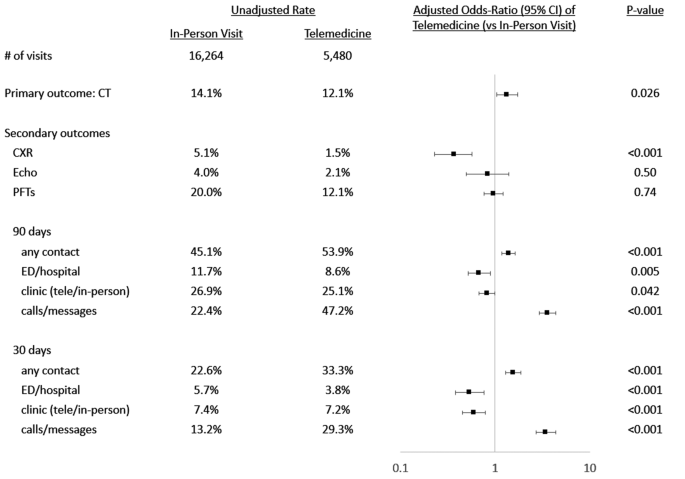
Association of Telemedicine with Resource Use. 
21,744 clinic visits were included: 5,480 (25.2%) telemedicine and 16,264 (74.8%) in-person. In both, the majority were < 65-years-old, female, and identified as Hispanic white. Patients seen with telemedicine had increased odds of having CT scans ordered within 7 days (adjusted odds ratio [aOR] 1.34, [95% confidence interval 1.04–1.74]); and decreased odds of chest x-rays (aOR 0.37 [0.23–0.57]). Telemedicine increased odds of contact of any kind with our healthcare system within 30-days (aOR 1.56 [1.29–1.88]) and 90-days (aOR 1.39 [1.17–1.64]).

June 5, 2024

Anaphylaxis in a Swiss university emergency department: clinical characteristics and supposed triggers

Ehrhard, S., Eyb, V., Gautschi, D. et al. Allergy Asthma Clin Immunol 20, 35 (2024). https://doi.org/10.1186/s13223-024-00901-y

Abstract

Background

Anaphylaxis is the most severe form of acute systemic and potentially life-threatening reactions triggered by mast and basophilic cells. Recent studies show a worldwide incidence between 50 and 112 occurrences per 100,000 person-years. The most identified triggers are food, medications, and insect venoms. We aimed to analyze triggers and clinical symptoms of patients presenting to a Swiss university emergency department for adults.

Methods

Six-year retrospective analysis (01/2013 to 12/2018) of all patients (> 16 years of age) admitted with moderate or severe anaphylaxis (classification of Ring and Messmer ≥ 2) to the emergency department. Patient and clinical data were extracted from the electronic medical database of the emergency department.

Results

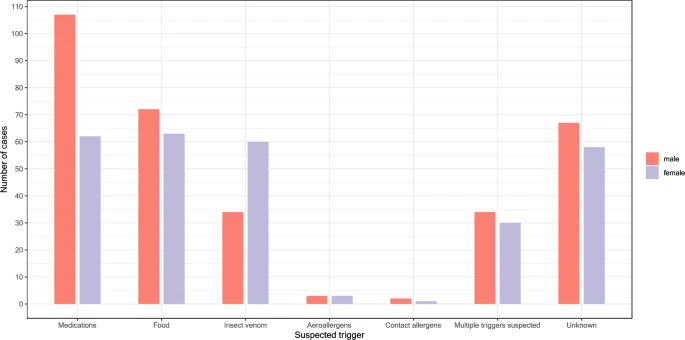
Suspected triggers: different frequency between women and men, n = 531
Of the 531 includes patients, 53.3% were female, the median age was 38 [IQR 26–51] years. The most common suspected triggers were medications (31.8%), food (25.6%), and insect stings (17.1%).

June 2, 2024

Multiplex Assays in Allergy Diagnosis: Allergy Explorer 2 versus ImmunoCAP ISAC E112i


Nösslinger H, Mair E, Oostingh GJ, Ahlgrimm-Siess V, Ringauf A, Lang R.  Diagnostics (Basel). 2024 May 8;14(10):976. doi: 10.3390/diagnostics14100976.

Abstract

Frequency of detection of animal and plant pan-allergens
by ISAC (blue) and ALEX
2 (green) and their concordance
ImmunoCAP ISAC E112i (ISAC) and Allergy Explorer 2 (ALEX2) detect specific immunoglobulin E (IgE) reactivity. Both multiplex assays contain molecular allergens and ALEX2 additionally includes allergen extracts and inhibitors that block the binding of IgE to cross-reacting carbohydrate determinants (CCDs). This study aimed to compare the performance of ISAC and ALEX2 by determining the IgE reactivity against allergen extracts and/or allergen components and by using qualitative, semiquantitative, and quantitative analyses of all comparable allergen components in sera from 216 participants recruited in South Tyrol/Italy.

How to diagnose IgE-mediated food allergy

Lieberman J, Muraro A, Blaiss M. Arch Dis Child Educ Pract Ed. 2024 Mar 7:edpract-2023-325938. doi: 10.1136/archdischild-2023-325938. 


Abstract

Immunoglobulin E (IgE)-mediated food allergy is an immune response, typically to a food protein. Accurate diagnosis reduces unnecessary dietary restrictions and economic and psychological burden on patients and caregivers but relies on a rigorous clinical history, specific IgE diagnostic tests and, where needed, oral food challenge. Increased awareness is needed around which patients to test for IgE-mediated food allergy, as well as terms commonly associated with IgE-mediated food allergy testing, in order to optimise patient diagnosis and management. Herein, we describe approaches to diagnosis of IgE-mediated food allergy, appropriate interpretation of results and risks of overtesting.

PDF

Tezepelumab in a case of severe asthma exacerbation and influenza-pneumonia on VV-ECMO.

E. Grasmuk-Siegl, E. Xhelili, D. Doberer, M.H. Urban, A. Valipour, Respiratory Medicine Case Reports, 2024, 102057, https://doi.org/10.1016/j.rmcr.2024.102057.


Abstract

We present a case of 43-year-old male patient with broadly by Omalizumab, Mepolizumab and Benralizumab pretreated allergic asthma, who suffered a near fatal exacerbation, triggered by an influenza A infection. Due to massive bronchoconstriction with consecutive hypercapnic ventilatory failure veno-venous ECMO therapy had to be implemented.

May 31, 2024

Oral Sebetralstat for On-Demand Treatment of Hereditary Angioedema Attacks


Marc A. Riedl, M.D., Henriette Farkas, M.D., Ph.D., D.Sc., Emel Aygören-Pürsün, M.D. et al. NEJM Published May 31, 2024 DOI: 10.1056/NEJMoa2314192

Abstract

BACKGROUND

Approved on-demand treatments for hereditary angioedema attacks need to be administered parenterally, a route of administration that is associated with delays in treatment or withholding of therapy.

METHODS

In this phase 3, double-blind, three-way crossover trial, we randomly assigned participants at least 12 years of age with type 1 or type 2 hereditary angioedema to take up to two oral doses of sebetralstat (300 mg or 600 mg) or placebo for an angioedema attack. The primary end point, assessed in a time-to-event analysis, was the beginning of symptom relief, defined as a rating of “a little better” on the Patient Global Impression of Change scale (ratings range from “much worse” to “much better”) at two or more consecutive time points within 12 hours after the first administration of the trial agent. Key secondary end points, assessed in a time-to-event analysis, were a reduction in attack severity (an improved rating on the Patient Global Impression of Severity [PGI-S] scale, with ratings ranging from “none” to “very severe”) at two or more consecutive time points within 12 hours and complete attack resolution (a rating of “none” on the PGI-S scale) within 24 hours.

RESULTS

Primary and Key Secondary End Points.
A total of 136 participants were assigned to one of six trial sequences, with 110 treating 264 attacks. The time to the beginning of symptom relief with the 300-mg dose and the 600-mg dose was faster than with placebo (P<0.001 and P=0.001 for the two comparisons, respectively), with median times of 1.61 hours (interquartile range, 0.78 to 7.04), 1.79 hours (1.02 to 3.79), and 6.72 hours (1.34 to >12), respectively.

Efficacy and Safety of Donidalorsen for Hereditary Angioedema

Marc A. RiedlM.D.Raffi TachdjianM.D., M.P.H.William R. LumryM.D., et al. NEJM Published May 31, 2024 DOI: 10.1056/NEJMoa2402478

Abstract

BACKGROUND

Hereditary angioedema is a rare disorder characterized by episodic, potentially life-threatening swelling caused by kallikrein–kinin dysregulation. Long-term prophylaxis can stabilize this system. Donidalorsen, an antisense oligonucleotide, specifically reduces prekallikrein expression.

METHODS

In this phase 3, double-blind, randomized trial, we assigned patients with hereditary angioedema to receive donidalorsen (80 mg subcutaneously) or placebo once every 4 or 8 weeks. The primary end point was the time-normalized number of investigator-confirmed hereditary angioedema attacks per 4 weeks (attack rate) from week 1 to week 25.

RESULTS

Patients with a Reduction in Hereditary Angioedema Attacks.
A total of 90 patients received donidalorsen every 4 weeks (45 patients), donidalorsen every 8 weeks (23 patients), or placebo (22 patients). The least-squares mean time-normalized attack rate was 0.44 (95% CI, 0.27 to 0.73) in the 4-week group, 1.02 (95% CI, 0.65 to 1.59) in the 8-week group, and 2.26 (95% CI, 1.66 to 3.09) in the placebo group. The mean attack rate from week 1 to week 25 was 81% lower (95% CI, 65 to 89) in the 4-week group than in the placebo group (P<0.001) and 55% lower (95% CI, 22 to 74) in the 8-week group than in the placebo group (P=0.004); the median reduction in the attack rate from baseline was 90% in the 4-week group, 83% in the 8-week group, and 16% in the placebo group.