June 12, 2024

Embedding patients' values and preferences in guideline development for allergic diseases: The case study of Allergic Rhinitis and its Impact on Asthma 2024.

Vieira RJ, Sousa-Pinto B, Bognanni A, Yepes-Nuñez JJ, Zhang Y, Lityńska J, Sadowska E, Borowiack E, Samolinski B, Togias A, Zuberbier T, Bousquet J, Schünemann HJ. Clin Transl Allergy. 2024 Jun;14(6):e12377. doi: 10.1002/clt2.12377.

Abstract

Recommendations for or against the use of interventions need to consider both desirable and undesirable effects as well as patients' values and preferences (V&P). In the decision-making context, patients' V&P represent the relative importance people place on the outcomes resulting from a decision. Therefore, the balance between desirable and undesirable effects from an intervention should depend not only on the difference between benefits and harms but also on the value that patients place on them. V&P are therefore one of the criteria to be considered when formulating guideline recommendations in the Evidence-to-Decision framework developed by the Grading of Recommendations, Assessment, Development and Evaluations (GRADE) Working Group.

Usage prevalence of angioedema patient-reported outcome measures: results from the UCARE and ACARE PROMUSE study

Cherrez-Ojeda I, Bousquet J, Giménez-Arnau A et al. J Allergy Clin Immunol Pract. 2024 May 9:S2213-2198(24)00464-1. doi: 10.1016/j.jaip.2024.04.056.

Clinical Communication

Angioedema manifests as self-limited, localized, and transient swellings of the skin or mucosal tissues due to a loss of vascular integrity. This allows fluid to move into tissues such as the face, larynx, genitals, and bowel wall(1). The global lifetime prevalence of acquired and hereditary angioedema is 7.4%(2) and 0.002%(3), respectively. Notably, angioedema is the third most common skin condition in emergency medicine.(4) The burden of angioedema includes poor quality of life, mental issues, and reduced work and school productivity, leading to substantial direct and indirect expenses.(5) Patient-reported outcome measures (PROMs) asses disease burden,activity, and control.(6) PROMs are also used to assess the response to treatments in routine clinical practice and help to evaluate innovative therapies under development in clinical trials. Moreover, the integration of PROMs will promote cooperative decision-making among healthcare practitioners and patients, eventually improving patient satisfaction and optimizing treatment outcomes(6).

June 11, 2024

Regular consumption following early introduction of allergenic foods and aggressive treatment of eczema are necessary for preventing the development of food allergy in children

Sakihara, Tetsuhiro. Current Opinion in Allergy and Clinical Immunology 24(3):p 160-165, June 2024. | DOI: 10.1097/ACI.0000000000000983

Abstract

Purpose of review 

Over the past two decades, food allergy prevention strategies have shifted from ‘delayed introduction’ to ‘no delayed introduction’ to ‘early introduction’ of allergenic foods. This article reviews important research in this field published in the early 2020s to support future strategies for food allergy prevention.

Recent findings 

Recent randomized controlled trials (RCTs), systematic reviews, meta-analyses, and real-world studies have reported that early allergenic food introduction, especially peanut and egg, are effective for preventing food allergies. However, there are also reports that food-induced anaphylaxis admission rates in infants are increasing.

Modelling the Costs of Sublingual Immunotherapy versus Subcutaneous Immunotherapy Based on Clinical Appointments and Impacts of Patient Travel in Sweden

Cardell LO, Sterner T, Ahmed W, Slættanes AK, Svärd M, Pollock RF. Clinicoecon Outcomes Res. 2024;16:493-506 https://doi.org/10.2147/CEOR.S462698

Abstract

Aim: In Sweden, allergy immunotherapy (AIT) is available as either subcutaneous immunotherapy (SCIT) injections or sublingual immunotherapy (SLIT) tablets and is used to treat moderate-severe allergic rhinitis (AR). This study sought to determine direct and indirect annual costs stemming from treatment-related travel, appointments, waiting times and medication costs, before exploring likely CO2 emission-related cost-savings for 20,330 patients receiving SCIT or SLIT-tablets in Sweden.

Methods: A model was developed in Python to capture each category of costs in the target patient population. Absenteeism costs arising from treatment-related travel were determined by obtaining average hourly pay data from Swedish Government sources. Absenteeism costs were also calculated for 30-minute post-dose observation times, which occurred during one clinical appointment for SLIT patients, and all clinical appointments for SCIT patients.

June 8, 2024

Metabolomics of IgE-Mediated Food Allergy and Oral Immunotherapy Outcomes based on Metabolomic Profiling


Yamini V. Virkud, Jennifer N. Styles, Rachel S. Kelly, Sarita U. Patil, Bert Ruiter, Neal P. Smith, Clary Clish, Craig E. Wheelock, Juan C. Celedón, Augusto A. Litonjua, Supinda Bunyavanich, Scott T. Weiss, Erin S. Baker, Jessica A. Lasky-Su, Wayne G. Shreffler medRxiv 2024.05.31.24308233; doi: https://doi.org/10.1101/2024.05.31.24308233

Abstract

Background The immunometabolic mechanisms underlying variable responses to oral immunotherapy (OIT) in patients with IgE-mediated food allergy are unknown.

Objective To identify novel pathways associated with tolerance in food allergy, we used metabolomic profiling to find pathways important for food allergy in multi-ethnic cohorts and responses to OIT.

Methods Untargeted plasma metabolomics data were generated from the VDAART healthy infant cohort (N=384), a Costa Rican cohort of children with asthma (N=1040), and a peanut OIT trial (N=20) evaluating sustained unresponsiveness (SU, protection that lasts after therapy) versus transient desensitization (TD, protection that ends immediately afterwards). Generalized linear regression modeling and pathway enrichment analysis identified metabolites associated with food allergy and OIT outcomes.

June 6, 2024

Telemedicine and Resource Utilization in Pulmonary Clinic

Puthumana, R.M., Grosgogeat, C.A., Davis, J.K. et al. BMC Pulm Med 24, 267 (2024). https://doi.org/10.1186/s12890-024-03066-x

Abstract

Background

Telemedicine use increased with the Covid-19 pandemic. The impact of telemedicine on resource use in pulmonary clinics is unknown.

Methods

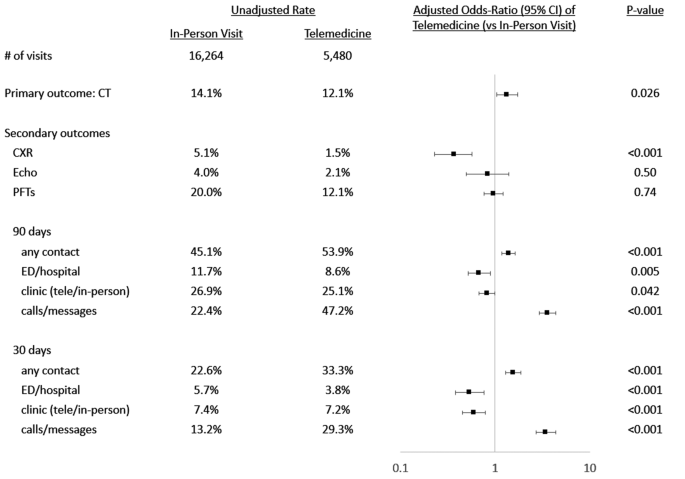
This retrospective cohort study identified adults with pulmonary clinic visits at the University of Miami Hospital and Clinics (January 2018-December 2021). The primary exposure was telemedicine versus in-person visits. Standard statistics were used to describe the cohort and compare patients stratified by visit type. Multivariable logistic regression models evaluated the association of telemedicine with resource use (primarily, computed tomography [CT] orders placed within 7 days of visit).

Results

Association of Telemedicine with Resource Use. 
21,744 clinic visits were included: 5,480 (25.2%) telemedicine and 16,264 (74.8%) in-person. In both, the majority were < 65-years-old, female, and identified as Hispanic white. Patients seen with telemedicine had increased odds of having CT scans ordered within 7 days (adjusted odds ratio [aOR] 1.34, [95% confidence interval 1.04–1.74]); and decreased odds of chest x-rays (aOR 0.37 [0.23–0.57]). Telemedicine increased odds of contact of any kind with our healthcare system within 30-days (aOR 1.56 [1.29–1.88]) and 90-days (aOR 1.39 [1.17–1.64]).

June 5, 2024

Anaphylaxis in a Swiss university emergency department: clinical characteristics and supposed triggers

Ehrhard, S., Eyb, V., Gautschi, D. et al. Allergy Asthma Clin Immunol 20, 35 (2024). https://doi.org/10.1186/s13223-024-00901-y

Abstract

Background

Anaphylaxis is the most severe form of acute systemic and potentially life-threatening reactions triggered by mast and basophilic cells. Recent studies show a worldwide incidence between 50 and 112 occurrences per 100,000 person-years. The most identified triggers are food, medications, and insect venoms. We aimed to analyze triggers and clinical symptoms of patients presenting to a Swiss university emergency department for adults.

Methods

Six-year retrospective analysis (01/2013 to 12/2018) of all patients (> 16 years of age) admitted with moderate or severe anaphylaxis (classification of Ring and Messmer ≥ 2) to the emergency department. Patient and clinical data were extracted from the electronic medical database of the emergency department.

Results

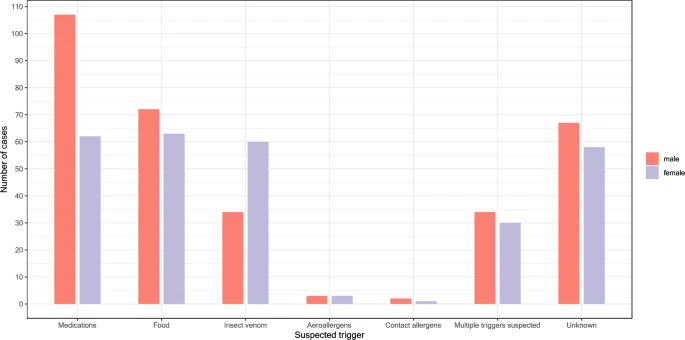
Suspected triggers: different frequency between women and men, n = 531
Of the 531 includes patients, 53.3% were female, the median age was 38 [IQR 26–51] years. The most common suspected triggers were medications (31.8%), food (25.6%), and insect stings (17.1%).

June 2, 2024

Multiplex Assays in Allergy Diagnosis: Allergy Explorer 2 versus ImmunoCAP ISAC E112i


Nösslinger H, Mair E, Oostingh GJ, Ahlgrimm-Siess V, Ringauf A, Lang R.  Diagnostics (Basel). 2024 May 8;14(10):976. doi: 10.3390/diagnostics14100976.

Abstract

Frequency of detection of animal and plant pan-allergens
by ISAC (blue) and ALEX
2 (green) and their concordance
ImmunoCAP ISAC E112i (ISAC) and Allergy Explorer 2 (ALEX2) detect specific immunoglobulin E (IgE) reactivity. Both multiplex assays contain molecular allergens and ALEX2 additionally includes allergen extracts and inhibitors that block the binding of IgE to cross-reacting carbohydrate determinants (CCDs). This study aimed to compare the performance of ISAC and ALEX2 by determining the IgE reactivity against allergen extracts and/or allergen components and by using qualitative, semiquantitative, and quantitative analyses of all comparable allergen components in sera from 216 participants recruited in South Tyrol/Italy.