June 23, 2024

Risk of Anaphylaxis Associated with Cold Urticaria

Bizjak, M., Rutkowski, K. & Asero, R. Curr Treat Options Allergy (2024). https://doi.org/10.1007/s40521-024-00366-9

Abstract

Purpose of review

Cold-induced anaphylaxis (ColdA) is a poorly understood form of anaphylaxis that occurs in patients with cold urticaria (ColdU). This comprehensive review aims to deepen the understanding of ColdA. It emphasizes the identification of high-risk ColdU patients susceptible to ColdA and provides recommendations for their effective management.

Recent findings

Recent studies, including the large international COLD-CE study, have identified clinical features of ColdU patients associated with increased ColdA risk. These individuals can now be recognized through routine clinical assessments.

June 21, 2024

COFAITH and COMFA: A Collective Roadmap for Past and Future Food Allergy Clinical Trials and Observational Research on Interventions

Protudjer, J. ., Munblit, D., Apfelbacher, C., Marchisotto, M., Cook, E., Capper, I., Rodríguez Del Río, P. and Comberiati, P. (2024) Clin Exp Allergy. https://doi.org/10.1111/cea.14522

Abbreviations
COFAITH: clinical outcomes of efficacy in food allergen immunotherapy trials
COMFA: core outcome measures for food allergy

Summary

  • Recent initiatives explored food allergy outcome harmonisation, for existing immunotherapy trials and future clinical trials.

  • Outcomes common to both initiatives included desensitisation, sustained unresponsiveness/remission, quality of life and allergic symptoms.


Management of Refractory Anaphylaxis: An Overview of Current Guidelines

Pouessel, G., Dribin, T., Tacquard, C., Tanno, L., Cardona, V., Worm, M., Deschildre, A., Muraro, A., Garvey, L. and Turner, P. (2024) Clin Exp Allergy. https://doi.org/10.1111/cea.14514

ABSTRACT

In this review, we compare different refractory anaphylaxis (RA) management guidelines focusing on cardiovascular involvement and best practice recommendations, discuss postulated pathogenic mechanisms underlining RA and highlight knowledge gaps and research priorities. There is a paucity of data supporting existing management guidelines.

First- and second-line treatment of refractory anaphylaxis
according to the current guidelines. IV, intravenous.
Therapeutic recommendations include the need for the timely administration of appropriate doses of aggressive fluid resuscitation and intravenous (IV) adrenaline in RA. The preferred second-line vasopressor (noradrenaline, vasopressin, metaraminol and dopamine) is unknown. Most guidelines recommend IV glucagon for patients on beta-blockers, despite a lack of evidence.

June 20, 2024

Unraveling determinants of severe anaphylaxis — A cluster analysis from a large national hospitalization database

Luciana Kase Tanno , Pham Thao Van Luong, Megane Dieval, Caroline Dunoyer, Nicolas Molinari, Isabella Annesi-Maesano, Pascal Demoly. Journal of Allergy and Hypersensitivity Diseases Volume 1, January–March 2024, 100004

Abstract

Background

Understanding potential risk factors and phenotypes at-risk of anaphylaxis can tailor public health actions to prevent avoidable deaths. Therefore, our aim was to explore patterns of hospital admissions diagnosed with anaphylaxis in France from 2012 to 2021, across different age groups, using the national French hospital database and to evaluate potential determinants to propose phenotypes at-risk, with a particular view to severe cases.

Methods

This is a descriptive study, using data from the French Program for the Medicalization of Information Systems, from 2012 to 2021. We included all patients hospitalized for anaphylaxis using International Classification of Diseases (ICD)-10 codes listed as a primary diagnosis.

Transition between subcutaneous and sublingual allergen immunotherapy: Recommendations of the Brazilian Association of Allergy and Immunology (ASBAI)

Aarestrup, Fernando Monteiro et al. Journal of Allergy and Clinical Immunology: Global, Volume 3, Issue 3, 100281

Abstract

The use of allergen immunotherapy (AIT) in Brazil has specific regional conditions owing to the pattern of allergen sensitization, as well as to genetic, socioeconomic, and cultural characteristics. This review article aims to discuss the clinical practice of AIT by the subcutaneous or sublingual route in Brazil, addressing the possibilities of transition between these forms of administration. A systematic review using the PubMed and Cochrane databases was performed, and the websites of major allergy and immunology organizations were consulted.

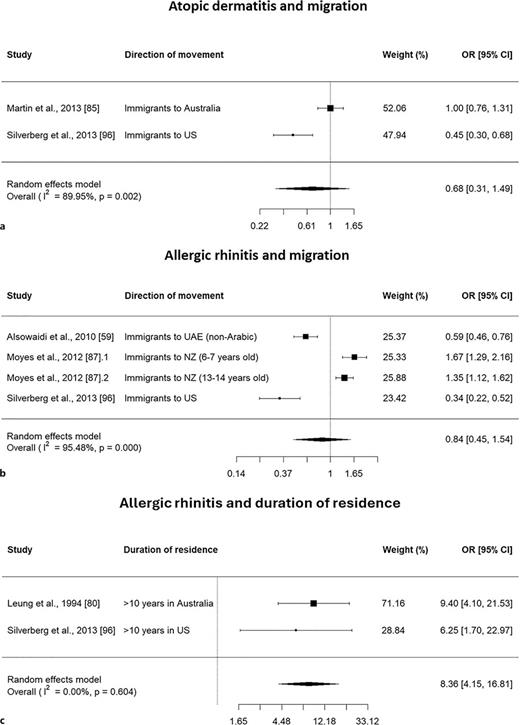
The Association between Migration and Prevalence of Allergic Diseases: A Systematic Review and Meta-Analysis

Qi Yi Ambrose Wong; Fook Tim Chew Int Arch Allergy Immunol 1–24.  JUNE 20 2024 https://doi.org/10.1159/000539382

Introduction: Allergic diseases remain of concern due to their increasing prevalence worldwide. Intrinsic and environmental risk factors have been implicated in the pathogenesis of allergic disease. Among the possible risk factors, migration has been associated with the manifestation of allergic diseases. We aimed to consolidate the existing evidence, review the hypotheses for the relationship between environmental factors and allergic disease, and provide a direction for future work. Methods: This systematic review and meta-analysis complied with Preferred Reporting Items for Systematic Reviews and Meta-Analyses (PRISMA) guidelines. The Web of Science database was searched in September 2023 to retrieve publications investigating the relationship between allergic rhinitis (AR), atopic dermatitis (AD), or asthma and the following factors: (i) migrant status (i.e., migrants vs. natives) or (ii) duration since migration among migrants.

June 19, 2024

Biomarkers of peanut allergy in children over time.

Foong R-X, Du Toit G, van Ree R, et al.  Allergy. 2024; 00: 1-12. doi:10.1111/all.16193

Abstract

Background

Various biomarkers are used to define peanut allergy (PA). We aimed to observe changes in PA resolution and persistence over time comparing biomarkers in PA and peanut sensitised but tolerant (PS) children in a population-based cohort.

Methods

Participants were recruited from the EAT and EAT-On studies, conducted across England and Wales, and were exclusively breastfeed babies recruited at 3 months old and followed up until 7–12 years old. Clinical characteristics, skin prick test (SPT), sIgE to peanut and peanut components and mast cell activation tests (MAT) were assessed at 12 months, 36 months and 7–12 years. PA status was determined at the 7–12 year time point.

Contribution of MASK-air® as an mHealth Tool for Digitally Enabled Person-Centered Care in Rhinitis and Asthma

Sousa-Pinto B, Fonseca JA, Bousquet J. J Investig Allergol Clin Immunol. 2024 May 14:0. doi: 10.18176/jiaci.0994. 


Abstract:

 How MASK-air® can contribute to research and clinical practice.
GDPR indicates General Data Protection Regulation.
In chronic diseases, mHealth apps help to improve clinical management and provide valuable real-world scientific evidence. In allergic rhinitis, a market research study identified only 4 mHealth apps that were multilingual, resulted in scientific publications, and displayed a comprehensive list of medications. Of these 4 apps, MASK-air® generated the highest number of scientific publications. MASK-air was launched in 2015 and is currently available in 30 countries, with data collected from more than 30 000 users. It comprises a daily monitoring questionnaire, enabling patients to register their daily allergy symptoms by means of visual analog scales and their medication use.