November 13, 2024

GA2LEN ANACARE consensus statement: Potential of omalizumab in food allergy management

Zuberbier T, Muraro A, Nurmatov U, et al.  Clin Transl Allergy. 2024;e70002. https://doi.org/10.1002/clt2.70002

Abstract

Immunoglobulin E (IgE)-mediated food allergies are the most common type of food allergy, often causing rapid symptoms after exposure to allergens posing a serious health risk and a high impact on patient's and caregiver's quality of life. Omalizumab, a humanized anti-IgE monoclonal antibody, reduces allergic reactions by binding to circulating IgE. Omalizumab has been successfully used in allergic asthma, chronic rhinosinusitis with nasal polyps, and chronic urticaria, and was recently approved for treating IgE-mediated food allergies by the US Food and Drug Administration (FDA).

This GA2LEN ANACARE Consensus Statement presents our position on the use of omalizumab for treating IgE-mediated food allergies, based on a systematic review and meta-analysis, experience with use for other conditions, and expert consensus achieved via an eDelphi process.

ARIA webinar: ARIA GUIDELINES 2024 (November 19th)

Dear Friends & Colleagues,

We invite you to attend an ARIA webinar entitled ARIA GUIDELINES 2024

DATE: Tuesday 19 November

TIME: 18.00 - 19.00 CET (France time zone)

AGENDA :

Jean Bousquet: Overall presentation of the ARIA Guidelines

Bernardo Sousa Pinto: Artificial Intelligence in ARIA Guidelines and Evidence to Decision

To join the webinar, please click here

For those who cannot join on Tuesday > we will be having a repeat webinar (exactly the same) before the end of the month. 

We look forward to seeing you there

Best wishes

Jean, Bernardo, Anna, Veronique


November 12, 2024

A comparative study between methylprednisolone versus dexamethasone as an initial anti-inflammatory treatment of moderate COVID-19 pneumonia: an open-label randomized controlled trial

Laikitmongkhon, J., Tassaneyasin, T., Sutherasan, Y. et al. BMC Pulm Med 24, 562 (2024). https://doi.org/10.1186/s12890-024-03364-4

Abstract

Background

The most appropriate anti-inflammatory treatment for moderate COVID-19 pneumonia remains uncertain. We aimed to compare the effectiveness of a high-dose methylprednisolone versus a high-dose dexamethasone in hospitalized moderate COVID-19 pneumonia, regarding the WHO clinical progression scales, mortality, and the length of hospitalization.

Methods

In this open-labeled randomized controlled trial, we enrolled patients with age > 18 years old who were diagnosed moderate COVID-19 pneumonia confirmed by real-time PCR, evidence of pneumonia by chest imaging and resting oxygen saturation between 90 and 94%. Patients were randomized at a 1:1 ratio to receive methylprednisolone 250 mg/day or dexamethasone 20 mg/day over the first three days.

November 9, 2024

V Brazilian Consensus on Rhinitis – 2024

Solé D, Kuschnir FC, Pastorino AC et al. Braz J Otorhinolaryngol. 2024 Sep 7;91(1):101500. doi: 10.1016/j.bjorl.2024.101500. 

Highlights

• This consensus brings together the most up-to-date information on rhinitis.

• Anamnesis is the key point in the suspected diagnosis and phenotype identification.

• It is especially important to recognize comorbidities.

• One aspect that impacts adequate treatment is low patient compliance.

Abstract

Since we published the “IV Brazilian Consensus on Rhinitis”, in 2017, several advances have been achieved and have enabled a further understanding of the different aspects of “Rhinitis”. This new guideline, developed jointly by ASBAI, SBP and SBORL, represents a relevant milestone in the updated and integrated management of the different forms of the disease, and it aims to unify evidence-based approaches to improve the diagnosis and treatment of this common and often underestimated condition. The document covers a wide range of topics, including clear definitions of the different phenotypes and endotypes of rhinitis, risk factors, updated diagnostic criteria, and recommended methods for clinical and laboratory investigation.

Cognitive and Behavioral Outcomes of Snoring Among Adolescents

Amal Isaiah, Sophia Uddin, Thomas Ernst, Christine Cloak, Dongdong Li, Linda Chang.  JAMA Netw Open. 2024;7(11):e2444057. doi:10.1001/jamanetworkopen.2024.44057

Key Points

Question  Is parent-reported snoring frequency associated with cognitive and behavioral outcomes in adolescents?

Findings  In this cohort study of 11 862 adolescents, frequent snoring was associated with greater problem behaviors but not with lower cognition.

Meaning  These findings suggest that clinicians should incorporate the differential associations of snoring with cognitive and behavioral outcomes in shared decision-making concerning the management of adolescents with sleep-disordered breathing symptoms.

Abstract

Importance  Snoring is central to sleep-disordered breathing (SDB), which arises from nocturnal upper airway resistance. Habitual snoring is associated with cognitive and behavioral problems in young children, but less is known about these associations in adolescents.

Objective  To assess the longitudinal associations of snoring with cognition and problem behaviors among adolescents.

November 7, 2024

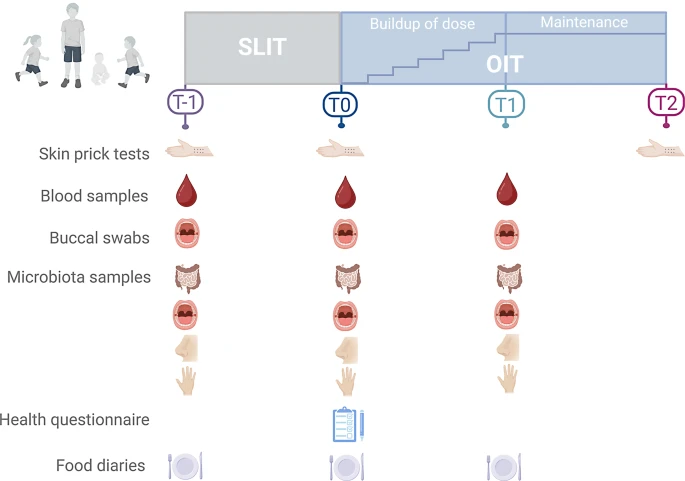
Zéro allergie research clinic: a clinical and research initiative in oral immunotherapy for managing IgE-mediated food allergy

Tremblay, B.L., Bégin, P., Gagnon-Brassard, F. et al. Allergy Asthma Clin Immunol 20, 59 (2024). https://doi.org/10.1186/s13223-024-00921-8


Abstract

Background and methods

Study protocol of the Zéro allergie research clinic.
Skin prick tests, food diaries, and various samples are taken
before the sublingual immunotherapy (SLIT) (T-1),
before the oral immunotherapy (OIT) (T0),
and at the end of the buildup of dose (T1)
The Zéro allergie research clinic (Saguenay, Canada) is a clinical and research initiative in oral immunotherapy (OIT) for managing IgE-mediated food allergy (FA). A total of 183 children with FA and 27 non-allergic siblings were recruited to date in the Zéro allergie cohort (ZAC) to better understand biological mechanisms underlying FA and OIT prognosis.

October 31, 2024

Improving Clinical Practice Through Patient Registries in Allergy and Immunology

Moore, Andrew et al. The Journal of Allergy and Clinical Immunology: In Practice, Volume 12, Issue 10, 2599 - 2609

Abstract

Patient registries are a mechanism for collecting data on allergic and immunologic diseases that provide important information on epidemiology and outcomes that can ultimately improve patient care. Key criteria for establishing effective registries include the use of a clearly defined purpose, identifying the target population and ensuring consistent data collection. Registries in allergic diseases include those for diseases such as inborn errors of immunity (IEI), food allergy, asthma and anaphylaxis, pharmacological interventions in vulnerable populations, and adverse effects of pharmacologic interventions including hypersensitivity reactions to drugs and vaccines.

After high-level planning, the next steps include assembling a team with the requisite project management, subject expertise, technical, legal, and quality assurance competencies.

Analysis of criteria for choosing drug treatment strategies in allergic rhinitis


Grzegorzewski D, Sobczak M, Tołkacz M, Pawliczak R. Front Pharmacol. 2024 Oct 1;15:1340554. doi: 10.3389/fphar.2024.1340554

Abstract

Background: Allergic rhinitis (AR) is the most common type of rhinitis, the treatment of which relies on relieving symptoms. Therefore, we aimed to assess the criteria that influence doctors' decision-making in the process of drug selection for the treatment of allergic rhinitis based on quantitative, qualitative, and cost analyses.

Methods: We conducted a survey study with the participation of 300 allergologists. A self-developed questionnaire was presented during a computer-assisted telephone interview (CATI) according tostandard procedures. The contingency table underwent statistical analysis using the chi-square test with Cramer's V. Results were considered statistically significant at p < 0.05.

Routes of drug administration preferred by patients
(A) overall (multiple choice) and (B) for oral drugs.
Results: Our analyses showed that doctors most often prescribe intranasal glucocorticoids and oral antihistamines to treat allergic rhinitis in patients of all ages. The most common factor that affects the decision-making related to AR treatment was the efficiency of the drug. We found a significant relationship between factors and the main workplace (X-squared = 122.81, df = 90, p-value = 0.0123, Cramer's V = 0.1787216), as well as voivodeship of the main workplace (X-squared = 440.75, df = 270, p-value = 2.378e-10, Cramer's V = 0.1954731).