July 15, 2023

Abatacept to induce remission of peanut allergy during oral immunotherapy (ATARI): protocol for a phase 2a randomized controlled trial.


Braun C, Azzano P, Gingras-Lessard F, Roy É, Samaan K, Graham F, Paradis L, Des Roches A, Bégin P. Front Med (Lausanne). 2023 Jun 28;10:1198173. doi: 10.3389/fmed.2023.1198173.

Abstract

Context: While oral immunotherapy (OIT) has been shown to promote the remission of mild peanut allergy in young children, there is still an unmet need for a disease-modifying intervention for older patients and those with severe diseases. In mice models, abatacept, a cytotoxic T lymphocyte-associated antigen-4 (CTLA-4) immunoglobulin fusion protein, has been shown to promote immune tolerance to food when used as an adjuvant to allergen immunotherapy. The goal of this study is to explore the potential efficacy of abatacept in promoting immune tolerance to food allergens during OIT in humans.

ATARI study design.
Methods: In this phase 2a proof-of-concept study (NCT04872218), 14 peanut-allergic participants aged from 14 to 55 years will be randomized at a 1:1 ratio to abatacept vs. placebo for the first 24 weeks of a peanut OIT treatment (target maintenance dose of 300 mg peanut protein).

The cow’s milk allergy that wasn’t: allergy to supplemental oral lactase enzyme


Allergy, Asthma & Clinical Immunology volume 19, Article number: 61 (2023

Background

Allergy to supplemental lactase is sparsely reported in the literature with only one prior case of anaphylaxis documented [2]. Reactions to this agent can occur following cow’s milk ingestion which could lead to an erroneous diagnosis of cow’s milk allergy in the absence of another explanation.

Case presentation

Our patient, a 48-year-old male with eczema, exercise-induced asthma and rhinoconjunctivitis, presented with four episodes of systemic reactions characterized by mucosal swelling and asthma symptoms following ice-cream exposure.

Abnormal adenosine metabolism of neutrophils inhibits airway inflammation and remodeling in asthma model induced by Aspergillus fumigatus


BMC Pulmonary Medicine volume 23, Article number: 258 (2023

Background

Neutrophils consume a large amount of energy when performing their functions. Compared with other white blood cells, neutrophils contain few mitochondria and mainly rely on glycolysis and gluconeogenesis to produce ATP. The inflammatory site is hypoxic and nutrient poor. Our aim is to study the role of abnormal adenosine metabolism of neutrophils in the asthmatic airway inflammation microenvironment.

Method

In this study, an asthma model was established by intratracheal instillation of Aspergillus fumigatus extract in Ecto-5'-Nucleotidase (CD73) gene–knockout and wild-type mice.

July 13, 2023

Racial, Ethnic, and Socioeconomic Differences in Food Allergies in the US

Jiang J, Warren CM, Brewer A, Soffer G, Gupta RS.


JAMA Netw Open. 2023 Jun 1;6(6):e2318162. doi: 10.1001/jamanetworkopen.2023.18162.
Key Points

Question  What is the national distribution of food allergies among all US individuals across race, ethnicity, and socioeconomic groups?

Findings  In this survey study of 51 819 households, Asian, Black, and Hispanic individuals were more likely to report having food allergies compared with White individuals. The prevalence of food allergies was lowest among households in the highest income bracket.

Meaning  This study suggests that racial, ethnic, and socioeconomic differences in the prevalence of food allergies exist and are evident in clinical outcomes such as food allergy–related emergency department visits and epinephrine autoinjector use.

Abstract

Importance  Food allergies affect approximately 8% of children and 11% of adults in the US. Racial differences in food allergy outcomes have previously been explored among Black and White children, but little is known about the distribution of food allergies across other racial, ethnic, and socioeconomic subpopulations.

July 12, 2023

Efficacy and safety of subcutaneous immunotherapy in asthmatic children allergic to house dust mite: a meta-analysis and systematic review

Front Pediatr. 2023 Jun 15;11:1137478. doi: 10.3389/fped.2023.1137478.

Chen Zheng, Hao Xu, Shumin Huang and Zhimin Chen*

  • Department of Pulmonology, The Children's Hospital, Zhejiang University School of Medicine, Hangzhou, China

Background: Subcutaneous immunotherapy (SCIT) has been proved to be effective and safe in adult asthma. But it is still controversial in children.

Object: To evaluate the efficacy and safety of SCIT in asthmatic children with allergy to house dust mite.

Nausea, Vomiting, and Diarrhea Are Common in Community-Acquired Acute Viral Respiratory Illness


Dig Dis Sci (2023). https://doi.org/10.1007/s10620-023-07976-4

Abstract

Background

Gastrointestinal (GI) symptoms are recognized sequelae of acute respiratory illness (ARI), but their prevalence is not well documented. Our study aim was to assess the incidence of GI symptoms in community ARI cases for persons of all ages and their association with clinical outcomes.

Methods

We collected mid-nasal swabs, clinical, and symptom data from Seattle-area individuals during the 2018–2019 winter season as part of a large-scale prospective community surveillance study.

July 11, 2023

Identification of key genes and the pathophysiology associated with allergen-specific immunotherapy for allergic rhinitis

Fan, K., Zhou, S., Jin, L. et al. BMC Immunol 24, 19 (2023). https://doi.org/10.1186/s12865-023-00556-1

Abstract

Background

Allergen-specific immunotherapy (AIT) is a causative treatment in allergic rhinitis (AR), comprising long-term allergen administration and over three years of treatment. This study is carried out for revealing the mechanisms and key genes of AIT in AR.

Methods

The present study utilized online Gene Expression Omnibus (GEO) microarray expression profiling dataset GSE37157 and GSE29521 to analyze the hub genes changes related to AIT in AR. Based on limma package, differential expression analysis for the two groups (samples of allergic patients prior to AIT and samples of allergic patients undergoing AIT) was performed to obtain differentially expressed genes (DEGs). Gene Ontology (GO) analysis and Kyoto Encyclopedia of Genes and Genomes (KEGG) pathway analysis of DEGs were conducted using DAVID database. A Protein-Protein Interaction network (PPI) was built and a significant network module was acquired by using Cytoscape software (Cytoscape, 3.7.2).

Real-time environmental surveillance of SARS-CoV-2 aerosols

Puthussery, J.V., Ghumra, D.P., McBrearty, K.R. et al.  Nat Commun 14, 3692 (2023). https://doi.org/10.1038/s41467-023-39419-z

Abstract

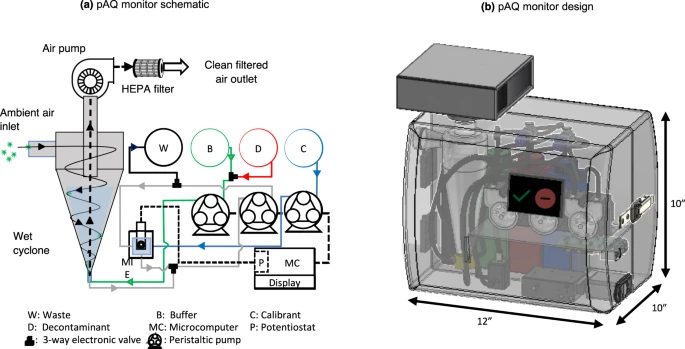
Real-time surveillance of airborne SARS-CoV-2 virus is a technological gap that has eluded the scientific community since the beginning of the COVID-19 pandemic. Offline air sampling techniques for SARS-CoV-2 detection suffer from longer turnaround times and require skilled labor. Here, we present a proof-of-concept pathogen Air Quality (pAQ) monitor for real-time (5 min time resolution) direct detection of SARS-CoV-2 aerosols. The system synergistically integrates a high flow (~1000 lpm) wet cyclone air sampler and a nanobody-based ultrasensitive micro-immunoelectrode biosensor.