Abstract
Background
Since 2015, our nasal allergen challenge (NAC) protocol has been used to investigate the pathophysiology of allergic rhinitis (AR) with various allergens. However, we have yet to publish a comprehensive examination of the pathophysiology associated with AR to ragweed pollen.
Methods
Nineteen ragweed pollen allergic and 12 healthy (nonallergic) control participants from Kingston, Ontario, Canada, completed the NAC to ragweed pollen extract out-of-season. Total nasal symptom score (TNSS) and percent fall in peak nasal inspiratory flow (PNIF) were collected up to 48 h post-exposure. Nasal fluid and serum samples were collected post-exposure, and white blood cell differential counts, serum ragweed-specific and total immunoglobulin-E (IgE), and nasal cytokine concentrations were analyzed. Statistical tests were performed using GraphPad Prism 10.4.0.
Results
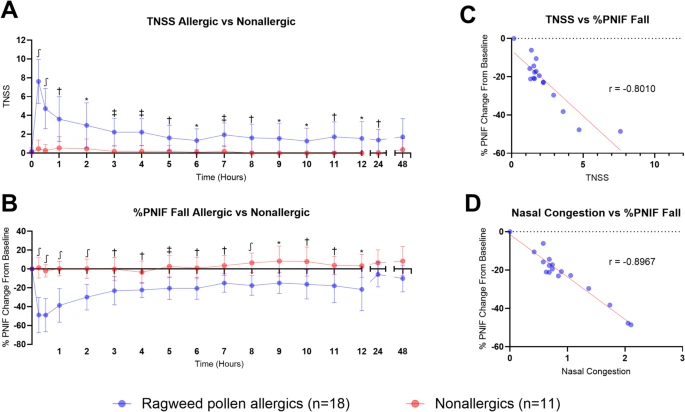 |
| Clinical symptoms induced by nasal allergen challenge (NAC) with Ragweed pollen |
Conclusions
This study confirms the effectiveness of our NAC protocol in eliciting clinical and biological responses in ragweed-allergic participants, particularly highlighting eosinophil activity, IgE, and cytokine dynamics. Future research should investigate the roles of specific IgE, IL-4, and eosinophil activation in allergic inflammation. Additionally, this NAC study population provides a strong foundation for examining the nasal microbiome in AR. Longitudinal studies exploring the relationship between allergic responses and microbiome shifts could offer deeper insights into the underlying mechanisms of disease.


No comments:
Post a Comment