July 17, 2024

Chronic urticaria: unmet needs, emerging drugs, and new perspectives on personalized treatment

Torsten Zuberbier, Luis Felipe Ensina, Ana Giménez-Arnau, et al. (2024) The Lancet. doi:https://doi.org/10.1016/S0140-6736(24)00852-3.

Summary

Available and novel therapies under development for chronic urticaria
Chronic urticaria is a common and debilitating mast cell-driven skin disease presenting with itchy wheals, angio-oedema, or both. Chronic urticaria is classified as spontaneous (without definite triggers) and inducible (with definite and subtype-specific triggers; eg, cold or pressure). Current management guidelines recommend step-up administration of second-generation H1-antihistamines to four-fold the approved dose, followed by omalizumab and ciclosporin.

July 16, 2024

JACQLQ subjective symptom questionnaire score and clinical test results for patients with allergic conjunctival disease

Yamana, Y., Yamana, S. & Uchio, E. Sci Rep 14, 16235 (2024). https://doi.org/10.1038/s41598-024-67117-3

Abstract

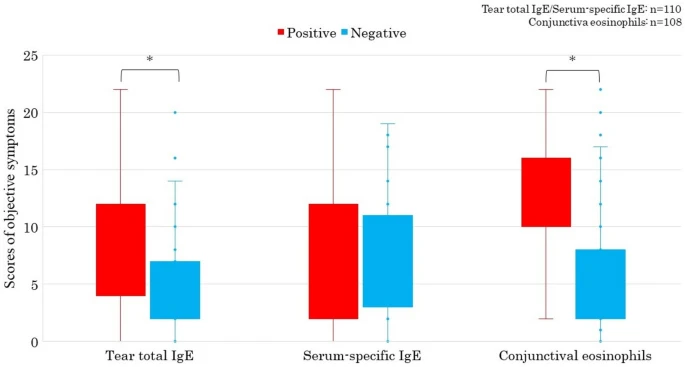
Comparison of objective symptoms’ scores by JACQLQ ver1 between
cases positive or negative for tear total IgE, serum specific IgE
and conjunctival eosinophils
We investigated the relationship between subjective symptoms and objective findings in patients with allergic conjunctival diseases (ACD) and test results for tear total IgE (t-tIgE), conjunctival eosinophils (c-Eo), serum total IgE (s-tIgE), serum-antigen specific IgE (s-sIgE), and serum eosinophils (s-Eo). Subjective symptoms and objective findings of patients with ACD were evaluated using Japanese Allergic Conjunctival Disease Quality of Life Questionnaire (JACQLQ), which described disability score and emotional score written by patient and clinical findings score written by ophthalmologist.

Performance Analysis of Non-invasive Biomarkers in the Treatment of Eosinophilic Oesophagitis

Emilio Narváez-Fernández, Margarita Tomás-Perez. EMJ Allergy Immunol. 2024;9[1]:63-69. 

Abstract

Introduction: Eosinophilic oesophagitis (EoE) is an emerging disease of the oesophagus. However, so far there are no fully validated biomarkers for diagnosis and monitoring. Moreover, research focuses on parameters that are not very useful and accessible for routine clinical practice. Thus, endoscopy remains the main method of follow-up in this population.

Methods: The team analysed the levels of total Ig E, absolute eosinophil count (AEC), eosinophil cationic protein, and immunoglobulin G4 in a cohort of 399 adult patients with EoE (without other oesophageal pathologies). After controlling for confounding factors, they compared patients with active EoE and those in remission (responders).

Comparison of markers by treatment group.
Results: It was observed that, in responders, the AEC was lower (p=0.014). Furthermore, in corticosteroid-controlled patients, total Ig E was lower (p=0.016); while in proton pump inhibitors, responders both absolute (p=0.007) and percentage (p=0.002) eosinophils were lower.

July 14, 2024

Prenatal Factors in the Development of Allergic Diseases

Grijincu M, Buzan MR, Zbîrcea LE, Păunescu V, Panaitescu C.  Int J Mol Sci. 2024 Jun 8;25(12):6359. doi: 10.3390/ijms25126359. 

Abstract

Allergic diseases are showing increasing prevalence in Western societies. They are characterized by a heightened reactivity towards otherwise harmless environmental stimuli. Allergic diseases showing a wide range of severity of symptoms have a significant impact on the quality of life of affected individuals. This study aims to highlight the mechanisms that induce these reactions, how they progress, and which prenatal factors influence their development. Most frequently, the reaction is mediated by immunoglobulin E (IgE) produced by B cells, which binds to the surface of mast cells and basophils and triggers an inflammatory response. The antibody response is triggered by a shift in T-cell immune response. The symptoms often start in early childhood with eczema or atopic dermatitis and progress to allergic asthma in adolescence.
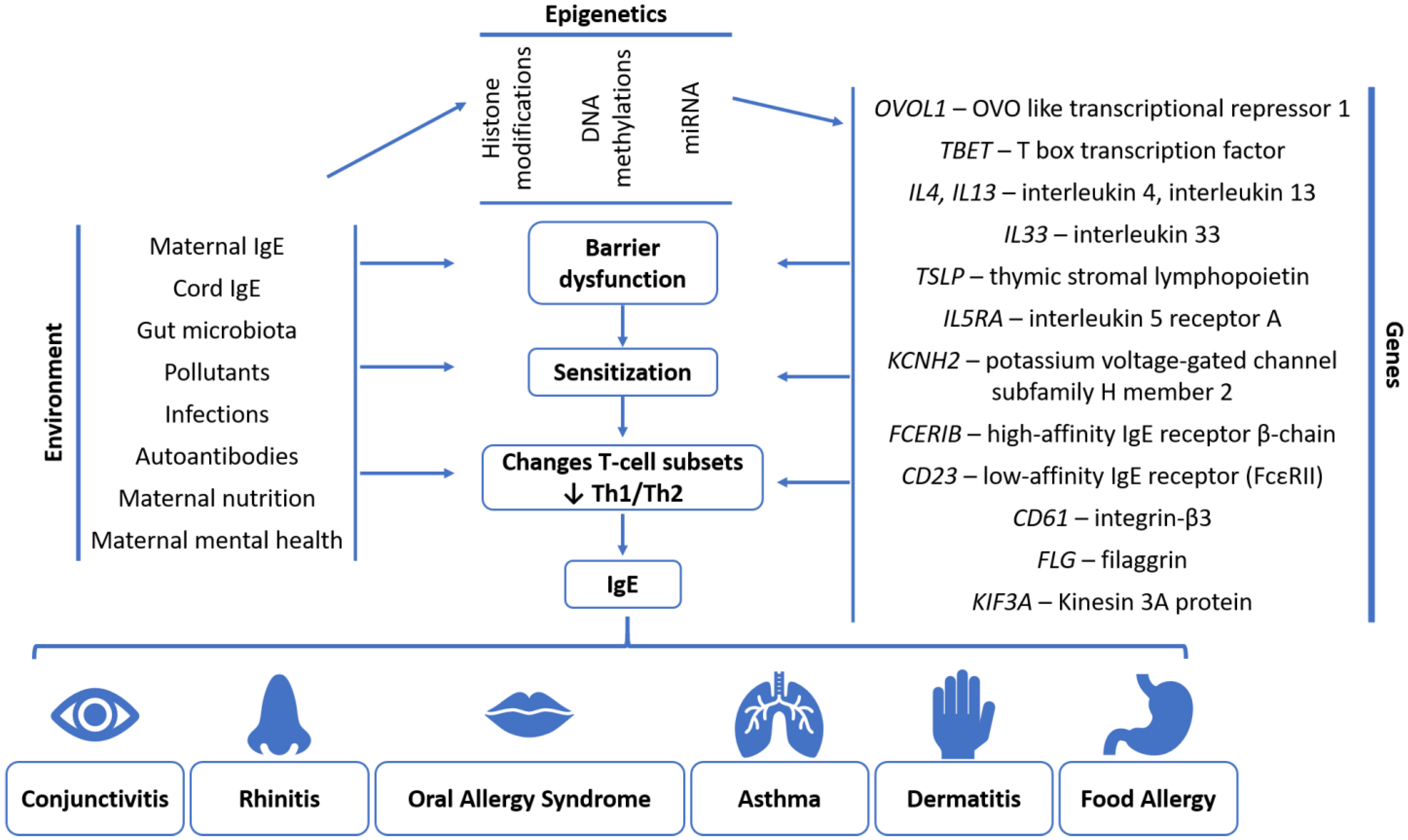
Environmental, epigenetic and genetic factors leading to
the development of allergic diseases
An important determinant of allergic diseases seems to be parental, especially maternal history of allergy. Around 30% of children of allergic mothers develop allergic sensitization in childhood. Genes involved in the regulation of the epithelial barrier function and the T-cell response were found to affect the predisposition to developing allergic disorders. Cord blood IgE was found to be a promising predictor of allergic disease development. Fetal B cells produce IgE starting at the 20th gestation week.

Combining treat-to-target principles and shared decision-making: International expert consensus-based recommendations with a novel concept for minimal disease activity criteria in atopic dermatitis

Silverberg JI, Gooderham M, Katoh N, Aoki V, Pink AE, Binamer Y, et al.  J Eur Acad Dermatol Venereol. 2024; 00: 1–10. https://doi.org/10.1111/jdv.20229

Abstract

Background

Current treat-to-target recommendations for atopic dermatitis (AD) may not include high enough treatment targets and do not fully consider patient needs.

Objective

To develop recommendations for optimized AD management, including disease severity assessments, treatment goals and targets, and guidance for treatment escalation/modification.

Methods

An international group of expert dermatologists drafted a series of recommendations for AD management using insights from a global patient study and 87 expert dermatologists from 44 countries. Experts voted on recommendations using a modified eDelphi voting process.

Results

Overview of the AHEAD approach.

Drug-Induced Angioedema Without Urticaria: A Case Report

Raikar S R, G S, Sneha S, et al. (July 13, 2024) Cureus 16(7): e64452. doi:10.7759/cureus.64452


Abstract

Diclofenac-induced hypersensitivity reaction - angioedema
Non-steroidal anti-inflammatory drugs (NSAIDs) are widely prescribed for various conditions but are associated with numerous adverse drug reactions (ADRs). Understanding these ADRs is necessary to reduce morbidity and mortality. NSAID-induced angioedema, although rare, can be life-threatening and is often due to increased leukotriene production from COX pathway inhibition.

July 13, 2024

Multiplex LAMP assay for detecting the prevalent species of dust mites Dermatophagoides farinae and Dermatophagoides pteronyssinus in the domestic environment

Shuai, Y., Xue, Q., Tu, H. et al. Sci Rep 14, 16156 (2024). https://doi.org/10.1038/s41598-024-66043-8


Abstract

Dermatophagoides farina (D. farinae) and Dermatophagoides pteronyssinus (D. pteronyssinus) are the prevalent kinds of house dust mites (HDMs). HDMs are common inhalant allergens that cause a range of allergic diseases, such as rhinitis, atopic dermatitis, and asthma. The epidemiology of these diseases is associated with exposure to mites. Therefore, in the present study, a method named multiplex loop-mediated isothermal amplification (LAMP) was developed to detect environmental dust mites. 

Unraveling the Molecular Threads: A Comprehensive Review of the Pathogenesis and Therapeutic Insights Into Allergic Rhinitis.

Sharma A, Deshmukh P, Jain S, et al. Cureus 16(7): e64410. doi:10.7759/cureus.64410

Abstract

Allergic rhinitis (AR) is a prevalent inflammatory disorder of the nasal mucosa, triggered by allergen exposure and characterized by symptoms such as sneezing, nasal congestion, itching, and rhinorrhea. This comprehensive review aims to unravel the molecular mechanisms underpinning AR, exploring the pathogenesis from allergen recognition to chronic inflammation and tissue remodelling. Central to the disease are immunoglobulin E (IgE)-mediated hypersensitivity reactions, involving key inflammatory mediators and cellular players such as mast cells, eosinophils, and T cells.
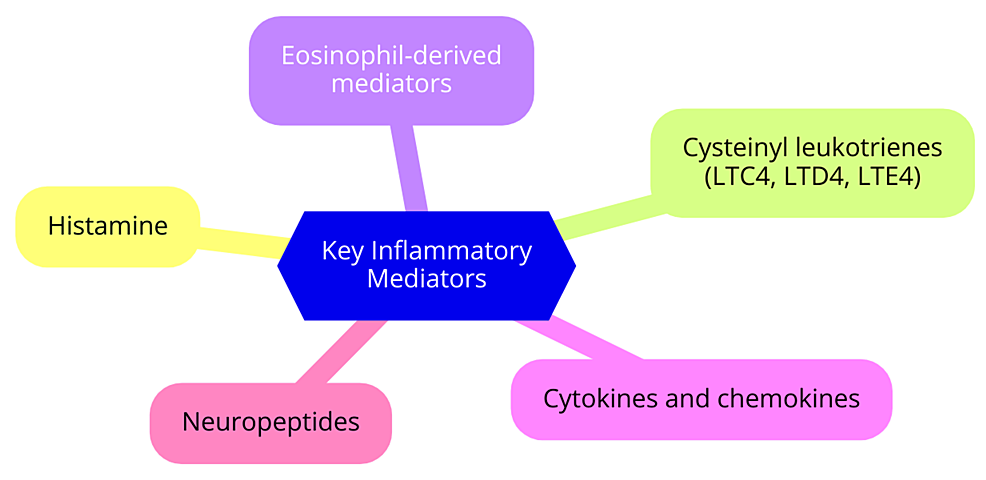
Key inflammatory mediators involved
Genetic predisposition and environmental factors also play significant roles in susceptibility and disease progression.