October 16, 2025

Efficacy of 5-Grass Pollen Liquid Sublingual Allergen Immunotherapy for Seasonal Allergic Rhinoconjunctivitis: A Systematic Review and Meta-analysis

Di Bona D, Paoletti G, Cognet-Sicé J et al. J Investig Allergol Clin Immunol 2025; Vol 35(5) : 341-352 doi: 10.18176/jiaci.1076

Abstract:

Subgroup analyses of symptom score by age and sensitization
status of sublingual immunotherapy vs placebo.
The efficacy and safety of allergen immunotherapy (AIT) have been demonstrated in randomized controlled trials (RCTs). However, differences in study protocols, populations, and AIT products lead to variability in outcomes. The World Allergy Organization and the European Academy of Allergy and Clinical Immunology advise assessing individual AIT products rather than assuming a universal class effect. We conducted a meta-analysis on the efficacy and safety of 5–grass pollen liquid sublingual immunotherapy (SLIT) (5-grass SLIT liquid) in patients affected by allergic rhinoconjunctivitis (ARC) with and without asthma. We searched computerized databases (MEDLINE, ISI Web of Science, LILACS, the Cochrane Library, ClinicalTrial.gov) up to June 2023, supplemented our approach with manual literature searches, and included RCTs comparing 5-grass SLIT-liquid to placebo, irrespective of primary endpoints or treatment duration.

October 13, 2025

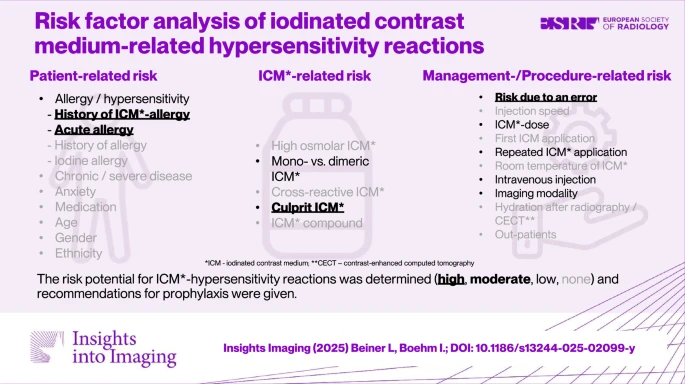
Risk factor analysis of iodinated contrast medium-related hypersensitivity reactions

Beiner, L., Boehm, I.  Insights Imaging 16, 216 (2025). https://doi.org/10.1186/s13244-025-02099-y


Abstract

Graphical Abstract
Hypersensitivity reactions caused by iodinated contrast media (ICM) are by definition type B adverse reactions and therefore, they are not predictable. To partially limit this uncertainty, since the 1980s, risk factors have been defined and published. Currently, there are so many risks that any patient undergoing a contrast-enhanced imaging examination would have at least one risk. This is not helpful and instead leads to uncertainty again. From both studies and clinical experience, we know that only a small percentage of patients develop hypersensitivity reactions after ICM administration. Therefore, we subjected the risks published to a critical analysis. Based on 126 publications, we identified 43 risks, which were divided into three categories (patient-related, contrast agent-related and management-related risks).

October 11, 2025

Correlation Between Allergic Rhinitis, Asthma, and Laryngopharyngeal Reflux Disease: A Systematic Review

Awad BI, Aldokhail LS, Alotaibi EMet al. Ear Nose Throat J. 2025 Oct 5:1455613251378726. doi: 10.1177/01455613251378726. 

Abstract

Background:

Laryngopharyngeal reflux (LPR), allergic rhinitis (AR), and asthma are common airway disorders that often coexist, suggesting shared inflammatory mechanisms. LPR involves gastric reflux into the laryngopharynx, while AR and asthma are linked by the “united airway” hypothesis. Evidence indicates LPR may contribute to AR and asthma exacerbation, yet their interactions remain unclear. Understanding their interaction may enhance clinical outcomes.

Objective:

This systematic review aimed to evaluate the associations between LPR, AR, and asthma by analyzing studies that examined these conditions in various patient populations.

Methodology:


A comprehensive search of electronic databases, including PubMed, Scopus, and Google Scholar, was conducted for studies published up until 2024.

October 9, 2025

ARIA webinar sessions (6 & 7 October 2025)

Jean Bousquet:

  • ARIA: Past, present and future
  • ARIA and MASK-air: Novel findings
  • ARIA 2024-2025: Concept and sources of information

Bernardo Sousa-Pinto:

  • Presentation of the recommendations of intranasal treatments for the ARIA 2024-2025 guidelines
  • What's new in ARIA 2024-2025 in terms of rhinitis management with intranasal treatments?


October 6, 2025

Long-Term, Real-World Effectiveness of Allergen Immunotherapy in Children and Adolescents With Allergic Rhinitis and Asthma

C. Woehlk, T. Stranzl, M. Contoli, et al. Allergy (2025): 1–11, https://doi.org/10.1111/all.70085.

ABSTRACT

Background

Respiratory allergies often begin in childhood and can progress over time, leading to increased disease burden. Allergen immunotherapy (AIT) is the only causal treatment for allergic respiratory diseases with disease-modifying potential. While randomised trials support its efficacy in controlling allergic rhinitis (AR) and asthma symptoms, long-term real-world data in children remain limited.

Methods
This paediatric study (n = 11,036) was conducted within the pre-defined framework of the REACT study, based on protocol-specified objectives. Children (< 18 years) with physician-diagnosed AR, with or without pre-existing asthma, were included. AIT-treated patients were matched 1:1 to non-AIT controls.

October 4, 2025

Digital Monitoring of Symptoms and Lung Function During Birch Pollen Season in Pediatric Patients

Tanninen TH, Reiterä PH, Saarto A et al. Clin Transl Allergy. 2025 Oct;15(10):e70101. doi: 10.1002/clt2.70101. 

ABSTRACT

Background

Mobile health (mHealth) applications for asthma and allergic rhinitis (AR) may guide patients in following medication use, symptoms, and lung function supporting self-management.

Objective

The primary study objective was to investigate the objective effect of birch pollen on asthma and AR symptoms and medicine use in pediatric patients with varying levels of birch-specific immunoglobulin E (IgE) during the 2022 birch pollen season using digital tools. The secondary objectives were to determine the effect of birch pollen on Asthma Control Test scores, and to record the subjective benefits in self-management while using the application.

Methods

Altogether, 48 pediatric participants were categorized into three groups based on their birch-specific IgE levels.
October 3, 2025

Transient refractory period in severe iodinated contrast media allergy: a case report

Dungan, L., Cox, F.  Allergy Asthma Clin Immunol 21, 43 (2025). https://doi.org/10.1186/s13223-025-00972-5

Abstract

Background

Hypersensitivity reactions to iodinated contrast media (ICM) are rare but can be life-threatening. Management typically involves avoidance of the offending agent and the use of alternative imaging strategies. The phenomenon of a transient refractory period—wherein a patient does not exhibit an allergic response upon re-exposure to the allergen shortly after an initial reaction—has been proposed but is not well-documented in the context of ICM.

Case presentation
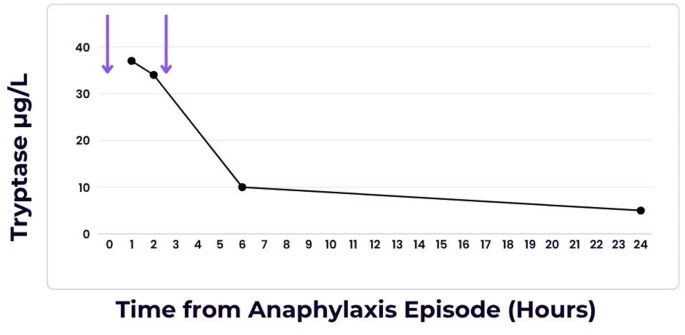
Serum Tryptase versus Time from Anaphylaxis Episode. Purple arrows
represent the two time points at which iodinated contrast media was
administered.
We report the case of a 56-year-old woman who experienced an anaphylaxis associated cardiac arrest following administration of iopamidol 370 (Niopam 370) during a computed tomography pulmonary angiogram (CTPA). She was resuscitated, intubated, and stabilized with noradrenaline. Two hours later, she underwent a second CT scan using iopamidol 300 (Niopam 300) without any obvious immediate hypersensitivity reaction.

October 2, 2025

Omalizumab in the Management of Food Allergy – a Narrative Review of Data from Clinical Studies, Case Series and Case Reports

Jankowski, W.M., Przychodniak, D. & Kurowski, M. Curr Treat Options Allergy 12, 19 (2025). https://doi.org/10.1007/s40521-025-00399-8

Abstract

Purpose of Review

Food allergy is a significant public health problem, affecting 8% of children and 3–4% of adults, with potentially life-threatening anaphylaxis being its most severe manifestation. Trigger food avoidance is still the mainstay of food allergy management, while novel treatments, including specific allergen immunotherapy and omalizumab, a humanized IgG1κ antibody, have shown potential to reduce the risk of allergic reaction after food ingestion. The purpose of this review is to provide an account of current knowledge regarding efficacy and safety profile of omalizumab in the management of food allergy, implemented as a standalone treatment or in combination with oral immunotherapy of food allergy.

Recent Findings

Food protein threshold values after OMA or placebo treatment
Current data indicate that omalizumab significantly increases the threshold of tolerance to food allergens in children, reducing the risk of severe anaphylactic reactions.