October 22, 2025

Association of allergen signatures with individualized allergic phenotypes

Kim D, Cho HJ, Kim CH, Rha MS. Allergol Int. 2025 Oct 15:S1323-8930(25)00109-1. doi: 10.1016/j.alit.2025.09.003.

Abstract

Background

Allergen sensitization patterns are heterogeneous, and their clinical relevance is often obscured by extensive cross-reactivity. We applied non-negative matrix factorization (NMF) to disentangle overlapping immunoglobulin E (IgE) signals and define clinically meaningful allergen signatures in a large Korean cohort.

Methods

We analyzed 45,065 patients who underwent multiplex allergen testing (35 inhalants and food components) between 2010 and 2025. Class-scaled specific IgE values (0–6) were factorized by NMF (k = 4). Signature weights were related to asthma, allergic rhinitis, and atopic dermatitis using multivariable logistic regression and to peripheral eosinophil counts and total IgE using age- and sex-adjusted linear models.

Results

Top allergen loadings for each non-negative matrix
factorization signature.
Four signatures—mite, grass/weed, pet, and tree—explained 77.7 % of the variance in sensitization. The mite signature predominated (57.6 % of patients) and was strongly associated with allergic rhinitis (adjusted OR: 7.21, 95 % CI: 5.66–9.16), as well as marked increases in eosinophils and total IgE.

October 20, 2025

AI, Health, and Health Care Today and Tomorrow The JAMA Summit Report on Artificial Intelligence

Angus DC, Khera R, Lieu T, et al. AI,  JAMA. Published online October 13, 2025. doi:10.1001/jama.2025.18490

Abstract

Importance  Artificial intelligence (AI) is changing health and health care on an unprecedented scale. Though the potential benefits are massive, so are the risks. The JAMA Summit on AI discussed how health and health care AI should be developed, evaluated, regulated, disseminated, and monitored.

Observations  Health and health care AI is wide-ranging, including clinical tools (eg, sepsis alerts or diabetic retinopathy screening software), technologies used by individuals with health concerns (eg, mobile health apps), tools used by health care systems to improve business operations (eg, revenue cycle management or scheduling), and hybrid tools supporting both business operations (eg, documentation and billing) and clinical activities (eg, suggesting diagnoses or treatment plans). Many AI tools are already widely adopted, especially for medical imaging, mobile health, health care business operations, and hybrid functions like scribing outpatient visits. All these tools can have important health effects (good or bad), but these effects are often not quantified because evaluations are extremely challenging or not required, in part because many are outside the US Food and Drug Administration’s regulatory oversight. A major challenge in evaluation is that a tool’s effects are highly dependent on the human-computer interface, user training, and setting in which the tool is used.

October 18, 2025

Efficacy of different allergen-specific immunotherapies for the treatment of allergic rhinitis in children and adults: an umbrella review

He Y, Liu X, Zhou B, Dai T.  Front Immunol. 2025 Sep 25;16:1658826. doi: 10.3389/fimmu.2025.1658826. 

Objective: The aim of this study was to summarize the therapeutic efficacy of various allergen immunotherapy (AIT) in the treatment of allergic rhinitis (AR) among different populations and for different allergens.

Methods: Systematic reviews or meta-analyses related to the efficacy of AIT in the treatment of AR until October 2024 were retrieved from PubMed, Web of Science, Embase, and Cochrane Library. Each study was independently evaluated by two investigators in accordance with the inclusion and exclusion criteria. The methodological quality was assessed using AMSTAR 2, and the quality of evidence was evaluated by the GRADE system.

Forest plot of the efficacy of SLIT in AR patients allergic to HDM.
[(A) Symptom scores. (B) Medication scores].
Results: A total of 16 SRs/Mas were included. The methodological quality was evaluated by AMSTAR 2, with 5 rated as “low” and the remainder as “very low”. The quality of the evidence was assessed using the GRADE system.

The Global Patient Perspective on Uncontrolled Moderate-to-Severe Asthma: Reducing Delays in Diagnosis and Treatment

Rance K, Young B, McCreary G et al. Adv Ther. 2025 Oct 6. doi: 10.1007/s12325-025-03346-w. 

Abstract

Introduction: Uncontrolled asthma greatly affects quality of life globally and highlights unmet medical needs. Despite advances in treatment and care, many patients still experience delayed diagnoses, poor symptom control, and a reliance on emergency care. The Global Allergy and Airways Patient Platform (GAAPP) surveyed patients with moderate-to-severe uncontrolled asthma to assess their care experiences.

Methods: The GAAPP Time Clock Survey is a cross-sectional, online, multilingual survey of adults living in Brazil, Germany, Italy, Japan, Saudi Arabia, the United Arab Emirates, and the US. The survey examined diagnosis, symptoms, treatment outcomes, challenges in self-management, and timelines for care coordination.

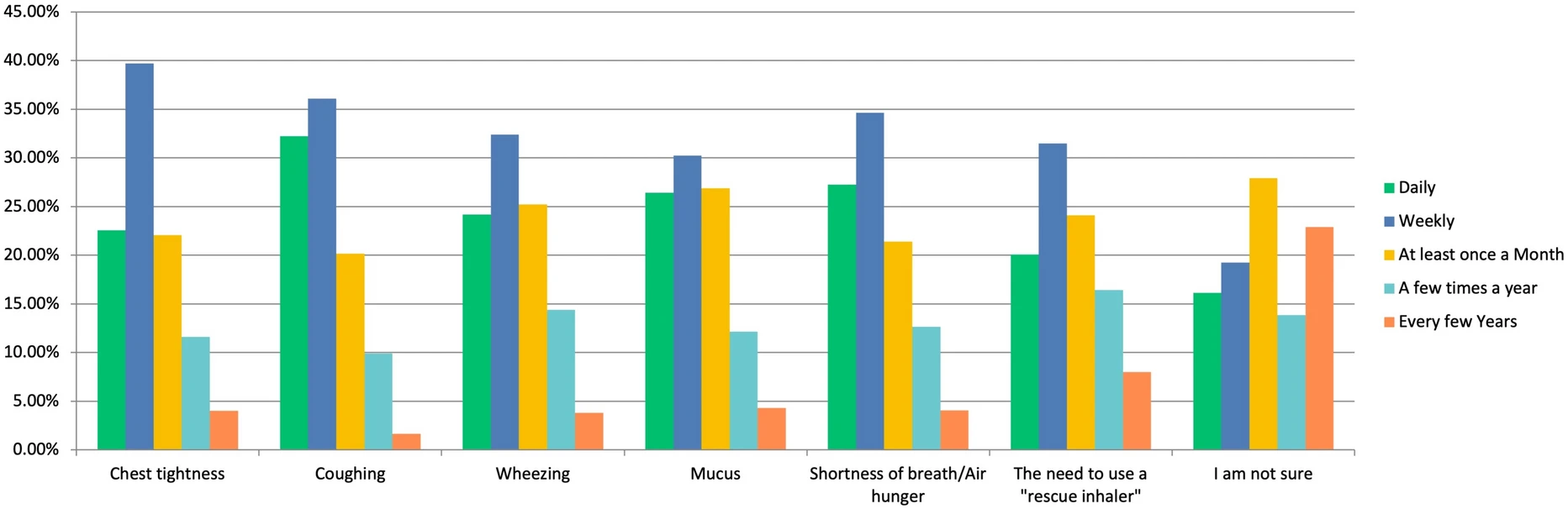
Respondents’ Symptom Report Self-reported frequency
of common asthma symptoms, including cough,
shortness of breath, mucus production, wheezing,
chest tightness, and rescue inhaler use
Results: A total of 1401 individuals with self-reported asthma using combination inhaler therapy and experiencing symptoms were enrolled in this study. Among these participants, 56% reported waiting more than 1 month to undergo pulmonary function testing for diagnosis.

Effect of tezepelumab on asthma exacerbations co-occurring with infection-attributed acute respiratory illnesses

Feleszko W, Caminati M, Gern JE et al.  Ann Allergy Asthma Immunol. 2025 Oct 8:S1081-1206(25)01201-3. doi: 10.1016/j.anai.2025.09.015. 

Abstract

Background

Tezepelumab, a human monoclonal antibody, blocks the activity of thymic stromal lymphopoietin (TSLP). In the phase 2b PATHWAY (NCT02054130) and phase 3 NAVIGATOR (NCT03347279) studies, tezepelumab reduced exacerbations and improved lung function, asthma control, and health-related quality of life versus placebo in patients with severe, uncontrolled asthma.

Objective

This post hoc analysis of PATHWAY and NAVIGATOR evaluated the incidence of asthma exacerbations co-occurring with documented acute respiratory illnesses attributed to infections.

Methods

Patients were randomized 1:1 to receive tezepelumab 210 mg subcutaneously or placebo every 4 weeks for 52 weeks. The incidence of asthma exacerbations co-occurring with respiratory illness-related adverse events (AEs) was assessed. Co-occurrence was defined as at least 1 day of overlap between a respiratory illness-related AE and the asthma exacerbation period beginning 7 days before the start of the exacerbation until the end of the asthma exacerbation.

Results

Respiratory illness-related AEs occurred at an incidence of
 ≥ 1 per 100 patient-years in either treatment group
Of the 1334 patients (tezepelumab, n = 665; placebo, n = 669) included, 312 experienced at least one asthma exacerbation co-occurring with a respiratory illness-related AE attributed to an infection.

October 16, 2025

Allergic Rhinitis and its Impact on Asthma (ARIA) Classes in MASK-air Users

Sousa-Pinto B, SavourĂ© M, Vieira RJ et al. J Investig Allergol Clin Immunol. 2025 Oct 15;35(5):373-383. doi: 10.18176/jiaci.1047. 

Abstract: 

Background: The Allergic Rhinitis and its Impact on Asthma (ARIA) guidelines classify rhinitis as "intermittent" or "persistent" and "mild" or "moderate-severe".

Objectives: To assess ARIA classes in a real-world study in terms of phenotypic differences and their association with asthma.

Methods: We performed a cross-sectional real-world study based on users of the MASK-air® app who reported data for at least 3 different months. We assessed the frequency of users according to the ARIA classes and compared these classes in terms of rhinitis symptoms, use of comedication, frequency of comorbid asthma, and the association between comorbid asthma and rhinitis control.

Maximum (A) and median (B) values of rhinitis visual analog scales (VAS)
in patients with no evidence of asthma (R) and in patients with probable asthma (R+A)
across the different Allergic Rhinitis and its Impact on Asthma (ARIA) classes. 
Results: A total of 2273 users (180 796 days) were assessed. Most users had moderate-severe rhinitis (n=2003; 88.1%) and persistent rhinitis (n=1144; 50.3%). The frequency of patients with probable asthma was 35.7% (95%CI, 34.5%-37.0%) for intermittent rhinitis and 48.5% (95%CI, 47.1%-49.9%) for persistent rhinitis.

Efficacy of 5-Grass Pollen Liquid Sublingual Allergen Immunotherapy for Seasonal Allergic Rhinoconjunctivitis: A Systematic Review and Meta-analysis

Di Bona D, Paoletti G, Cognet-Sicé J et al. J Investig Allergol Clin Immunol 2025; Vol 35(5) : 341-352 doi: 10.18176/jiaci.1076

Abstract:

Subgroup analyses of symptom score by age and sensitization
status of sublingual immunotherapy vs placebo.
The efficacy and safety of allergen immunotherapy (AIT) have been demonstrated in randomized controlled trials (RCTs). However, differences in study protocols, populations, and AIT products lead to variability in outcomes. The World Allergy Organization and the European Academy of Allergy and Clinical Immunology advise assessing individual AIT products rather than assuming a universal class effect. We conducted a meta-analysis on the efficacy and safety of 5–grass pollen liquid sublingual immunotherapy (SLIT) (5-grass SLIT liquid) in patients affected by allergic rhinoconjunctivitis (ARC) with and without asthma. We searched computerized databases (MEDLINE, ISI Web of Science, LILACS, the Cochrane Library, ClinicalTrial.gov) up to June 2023, supplemented our approach with manual literature searches, and included RCTs comparing 5-grass SLIT-liquid to placebo, irrespective of primary endpoints or treatment duration.

October 13, 2025

Risk factor analysis of iodinated contrast medium-related hypersensitivity reactions

Beiner, L., Boehm, I.  Insights Imaging 16, 216 (2025). https://doi.org/10.1186/s13244-025-02099-y


Abstract

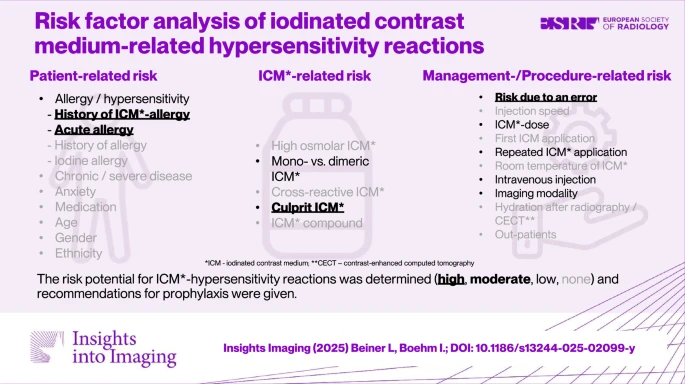
Graphical Abstract
Hypersensitivity reactions caused by iodinated contrast media (ICM) are by definition type B adverse reactions and therefore, they are not predictable. To partially limit this uncertainty, since the 1980s, risk factors have been defined and published. Currently, there are so many risks that any patient undergoing a contrast-enhanced imaging examination would have at least one risk. This is not helpful and instead leads to uncertainty again. From both studies and clinical experience, we know that only a small percentage of patients develop hypersensitivity reactions after ICM administration. Therefore, we subjected the risks published to a critical analysis. Based on 126 publications, we identified 43 risks, which were divided into three categories (patient-related, contrast agent-related and management-related risks).