August 24, 2025

Impact of Co-morbidities on Hypersensitivity Reactions to COVID-19 Vaccines

Pelin KORKMAZ, Deniz EYICE KARABACAK, Ilkim Deniz TOPRAK, Osman Ozan YEGIT, Derya UNAL, Semra DEMIR, Asli AKKOR. ASTHMA ALLERGY IMMUNOLOGY. Early Access. doi: 10.21911/aai.2025.759.

Background and Aim: Coronavirus disease of 2019 (COVID-19), also known as SARS Coronavirus-2, is an infectious disease caused by a single-stranded RNA (ssRNA) virus that emerged in Wuhan, China, in December 2019, leading to a global pandemic. Among the vaccines developed for COVID-19, BioNTech, CoronaVac, and TURKOVAC™ have been administered in Türkiye. While they were the best way to control the pandemic, allergic reactions associated with these vaccines have been reported. We aimed to evaluate the possible risk factors by examining the demographic and clinical characteristics of patients who showed hypersensitivity reactions to BioNTech and CoronaVac vaccines, and especially any concomitant diseases. TURKOVAC™ was not administered to any of the patients who presented to our clinic.

Materials and Methods: This retrospective study included 45 patients who presented with hypersensitivity reactions to COVID-19 vaccines at the Istanbul Faculty of Medicine`s adult allergy clinic.

August 23, 2025

Statistical Analysis in Allergy and Immunology: A Review With Practical Examples

Ordak M, Paoletti G, Di Bona D, Sousa-Pinto B, Martini M, Bognanni A, Bousquet J, Canonica GW. Allergy. 2025 Aug 23. doi: 10.1111/all.70013. Epub ahead of print.

ABSTRACT

Statistical analysis plays a critical role in biomedical research, ensuring that data are interpreted appropriately and that conclusions are both valid and reproducible. In allergy and immunology, where studies increasingly rely on complex data structures and analytical approaches, clarity on biostatistical methods is essential to support transparency and scientific rigor. However, inconsistent statistical reporting and misuse of analytical techniques remain persistent challenges in the field. This review provides a structured and practice-oriented overview of key statistical aspects relevant to research in allergy and immunology.

August 21, 2025

Food Anaphylaxis: Eight Food Allergens Without Mandatory Labelling Highlighted by the French Allergy-Vigilance Network

Sabouraud-Leclerc, D., Mariotte, D., Bradatan, E., Divaret-Chauveau, A., Metz-Favre, C., Beaumont, P., Dumond, P., Serrier, J., Karaca-Altintas, Y., Tscheiller, S., Pouessel, G. and Van der Brempt, X. (2025), Clin Exp Allergy. https://doi.org/10.1111/cea.70130

ABSTRACT

Background


The European Regulation list on mandatory labelling of foods includes 14 allergenic foods; however, other foods are also frequently implicated in food-induced anaphylaxis (FIA).

Methods

We analysed FIA cases reported to the Allergy Vigilance Network from 2002 to 2023. Allergenic foods involved in ≥ 1% of cases and not included in the list were assessed as emerging food allergens (EFA). We assessed their frequency, severity (Ring classification), recurrence, and potential presence in hidden form to determine which allergens might warrant inclusion on the list.

Results

August 19, 2025

Characterizing the symptomatology and pathophysiology of allergic rhinitis using a nasal allergen challenge model – a subset of the allergic rhinitis microbiome study

Linton, S., Hossenbaccus, L., Davis, A. et al.  Allergy Asthma Clin Immunol 21, 36 (2025). https://doi.org/10.1186/s13223-025-00980-5

Abstract

Background

Since 2015, our nasal allergen challenge (NAC) protocol has been used to investigate the pathophysiology of allergic rhinitis (AR) with various allergens. However, we have yet to publish a comprehensive examination of the pathophysiology associated with AR to ragweed pollen.

Methods

Nineteen ragweed pollen allergic and 12 healthy (nonallergic) control participants from Kingston, Ontario, Canada, completed the NAC to ragweed pollen extract out-of-season. Total nasal symptom score (TNSS) and percent fall in peak nasal inspiratory flow (PNIF) were collected up to 48 h post-exposure. Nasal fluid and serum samples were collected post-exposure, and white blood cell differential counts, serum ragweed-specific and total immunoglobulin-E (IgE), and nasal cytokine concentrations were analyzed. Statistical tests were performed using GraphPad Prism 10.4.0.

Results

Clinical symptoms induced by nasal allergen challenge (NAC)
with Ragweed pollen
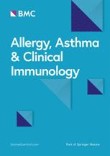
The mean TNSS and percent PNIF fall from baseline were significantly higher in participants with ragweed pollen allergy compared to nonallergic controls up to 24 h (P ≤ 0.05) and 12 h (P ≤ 0.05) post-NAC, respectively.

August 18, 2025

Targeted Biologic Therapies in Severe Asthma: Mechanisms, Biomarkers, and Clinical Applications

Văruț RM, Dalia D, Radivojevic K, Trasca DM, Stoica GA, Adrian NS, Carmen NE, Singer CE.  Pharmaceuticals (Basel). 2025 Jul 10;18(7):1021. doi: 10.3390/ph18071021.

Abstract

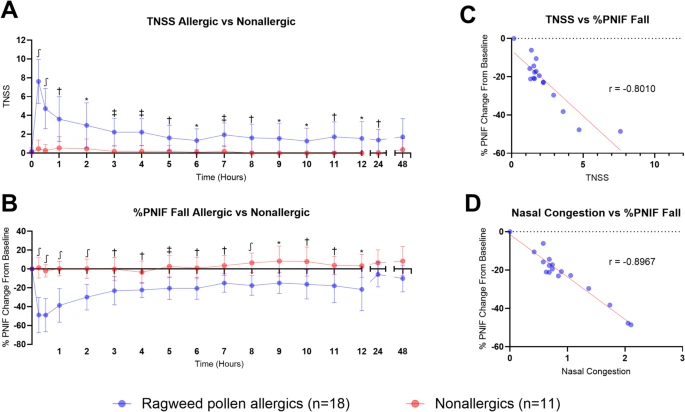
Immune cell differentiation and IgE-mediated responses
in allergic asthma pathogenesis
Asthma represents a heterogeneous disorder characterized by a dynamic balance between pro-inflammatory and anti-inflammatory forces, with allergic sensitization contributing substantially to airway hyperresponsiveness and remodeling. Central to its pathogenesis are cytokines such as IL-4, IL-5, IL-13, IL-17, and IL-33, which drive recruitment of eosinophils, neutrophils, and other effector cells, thereby precipitating episodic exacerbations in response to viral and environmental triggers.

August 16, 2025

COVID-19 infection raises respiratory type-2 inflammatory disease risk, whereas vaccination is protective

Olbrich H, Preuß SL, Kridin K, Hernandez G, Thaçi D, Ludwig RJ, Curman P.  J Allergy Clin Immunol. 2025 Aug 12:S0091-6749(25)00858-9. doi: 10.1016/j.jaci.2025.07.030. 

ABSTRACT

Background

COVID-19 infection and vaccination have unclear impacts on type-2 inflammatory diseases. Although viral infections can drive immune dysregulation, the extent to which COVID-19 infection and vaccination affect type-2 inflammatory diseases in various organ systems remains underexplored.

Objective

We aimed to assess the risk of new-onset type-2 inflammatory diseases after COVID-19 infection and vaccination.

Methods

 Flow-chart depicting the study outline.
We conducted a large-scale retrospective matched cohort study within a United States electronic health records database of over 118 million patients. Three cohorts were defined: individuals with COVID-19 infection (973,794), individuals with COVID-19 vaccination (691,270), and unexposed controls (4,388,409). Propensity-score matching balanced demographic and clinical covariates. We calculated hazard ratios for incident asthma, allergic rhinitis, chronic rhinosinusitis, atopic dermatitis, and eosinophilic esophagitis over a three-month follow-up.

August 15, 2025

The role of skin testing, drug challenge and IFN-γ ELISpot in delayed hypersensitivity to iodinated contrast media

Copaescu, A.M., Chua, K.Y.L., Mouhtouris, E. et al. Allergy Asthma Clin Immunol 21, 35 (2025). https://doi.org/10.1186/s13223-025-00982-3

Abstract

Background

The use of in vivo and ex vivo diagnostic tools for delayed hypersensitivity reactions (DHRs) associated with iodinated contrast media (ICM) is currently ill-defined.

Objective

To evaluate the role of in vivo and ex vivo diagnostic tools for DHRs occurring >6 h following intravenous low-osmolality ICM.

Methods

We conducted a prospective, multicenter, international cohort study. The patients were recruited from two tertiary care adult allergy clinics, Austin Health, Australia and the McGill University Health Centre, Canada. Eligible participants were adults who reported a DHR after receiving ICM. In vivo testing (skin testing and intravenous challenge) was performed to identify an alternative agent. Ex vivo testing using interferon-γ enzyme-linked ImmunoSpot assay was performed in four Australian patients to explore its diagnostic performance.

Results

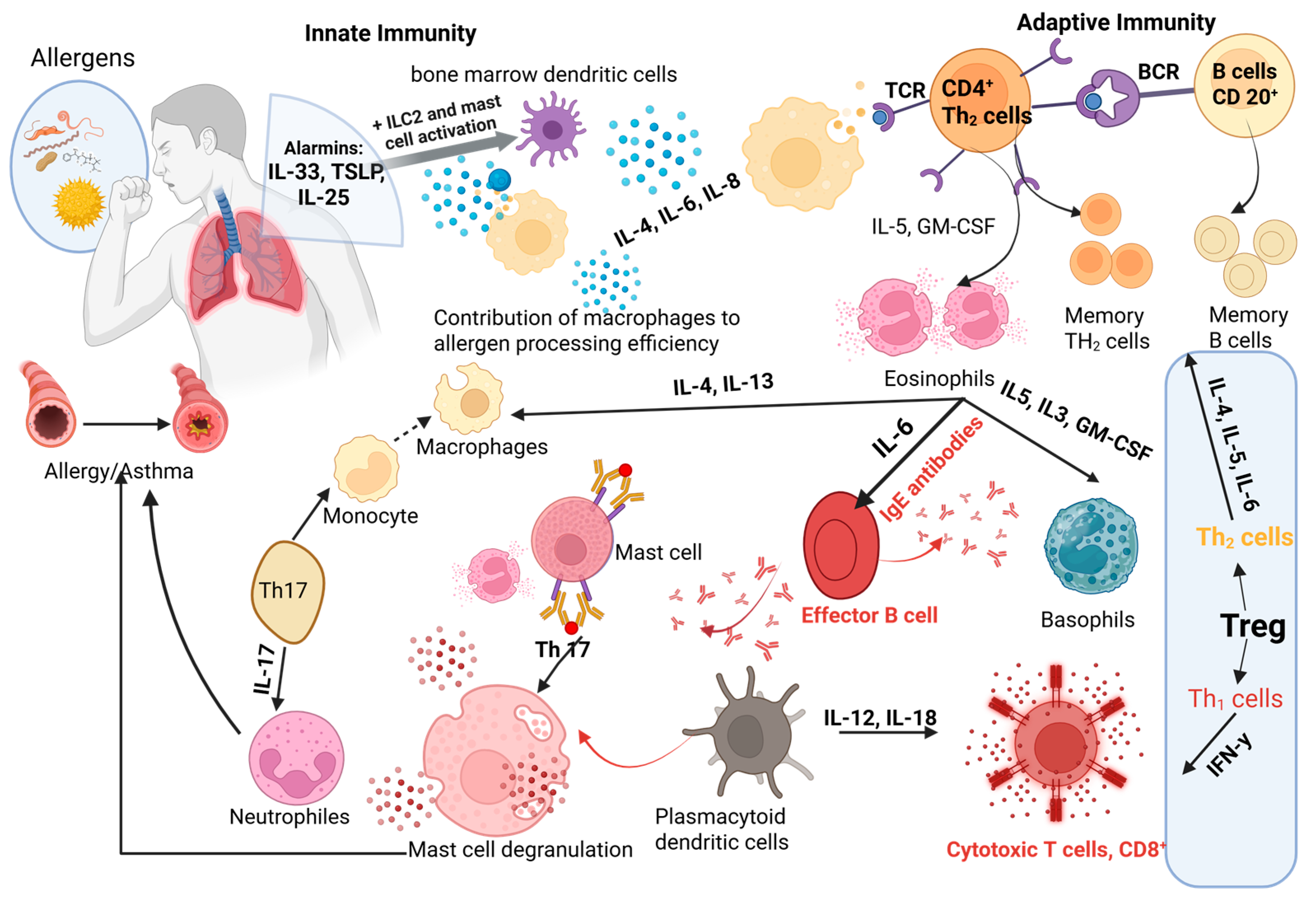
Examples of delayed positive intradermal skin testing and intravenous challenges
The culprit ICM was identified by dIDT in 17/20 (85%) while in 3/20 (15%) a challenge was necessary to confirm delayed hypersensitivity. All patients with a positive dIDT to iohexol were positive to iodixanol (15/15; 100%) while 3/4 (75%), 3/4 (75%), 4/6 (67%), and 3/5 (60%) were positive to iopromide, ioversol, iopamidol, and iobitridol, respectively.

August 11, 2025

Distinct Roles for Thymic Stromal Lymphopoietin (TSLP) and IL-33 in Experimental Eosinophilic Esophagitis

A. Dsilva, A. Wagner, M. Itan, et al. Allergy (2025): 1–13, https://doi.org/10.1111/all.16682.

ABSTRACT

Rationale

Thymic stromal lymphopoietin (TSLP) and IL-33 are alarmins implicated in eosinophilic esophagitis (EoE) pathogenesis by activating multiple cells, including mast cells (MCs). Whether TSLP or IL-33 have a role in EoE and whether their activities are distinct requires further investigation.

Methods

Experimental EoE was induced in wild type (WT) Il33−/− and Crlf2−/− mice. TSLP or IL-5 were neutralized using antibodies. Esophageal histopathology was determined by H&E, anti-Ki67, anti-CD31, and anti-MBP staining. Esophageal RNA was subjected to RNA sequencing. Bone marrow-derived MCs were activated with TSLP and IL-13 was determined (ELISA).

Results

TSLP and IL-33 were overexpressed in human and experimental EoE.